

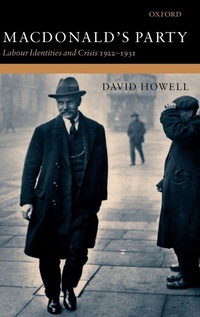
MacDonald's Party
Labour Identities and Crisis 1922-1931
Published on 5. September 2002
Book
Hardback
464 pages
978-0-19-820304-9 (ISBN)
Description
The Labour Party became a major political force during the 1920s. It unexpectedly entered office as a minority government in 1924; five years later as the largest party in the Commons it took office again. For many the party's enhanced status was associated closely with its leader, Ramsay MacDonald. The years of optimism were destroyed by rising unemployment; in August 1931, the second Labour Government faced pressures for public expenditure cuts in the midst of a financial crisis. The Government collapsed, and MacDonald led a new administration composed of erstwhile opponents and a few old colleagues. Labour went into opposition; an early election reduced it to a parliamentary rump.
This study offers a uniquely detailed analysis of Labour in the 1920s based on a wide variety of unpublished sources. The emphasis is on the variety of identities available within the party, and demonstrates how disputes over identity made a crucial contribution to the 1931 crisis. Thorough scholarship and distinctive interpretation combine to provide an important examination of a major episode in twentieth-century history.
This study offers a uniquely detailed analysis of Labour in the 1920s based on a wide variety of unpublished sources. The emphasis is on the variety of identities available within the party, and demonstrates how disputes over identity made a crucial contribution to the 1931 crisis. Thorough scholarship and distinctive interpretation combine to provide an important examination of a major episode in twentieth-century history.
Reviews / Votes
David Howell has here produced the first comprehensive study of the Labour Party during the 'Ramsay MacDonald years'. This alone makes MacDonald's Party an extremely significant book; more importantly, it is an extensive and exhaustive analysis of its subject. * Labour History Review * ... magisterial ... one of the most learned and authoritative contributions to 20th-century labour history I can think of. Howell has woven the details into a rich and compelling narrative. No one who wants to understand the Labour Party - new or old - can afford to ignore it. * David Marquand, New Statesman, January 2004 * This book joins the ranks of indispensable works for historians of the labour movement and early twentieth-century politics. * Contemporary British History * David Howell is one of the finest of Britain's current crop of Labour historians and his latest volume shows why ... What is impressive about Howell's approach is his painstaking attention to detail and the subtle way in which he reconstructs the complexities of the party that Ramsay MacDonald shaped, led and then abandoned. This is scholarship of the highest order. Howell gives proper priority to the vital importance of the trade unions in Labour's early development. Nearly a third of his book is devoted to a close analysis of the union presence, but not a word is wasted ... By placing the unions at the centre of his study, Howell illustrates with magisterial authority why Labour was so distinctive in its character and ideology from other socialist parties in Europe at that time ... splendid volume. * Tribune * Fine study ... closely researched, judicious and wide-ranging account. * Martin Pugh, Times Literary Supplement *More details
Language
English
Place of publication
Oxford
United Kingdom
Target group
Professional and scholarly
Dimensions
Height: 240 mm
Width: 161 mm
Thickness: 30 mm
Weight
863 gr
ISBN-13
978-0-19-820304-9 (9780198203049)
Copyright in bibliographic data and cover images is held by Nielsen Book Services Limited or by the publishers or by their respective licensors: all rights reserved.
Schweitzer Classification
Other editions
Additional editions
E-Book
09/2002
1st Edition
Oxford University Press
€127.59
Available for download