

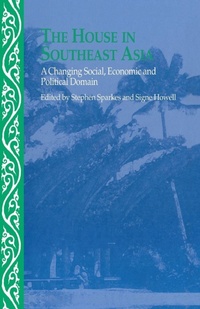
The House in Southeast Asia
A Changing Social, Economic and Political Domain
1st Edition
Published on 21. January 2016
Book
Paperback/Softback
286 pages
978-1-138-99174-3 (ISBN)
Description
Explores the concept of 'house' in the context of Levi-Strauss' idea of the house as a link between kinship-based societies and class societies, developing this further into an examination of a conjuncture of architecture, people and symbolism.
Reviews / Votes
Review in - Anthropos, Vol 99, 2004'Although this book is written for anthropologists, the sheer richness of the ethnographic materials described in it will reward some general readers.' - The Times Higher Education Supplement
More details
Language
English
Place of publication
London
United Kingdom
Publishing group
Taylor & Francis Ltd
Target group
College/higher education
Dimensions
Height: 216 mm
Width: 140 mm
Thickness: 16 mm
Weight
366 gr
ISBN-13
978-1-138-99174-3 (9781138991743)
Copyright in bibliographic data and cover images is held by Nielsen Book Services Limited or by the publishers or by their respective licensors: all rights reserved.
Schweitzer Classification
Other editions
Additional editions
Signe Howell | Stephen Sparkes
The House in Southeast Asia
A Changing Social, Economic and Political Domain
E-Book
07/2013
1st Edition
Routledge
€64.49
Available for download

Signe Howell | Stephen Sparkes
The House in Southeast Asia
A Changing Social, Economic and Political Domain
E-Book
07/2013
1st Edition
Routledge
€64.49
Available for download
Signe Howell | Stephen Sparkes
The House in Southeast Asia
A Changing Social, Economic and Political Domain
Book
10/2002
Routledge
€206.30
Shipment within 10-20 days
Persons
Signe Howell, Stephen Sparkes
Content
Introduction 1. Borgo fishermen 2. House and granary in former Toba Batak arhitecture 3. The house as a maker of identity 4. The house - empirical reality and theoretical category 5. Who's in charge around here? 6. Meanings and metaphors in the Jambi house 7. The imagined house; Society and house in rural Cambodia 8. Toba Batak women as custodians of the house 9. Fixed spaces for fluxed sentiments 10. Sociality on display 11. From house to house 12. Village, house and identity in Pipikoro 13. An ethnoarchaeologist in space 14. A view from Luang Prabang 15. The immortality of the house in Tana Toraja 16. Please come to my house and don't leave it.