

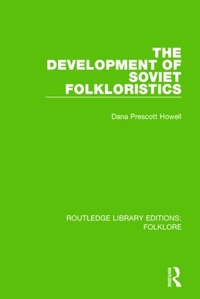
The Development of Soviet Folkloristics (RLE Folklore)
1st Edition
Published on 10. February 2015
Book
Hardback
486 pages
978-1-138-84258-8 (ISBN)
Description
Crucial to the world history of folkloristics is this key study, first published in 1992, of the development of folklore study in the Soviet Union. Nowhere else has political ideology been so heavily involved with folklore scholarship. Professor Howell has examined in depth the institutional development of folkloristics in the Soviet Union in the first half of the twentieth century, concentrating especially upon the transition from pre-revolutionary Russian to Soviet Marxist folkloristics. The study of folklore moved from narrator studies to the description of the relationship of lore to larger contexts of social groups and social classes. Showing an exceptional knowledge of Russian, political theory and folkloristics, Dana Howell provides a valuable window into the rise of folkloristics in a country undergoing almost unprecedented changes in social and political conditions.
More details
Series
Language
English
Place of publication
London
United Kingdom
Publishing group
Taylor & Francis Ltd
Target group
College/higher education
Dimensions
Height: 234 mm
Width: 156 mm
Weight
1060 gr
ISBN-13
978-1-138-84258-8 (9781138842588)
Copyright in bibliographic data and cover images is held by Nielsen Book Services Limited or by the publishers or by their respective licensors: all rights reserved.
Schweitzer Classification
Other editions
Additional editions
Book
09/2016
1st Edition
Routledge
€73.10
Shipment within 10-20 days
E-Book
02/2015
Routledge
€64.49
Available for download
E-Book
02/2015
Routledge
€64.49
Available for download
Person
Dana Howell
Content
1. Scholarly Heritage from the Pre-Revolutionary Period 1.1. Centres of Folkloristics in St Petersburg (Leningrad) and Moscow 1.2. The Development of Performer Studies, 1908-1918 1.3. The Political Character of Folkloristics and Folkloristics on the Eve of the Revolution 2. Critical Experiences: Revolution, Regional Studies, Radical Pressures, and Government Policy 2.1. Revolution and Survival: Folkloristics in the Cities 2.2. Folkloristics in Regional Centres and the Regional Studies Movement 2.3. Government Cultural Policy and the Political Importance of Folklore and Folkloristics 3. Research Organizations and Activities in the Period of the New Economic Policy (NEP) (1921-1927) 3.1. Moscow 3.2. Leningrad 3.3. Research Methodology: Scientific Standards of Collecting and Amateur Participation 4. Theoretical Development in the Years of NEP: The 'Sociology of Folklore' 4.1. The Study of Tale Tradition: Folklore as Art 4.2. The Study of Epic Tradition (Bylina): Folklore as History 4.3. New Interests and the 'Sociology of Folklore' 4.4. The Identification of Social Class in Tale Material 5. Folkloristics in the Years of the First Five-Year Plan (1928-1932): Intradisciplinary Differences and Challenges from Literary Circles 5.1. Research Organizations and Activities in Leningrad and Moscow 5.2. Splitting the Discipline and Linking Theory to New Practice: The Meetings on Folklore in Leningrad and Moscow, 1931 5.3. Personal Experience Accounts: A Challenge to the Definition of Folklore as Traditional Collective Art 6. Folklore as Literature: The Years of the Second Five-Year Plan (1933-1937) 6.1. Leningrad: Links of Folklore Studies with Ethnography in the 1930s 6.2. Moscow: Links of Folklore Studies to Literary Work 6.3. The Implications of the Links with Literature: Redefining Folklore as Ideology 7. Folkloristics as Ideology: The Rejection of the 'Sociology of Folklore' and the Reclaiming of 'Popular' Culture 7.1. The First All-Union Folklore Conference, 1936: The Criticism of Fascist Folkloristics in Europe and Its Influences upon Soviet Work 7.2. Public Criticism of Bylina Scholarship and the Rejection of the 'Theory of Aristocratic Origin' 7.3. Reclaiming 'Popular' Culture: Soviet Folklore and National Traditions