

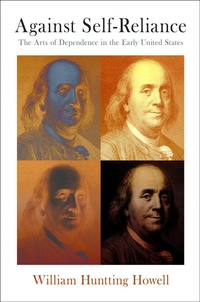
Against Self-Reliance
The Arts of Dependence in the Early United States
Published on 15. April 2015
Book
Hardback
312 pages
978-0-8122-4703-9 (ISBN)
Description
Individualism is arguably the most vital tenet of American national identity: American cultural heroes tend to be mavericks and nonconformists, and independence is the fulcrum of the American origin story. But in the late eighteenth and early nineteenth centuries, a number of American artists, writers, and educational philosophers cast imitation and emulation as central to the linked projects of imagining the self and consolidating the nation. Tracing continuities between literature, material culture, and pedagogical theory, William Huntting Howell uncovers an America that celebrated the virtues of humility, contingency, and connection to a complex whole over ambition and distinction.
Against Self-Reliance revalues and rethinks what it meant to be repetitive, derivative or pointedly generic in the early republic and beyond. Howell draws on such varied sources as Benjamin Franklin's programs for moral reform, Phillis Wheatley's devotional poetry, David Rittenhouse's coins and astronomical machines, Benjamin Rush's psychological and political theory, Susanna Rowson's schoolbooks, and the novels of Charles Brockden Brown and Herman Melville to tease out patterns of dependence in early America. With its incisive critique of America's storied heroic individualism, Against Self-Reliance argues that the arts of dependence were-and are-critical to the project of American independence.
Against Self-Reliance revalues and rethinks what it meant to be repetitive, derivative or pointedly generic in the early republic and beyond. Howell draws on such varied sources as Benjamin Franklin's programs for moral reform, Phillis Wheatley's devotional poetry, David Rittenhouse's coins and astronomical machines, Benjamin Rush's psychological and political theory, Susanna Rowson's schoolbooks, and the novels of Charles Brockden Brown and Herman Melville to tease out patterns of dependence in early America. With its incisive critique of America's storied heroic individualism, Against Self-Reliance argues that the arts of dependence were-and are-critical to the project of American independence.
Reviews / Votes
"Against Self-Reliance is a remarkably original book and an impassioned critique of liberalism. Howell makes a compelling argument that imitation and emulation occupied a central place in the emergence of the United States. This alternative story has, he suggests, important implications for the way we view our world. His analysis crackles with urgency." (Catherine Kelly, University of Oklahoma) "Modern Americans often describe their nation as founded on principles of political and economic individualism: a democratic culture of self-made men and women.Against Self-Reliance revisits the founding period to tell a different story. Focusing on the overlapping domains of politics, religion, science, education, and literature, Howell reveals the priorities of imitation, emulation, and cultural dependence on the eve and in the wake of American Independence. In this fine literary and cultural history, both historians and critics will find something new." (Eric Slauter, University of Chicago)More details
Series
Language
English
Place of publication
Pennsylvania
United States
Target group
College/higher education
Product notice
Paper over boards
Illustrations
19 illus.
Dimensions
Height: 231 mm
Width: 160 mm
Thickness: 28 mm
Weight
635 gr
ISBN-13
978-0-8122-4703-9 (9780812247039)
Copyright in bibliographic data and cover images is held by Nielsen Book Services Limited or by the publishers or by their respective licensors: all rights reserved.
Schweitzer Classification
Other editions
Additional editions
E-Book
03/2015
1st Edition
University of Pennsylvania Press
€63.49
Available for download
Person
William Huntting Howell teaches English at Boston University.
Content
Introduction: Imitation Is Suicide
PART I. COPY-WRITING
Chapter 1. Imitatio Franklin, or the American Example
Chapter 2. Phillis Wheatley's Dependent Harmonies
PART II. EMULATION AND ETHICS
Chapter 3. Reproducing David Rittenhouse
Chapter 4. The Republican Girl and the Spirit of Emulation
PART III. CRITIQUES AND AFFIRMATIONS
Chapter 5. The Horrors of the Republican Machine
Chapter 6. The Copyist Moby-Dick
Notes
Bibliography
Index
Acknowledgments
PART I. COPY-WRITING
Chapter 1. Imitatio Franklin, or the American Example
Chapter 2. Phillis Wheatley's Dependent Harmonies
PART II. EMULATION AND ETHICS
Chapter 3. Reproducing David Rittenhouse
Chapter 4. The Republican Girl and the Spirit of Emulation
PART III. CRITIQUES AND AFFIRMATIONS
Chapter 5. The Horrors of the Republican Machine
Chapter 6. The Copyist Moby-Dick
Notes
Bibliography
Index
Acknowledgments