

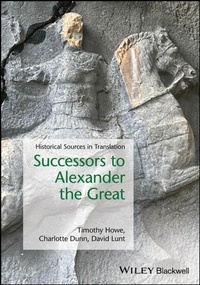
Successors to Alexander the Great
Historical Sources in Translation
1st Edition
Will be published approx. on 16. December 2025
Book
Paperback/Softback
384 pages
978-1-119-68828-0 (ISBN)
Description
A comprehensive collection of translated sources on the wars and world of Alexander's successors
Successors to Alexander the Great brings together-for the first time in a single collection-the essential translated sources for the tumultuous period following the death of Alexander the Great in 323 BCE. Spanning Greek, Latin, Persian Babylonian, Egyptian, and epigraphic materials, this volume provides direct access to a wide range of documents that illuminate the world and the wars of the Diadochi and the complex efforts to reassemble, rule, and redefine the fragments of Alexander's empire.
Organized thematically and geographically, this book allows readers to explore the Successors' ambitions, alliances, propaganda, and political innovation across a sprawling and multi-ethnic landscape. Contextual commentary throughout helps readers navigate the fragmentary nature of source evidence, the biases of ancient authors, and the evolving concepts of legitimacy and kingship. With its thematic structure and source diversity, the book offers an ideal foundation for historical, literary, and historiographical inquiry into the Hellenistic world.
The first unified, carefully curated, deeply contextualized collection of primary sources on the post-Alexander Hellenistic world, Successors to Alexander the Great:
Features Greek, Latin, Persian, Babylonian, Egyptian, and epigraphic material spanning multiple traditions and viewpoints
Includes bibliographies with each chapter for ease of reference and deeper research engagement
Highlights the complexity of succession politics, propaganda, and kingship after Alexander's death
Illuminates lesser-known figures and regions often excluded from traditional Hellenistic narratives
Promotes critical thinking and historiographical awareness through exposure to conflicting ancient perspectives
Supports interdisciplinary teaching on identity, authority, and empire-building in the ancient world
Presenting a single, coherent, and accessible narrative, Successors to Alexander the Great is ideal for upper-level undergraduate and graduate courses on Alexander the Great, the Hellenistic world, and ancient Greek history. It supports degree programs in Classics, History, Ancient Studies, Middle Eastern Studies, and related disciplines, and serves as a vital reference for scholars, educators, and researchers.
Successors to Alexander the Great brings together-for the first time in a single collection-the essential translated sources for the tumultuous period following the death of Alexander the Great in 323 BCE. Spanning Greek, Latin, Persian Babylonian, Egyptian, and epigraphic materials, this volume provides direct access to a wide range of documents that illuminate the world and the wars of the Diadochi and the complex efforts to reassemble, rule, and redefine the fragments of Alexander's empire.
Organized thematically and geographically, this book allows readers to explore the Successors' ambitions, alliances, propaganda, and political innovation across a sprawling and multi-ethnic landscape. Contextual commentary throughout helps readers navigate the fragmentary nature of source evidence, the biases of ancient authors, and the evolving concepts of legitimacy and kingship. With its thematic structure and source diversity, the book offers an ideal foundation for historical, literary, and historiographical inquiry into the Hellenistic world.
The first unified, carefully curated, deeply contextualized collection of primary sources on the post-Alexander Hellenistic world, Successors to Alexander the Great:
Features Greek, Latin, Persian, Babylonian, Egyptian, and epigraphic material spanning multiple traditions and viewpoints
Includes bibliographies with each chapter for ease of reference and deeper research engagement
Highlights the complexity of succession politics, propaganda, and kingship after Alexander's death
Illuminates lesser-known figures and regions often excluded from traditional Hellenistic narratives
Promotes critical thinking and historiographical awareness through exposure to conflicting ancient perspectives
Supports interdisciplinary teaching on identity, authority, and empire-building in the ancient world
Presenting a single, coherent, and accessible narrative, Successors to Alexander the Great is ideal for upper-level undergraduate and graduate courses on Alexander the Great, the Hellenistic world, and ancient Greek history. It supports degree programs in Classics, History, Ancient Studies, Middle Eastern Studies, and related disciplines, and serves as a vital reference for scholars, educators, and researchers.
More details
Series
Language
English
Place of publication
Hoboken
United Kingdom
Publishing group
John Wiley and Sons Ltd
Target group
Professional and scholarly
Dimensions
Height: 253 mm
Width: 181 mm
Thickness: 25 mm
Weight
714 gr
ISBN-13
978-1-119-68828-0 (9781119688280)
Copyright in bibliographic data and cover images is held by Nielsen Book Services Limited or by the publishers or by their respective licensors: all rights reserved.
Schweitzer Classification
Other editions
Additional editions
Timothy Howe | Charlotte Dunn | David Lunt
Successors to Alexander the Great
Historical Sources in Translation
E-Book
11/2025
1st Edition
Wiley
€45.99
Available for download
Timothy Howe | Charlotte Dunn | David Lunt
Successors to Alexander the Great
Historical Sources in Translation
E-Book
11/2025
1st Edition
Wiley
€45.99
Available for download
Persons
TIMOTHY HOWE is a Professor of History, Archaeology, and Ancient Studies at St. Olaf College. He has published extensively on Alexander the Great, ancient Mediterranean trade, and terrorism. He is the Senior Editor of The Ancient History Bulletin and co-directs archaeological excavations at Antiochia ad Cragum in Turkey.
CHARLOTTE DUNN is a Senior Lecturer in Classics at the University of Tasmania. Her research focuses on the Hellenistic world, especially the careers and self-representation of the Diadochi. She has published widely on topics like royal identity and coinage in the post-Alexander era and coauthored Demetrius the Besieger, the first full-length study of the Hellenistic king.
DAVID LUNT is a Professor of History at Southern Utah University. His research explores sport and cultural identity in the ancient world, particularly in relation to Greek athletics and festivals. He has written a book about the Crown Games of ancient Greece, and has published research treating Alexander's relationship to athletics. He serves on the editorial boards for the Journal of Sport History, the International Journal of the History of Sport, and the Journal of Olympic Studies.
CHARLOTTE DUNN is a Senior Lecturer in Classics at the University of Tasmania. Her research focuses on the Hellenistic world, especially the careers and self-representation of the Diadochi. She has published widely on topics like royal identity and coinage in the post-Alexander era and coauthored Demetrius the Besieger, the first full-length study of the Hellenistic king.
DAVID LUNT is a Professor of History at Southern Utah University. His research explores sport and cultural identity in the ancient world, particularly in relation to Greek athletics and festivals. He has written a book about the Crown Games of ancient Greece, and has published research treating Alexander's relationship to athletics. He serves on the editorial boards for the Journal of Sport History, the International Journal of the History of Sport, and the Journal of Olympic Studies.
Content
Translators' Note viii
Timeline ix
Acknowledgements xii
Introduction 1
1 Dramatis Personae 11
2 Articulations of Royal Power, Identity, and Interpretation
Before the Successors 60
3 Administration and the Army Under Alexander 89
4 With Alexander: Conquest and Empire 106
5 Symbols and Propaganda: Alexander's Image Among the Successors 134
6 The Successors at War 157
7 The Regency to the Deaths of Alexander IV and Herakles 186
8 The Fight for Macedonia 214
9 Fortress Egypt 229
10 The Fight for Asia 264
11 The Greek Cities and the Successors 303
12 Hellenistic Kingship 331
Index 000
Timeline ix
Acknowledgements xii
Introduction 1
1 Dramatis Personae 11
2 Articulations of Royal Power, Identity, and Interpretation
Before the Successors 60
3 Administration and the Army Under Alexander 89
4 With Alexander: Conquest and Empire 106
5 Symbols and Propaganda: Alexander's Image Among the Successors 134
6 The Successors at War 157
7 The Regency to the Deaths of Alexander IV and Herakles 186
8 The Fight for Macedonia 214
9 Fortress Egypt 229
10 The Fight for Asia 264
11 The Greek Cities and the Successors 303
12 Hellenistic Kingship 331
Index 000