

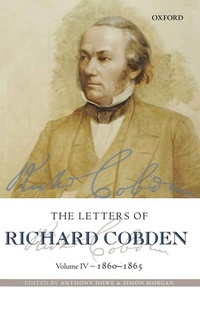
The Letters of Richard Cobden
Volume IV: 1860-1865
Published on 6. August 2015
Book
Hardback
690 pages
978-0-19-921198-2 (ISBN)
Description
The Letters of Richard Cobden (1804-1865) provides, in four printed volumes, the first critical edition of Cobden's letters, publishing the complete text in as near the original form as possible. The letters are accompanied by full scholarly apparatus, together with an introduction to each volume which re-assesses Cobden's importance in their light. Together, these volumes make available a unique source of the understanding of British liberalism in its European and international contexts, throwing new light on issues such as the repeal of the Corn Laws, British radical movements, the Crimean War, the Indian Mutiny, Anglo-French relations, and the American Civil War.
The fourth and final volume, drawing on some forty-six archives worldwide, is dominated by Cobden's search for a permanent political legacy at home and abroad, following the severe check to his health in the autumn of 1859. In January 1860, he succeeded in negotiating the Anglo-French Commercial Treaty, a landmark in Anglo-French relations designed to bind the two nations closer together, and to provide the basis for a Europe united by free trade. Yet the Treaty's benefits were threatened by a continuing naval arms race between Britain and France, fuelled by what Cobden saw as self-interested scare mongering in his tract The Three Panics (1862). By 1862 an even bigger danger was the possibility that British industry's need for cotton might precipitate intervention in the American Civil War. Much of Cobden's correspondence now centred on the necessity of non-intervention and a campaign for the reform of international maritime law, while he played a major part in attempts to alleviate the effects of the 'Cotton Famine' in Lancashire. In addition to Anglo-American relations, Cobden, the 'International Man', continued to monitor the exercise of British power around the globe. He was convinced that the 'gunboat' diplomacy of his prime antagonist, Lord Palmerston, was ultimately harmful to Britain, whose welfare demanded limited military expenditure and the dismantling of the British 'colonial system'. Known for a long time as the 'prophet in the wilderness', in 1864 Cobden welcomed Palmerston's inability to intervene in the Schleswig-Holstein crisis as a key turning-point in Britain's foreign policy, which, together with the imminent end of the American Civil War, opened up the prospect of a new reform movement at home. Disappointed with the growing apathy of the entrepreneurs he had once mobilised in the Anti-Corn Law League, Cobden now promoted the enfranchisement of the working classes as necessary and desirable in order to achieve the reform of the aristocratic state for which he had campaigned since the 1830s.
The fourth and final volume, drawing on some forty-six archives worldwide, is dominated by Cobden's search for a permanent political legacy at home and abroad, following the severe check to his health in the autumn of 1859. In January 1860, he succeeded in negotiating the Anglo-French Commercial Treaty, a landmark in Anglo-French relations designed to bind the two nations closer together, and to provide the basis for a Europe united by free trade. Yet the Treaty's benefits were threatened by a continuing naval arms race between Britain and France, fuelled by what Cobden saw as self-interested scare mongering in his tract The Three Panics (1862). By 1862 an even bigger danger was the possibility that British industry's need for cotton might precipitate intervention in the American Civil War. Much of Cobden's correspondence now centred on the necessity of non-intervention and a campaign for the reform of international maritime law, while he played a major part in attempts to alleviate the effects of the 'Cotton Famine' in Lancashire. In addition to Anglo-American relations, Cobden, the 'International Man', continued to monitor the exercise of British power around the globe. He was convinced that the 'gunboat' diplomacy of his prime antagonist, Lord Palmerston, was ultimately harmful to Britain, whose welfare demanded limited military expenditure and the dismantling of the British 'colonial system'. Known for a long time as the 'prophet in the wilderness', in 1864 Cobden welcomed Palmerston's inability to intervene in the Schleswig-Holstein crisis as a key turning-point in Britain's foreign policy, which, together with the imminent end of the American Civil War, opened up the prospect of a new reform movement at home. Disappointed with the growing apathy of the entrepreneurs he had once mobilised in the Anti-Corn Law League, Cobden now promoted the enfranchisement of the working classes as necessary and desirable in order to achieve the reform of the aristocratic state for which he had campaigned since the 1830s.
Reviews / Votes
With this volume, the editors have completed a series which will become an invaluable resource for historians of nineteenth-century European politics and society; they have also set a high editorial standard which will be difficult to surpass. * Peter M. Keeling, European History Quarterly * Anthony Howe and Simon Morgan's Letters of Richard Cobden provides an intriguing insight into the final five years of one of the major political figures of 19th-century Britain. * Marin Spychal, Parliamentary History *More details
Series
Language
English
Place of publication
Oxford
United Kingdom
Target group
College/higher education
Professional and scholarly
Illustrations
13 black and white illustrations
Dimensions
Height: 240 mm
Width: 161 mm
Thickness: 41 mm
Weight
1189 gr
ISBN-13
978-0-19-921198-2 (9780199211982)
Copyright in bibliographic data and cover images is held by Nielsen Book Services Limited or by the publishers or by their respective licensors: all rights reserved.
Schweitzer Classification
Persons
Anthony Howe specialises in the history of nineteenth and early twentieth-century Britain. His books include Free Trade and Liberal England, 1846-1946 (1998) and, with Simon Morgan, he has edited Rethinking Nineteenth-Century Liberalism: Richard Cobden Bicentenary Essays (2006).
Simon Morgan graduated with a PhD from the University of York in 2000. From 2002 to 2005 he was Research Officer at the Letters of Richard Cobden Project and since 2013 he has been Principal Lecturer in History at Leeds Beckett University (formerly Leeds Metropolitan University). His publications include A Victorian Woman's Place: Public Culture in the Nineteenth Century (2007) and, with Anthony Howe he has edited Rethinking Nineteenth Century Liberalism: Richard Cobden Bicentenary Essays (2006). He is currently studying the relationship between popular politics and a nascent culture of celebrity in the early nineteenth century.
Simon Morgan graduated with a PhD from the University of York in 2000. From 2002 to 2005 he was Research Officer at the Letters of Richard Cobden Project and since 2013 he has been Principal Lecturer in History at Leeds Beckett University (formerly Leeds Metropolitan University). His publications include A Victorian Woman's Place: Public Culture in the Nineteenth Century (2007) and, with Anthony Howe he has edited Rethinking Nineteenth Century Liberalism: Richard Cobden Bicentenary Essays (2006). He is currently studying the relationship between popular politics and a nascent culture of celebrity in the early nineteenth century.
Content
Introduction ; LETTERS, 1860 - 1865 ; Index