

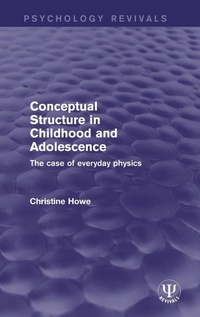
Conceptual Structure in Childhood and Adolescence
The Case of Everyday Physics
1st Edition
Published on 5. January 2016
Book
Hardback
248 pages
978-1-138-64789-3 (ISBN)
Description
'Heat breaks up charcoal and puts sulphur dioxide in'; 'The air pulls faster on heavy masses.' These and other similar statements by school-aged children untutored in physics carry two messages. First, children's pre-instructional conceptions of the physical world are a far cry from the received wisdom of science; second, despite their lack of orthodoxy, children's conceptions carry a definite sense of causal mechanism. This sense of mechanism is the focal concern of this book, originally published in 1998, for it raises issues of central importance to both psychological theory and educational practice.
In particular, some psychologists have claimed that human cognition is organised around causal mechanisms along the lines of a theory. This carries specific implications for teaching. Does the existence in children's thinking of causal mechanisms relating to the physical world support these psychologists? Does this have consequences for the teaching of science?
Christine Howe reviews evidence relating to pre-instructional conceptions in three broad topic areas: heat and temperature; force and motion; floating and sinking. A wide range of published work is discussed, including the author's own research. In addition, a new study covering all three topic areas is reported for the first time. The message is that causal mechanisms can indeed play an organising role, that untutored cognition can in other words be genuinely theoretical. However, this tendency is highly domain-specific, occurring in some topic areas but not in others.
Having drawn these conclusions, Christine Howe discusses their meaning in terms of both cognitive development and educational practice. A model is outlined which synthesises Piagetian action-groundedness with Vygotskyan cultural-symbolism and has a distinctive message for classrooms. This title will be useful to cognitive and developmental psychologists and to science educators alike.
In particular, some psychologists have claimed that human cognition is organised around causal mechanisms along the lines of a theory. This carries specific implications for teaching. Does the existence in children's thinking of causal mechanisms relating to the physical world support these psychologists? Does this have consequences for the teaching of science?
Christine Howe reviews evidence relating to pre-instructional conceptions in three broad topic areas: heat and temperature; force and motion; floating and sinking. A wide range of published work is discussed, including the author's own research. In addition, a new study covering all three topic areas is reported for the first time. The message is that causal mechanisms can indeed play an organising role, that untutored cognition can in other words be genuinely theoretical. However, this tendency is highly domain-specific, occurring in some topic areas but not in others.
Having drawn these conclusions, Christine Howe discusses their meaning in terms of both cognitive development and educational practice. A model is outlined which synthesises Piagetian action-groundedness with Vygotskyan cultural-symbolism and has a distinctive message for classrooms. This title will be useful to cognitive and developmental psychologists and to science educators alike.
More details
Series
Language
English
Place of publication
London
United Kingdom
Publishing group
Taylor & Francis Ltd
Target group
College/higher education
Professional and scholarly
Dimensions
Height: 240 mm
Width: 161 mm
Thickness: 18 mm
Weight
543 gr
ISBN-13
978-1-138-64789-3 (9781138647893)
Copyright in bibliographic data and cover images is held by Nielsen Book Services Limited or by the publishers or by their respective licensors: all rights reserved.
Schweitzer Classification
Other editions
Additional editions

Book
10/2017
1st Edition
Routledge
€60.30
Shipment within 10-20 days
E-Book
12/2015
Routledge
€52.49
Available for download
E-Book
12/2015
Routledge
€52.49
Available for download
Person
Authored by Howe, Christine
Content
Preface. Part 1: Introduction 1. Everyday Physics and Conceptual Structure 2. Rationale for a Developmental Perspective Part 2: Heat Transfer 3. Temperature Change and Childhood Theorising 4. The 'Peripheral' Case of Changes of Phase Part 3: Propelled Motion 5. Encapsulated Knowledge of Horizontal Motion 6. Horizontal and Vertical Motion Compared Part 4: Object Flotation 7. Flotation in Liquids and Stage-Like Progression 8. Flotation in Gases or Failure to Fall Part 5: Conclusion 9. An Action-Based Theory of Conceptual Growth 10. Action-Based Knowledge in a Wider Context. Appendix. Notes. References. Index