

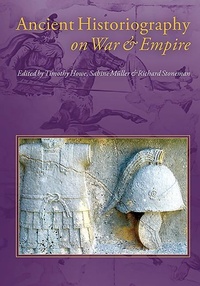
Ancient Historiography on War and Empire
Published on 30. November 2016
Book
Hardback
304 pages
978-1-78570-299-0 (ISBN)
Description
In the ancient Greek-speaking world, writing about the past meant balancing the reporting of facts with shaping and guiding the political interests and behaviours of the present. Ancient Historiography on War and Empire shows the ways in which the literary genre of writing history developed to guide empires through their wars. Taking key events from the Achaemenid Persian, Athenian, Macedonian and Roman 'empires', the 17 essays collected here analyse the way events and the accounts of those events interact.
Subjects include: how Greek historians assign nearly divine honours to the Persian King; the role of the tomb cult of Cyrus the Founder in historical narratives of conquest and empire from Herodotus to the Alexander historians; warfare and financial innovation in the age of Philip II and his son, Alexander the Great; the murders of Philip II, his last and seventh wife Kleopatra, and her guardian, Attalos; Alexander the Great's combat use of eagle symbolism and divination; Plutarch's juxtaposition of character in the Alexander-Caesar pairing as a commentary on political legitimacy and military prowess, and Roman Imperial historians using historical examples of good and bad rule to make meaningful challenges to current Roman authority. In some cases, the balance shifts more towards the 'literary' and in others more towards the 'historical', but what all of the essays have in common is both a critical attention to the genre and context of history-writing in the ancient world and its focus on war and empire.
Subjects include: how Greek historians assign nearly divine honours to the Persian King; the role of the tomb cult of Cyrus the Founder in historical narratives of conquest and empire from Herodotus to the Alexander historians; warfare and financial innovation in the age of Philip II and his son, Alexander the Great; the murders of Philip II, his last and seventh wife Kleopatra, and her guardian, Attalos; Alexander the Great's combat use of eagle symbolism and divination; Plutarch's juxtaposition of character in the Alexander-Caesar pairing as a commentary on political legitimacy and military prowess, and Roman Imperial historians using historical examples of good and bad rule to make meaningful challenges to current Roman authority. In some cases, the balance shifts more towards the 'literary' and in others more towards the 'historical', but what all of the essays have in common is both a critical attention to the genre and context of history-writing in the ancient world and its focus on war and empire.
Reviews / Votes
All of the papers are thought-provoking... * Bryn Mawr Classical Review * This is a massive, well-organised work on the historiography and history of the ancient world; as such, it makes a significant contribution to the present-day overview of historiography; the papers are erudite, well written, [...] Last but not least, it offers numerous fresh and provocative approaches to the seemingly marginal and/or somewhat neglected themes of historiography. * Ancient West & East *More details
Language
English
Place of publication
Oxford
United Kingdom
Target group
College/higher education
Professional and scholarly
Product notice
sewn/stitched
Cloth over boards
Illustrations
b/w and colour
Dimensions
Height: 241 mm
Width: 168 mm
Thickness: 25 mm
Weight
862 gr
ISBN-13
978-1-78570-299-0 (9781785702990)
Copyright in bibliographic data and cover images is held by Nielsen Book Services Limited or by the publishers or by their respective licensors: all rights reserved.
Schweitzer Classification
Other editions
Additional editions
Timothy Howe
Ancient Historiography on War and Empire
E-Book
11/2016
Oxbow Books
€35.49
Available for download

Timothy Howe
Ancient Historiography on War and Empire
E-Book
11/2016
OXBOW BOOKS
€35.49
Available for download
Persons
Timothy Howe is Professor of History and Ancient Studies at St. Olaf College (USA). His main research interests are in Alexander the Great, ancient Mediterranean warfare, agriculture, law, religion, trade, and, Greek and Latin epigraphy. Sabine Mueller is Professor of Ancient History at Marburg University (Germany) where she specialises in ancient Near East, Greece, Macedonia and Rome including iconography and the study of ancient writers in relation to archaeological evidence. Richard Stoneman is Honorary Visiting Professor at the University of Exeter (UK) with particular research interest in the continuity of the Greek world and Greek tradition up to the present day and in Alexander the Great, especially in later legend.
Content
Contributors
Forward: Ancient Historiography and Ancient History
Part I: Introduction
1 Why History? On the Emergence of Historical Writing
Mark Munn
Part II: Persia and Greece
2 The Political and the Divine in Achaemenid Royal Inscriptions
Eran Almagor
3 Cyrus the Great and the Sacrifices for a Dead King
Josef Wiesehoefer
4 The Horse and the Stag: Philistus' View of Tyrants
Frances Pownall
Part III: Macedon
5 Alexander II of Macedon
William Greenwalt
6 'The Giver of the Bride, the Bridegroom, and the Bride': A Study of the Death of Philip II and
its Aftermath
Waldemar Heckel, Timothy Howe and Sabine Mueller
7 Royal Tombs and Cult of the Dead Kings in Early Hellenistic Macedonia
Franca Landucci Gattinoni
Part IV: The Empires of Alexander the Great and the Diadochoi
8 The Financial Administration of Asia Minor under Alexander the Great: An Interpretation of
Two Passages from Arrian's Anabasis
Maxim M. Kholod
9 The Eagle has Landed: Divination in the Alexander Historians
Hugh Bowden
10 The Casualty Figures of Alexander's Army
Jacek Rzepka
11 Alexander's battles against Persians in the art of the Successors
Olga Palagia
12 How the Hoopoe Got His Crest: Reflections on Megasthenes' Stories of India
Richard Stoneman
13 Creating the King: The Image of Alexander the Great in 1 Maccabees, 1-10
Aleksandra Kleczar
Part V: Second Sophistic Rome
14 The Hero vs. the Tyrant: Legitimate And Illegitimate Rule in Plutarch's Alexander-Caesar
Rebecca Frank
15 Plutarch's Alexander, Dionysos and the Metaphysics of Power
Elias Koulakiotis
16 The Artistic King: Reflections on a Topos in Second Sophistic Historiography
Sabine Mueller
17 Flattery, History, and the Pepaideumenos
Sulochana Asirvatham
Index
Forward: Ancient Historiography and Ancient History
Part I: Introduction
1 Why History? On the Emergence of Historical Writing
Mark Munn
Part II: Persia and Greece
2 The Political and the Divine in Achaemenid Royal Inscriptions
Eran Almagor
3 Cyrus the Great and the Sacrifices for a Dead King
Josef Wiesehoefer
4 The Horse and the Stag: Philistus' View of Tyrants
Frances Pownall
Part III: Macedon
5 Alexander II of Macedon
William Greenwalt
6 'The Giver of the Bride, the Bridegroom, and the Bride': A Study of the Death of Philip II and
its Aftermath
Waldemar Heckel, Timothy Howe and Sabine Mueller
7 Royal Tombs and Cult of the Dead Kings in Early Hellenistic Macedonia
Franca Landucci Gattinoni
Part IV: The Empires of Alexander the Great and the Diadochoi
8 The Financial Administration of Asia Minor under Alexander the Great: An Interpretation of
Two Passages from Arrian's Anabasis
Maxim M. Kholod
9 The Eagle has Landed: Divination in the Alexander Historians
Hugh Bowden
10 The Casualty Figures of Alexander's Army
Jacek Rzepka
11 Alexander's battles against Persians in the art of the Successors
Olga Palagia
12 How the Hoopoe Got His Crest: Reflections on Megasthenes' Stories of India
Richard Stoneman
13 Creating the King: The Image of Alexander the Great in 1 Maccabees, 1-10
Aleksandra Kleczar
Part V: Second Sophistic Rome
14 The Hero vs. the Tyrant: Legitimate And Illegitimate Rule in Plutarch's Alexander-Caesar
Rebecca Frank
15 Plutarch's Alexander, Dionysos and the Metaphysics of Power
Elias Koulakiotis
16 The Artistic King: Reflections on a Topos in Second Sophistic Historiography
Sabine Mueller
17 Flattery, History, and the Pepaideumenos
Sulochana Asirvatham
Index