

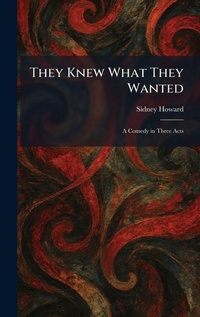
They Knew What They Wanted
Description
"They Knew What They Wanted" is a Pulitzer Prize-winning comedy in three acts by the celebrated American playwright Sidney Howard. Set against the sun-drenched backdrop of the Napa Valley in California, the play explores complex themes of love, desire, and the pragmatic compromises that define human relationships. The story centers on Tony, an aging Italian immigrant and successful winegrower, who seeks a young wife to share his prosperity. Through a series of misunderstandings and a daring long-distance courtship with Amy, a waitress from San Francisco, the narrative delves into the tensions between romantic idealism and the realities of companionship.
As the characters navigate a web of secrets and unexpected betrayals, Howard masterfully balances humor with profound emotional depth. The play is renowned for its realistic portrayal of the immigrant experience and its nuanced treatment of moral dilemmas. Sidney Howard's sharp dialogue and keen observation of social dynamics make this work a cornerstone of early 20th-century American drama. "They Knew What They Wanted" remains a powerful testament to the resilience of the human spirit and the lengths to which individuals will go to find a sense of belonging and fulfillment.
This work has been selected by scholars as being culturally important, and is part of the knowledge base of civilization as we know it. This work was reproduced from the original artifact, and remains as true to the original work as possible. Therefore, you may see the original copyright references, library stamps (as most of these works have been housed in our most important libraries around the world), and other notations in the work.
This work is in the public domain in the United States of America, and possibly other nations. Within the United States, you may freely copy and distribute this work, as no entity (individual or corporate) has a copyright on the body of the work.
As a reproduction of a historical artifact, this work may contain missing or blurred pages, poor pictures, errant marks, etc. Scholars believe, and we concur, that this work is important enough to be preserved, reproduced, and made generally available to the public. We appreciate your support of the preservation process, and thank you for being an important part of keeping this knowledge alive and relevant.