

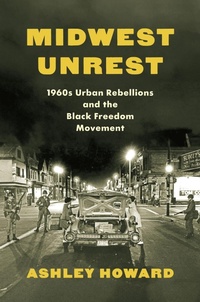
Midwest Unrest
1960s Urban Rebellions and the Black Freedom Movement
Published on 30. June 2025
Book
Paperback/Softback
256 pages
978-1-4696-8486-4 (ISBN)
Description
In the nation's so-called heartland, racism is sometimes subtler than in other parts of the country but just as insidious. When Black communities across America went up in flames in the 1960s, Midwest cities, where racial inequity was endemic, were among those most likely to burn. Midwest Unrest explores those rebellions, paying particular attention to the ways that region, race, class, and gender all played critical and often overlapping roles in shaping Black people's resistance to racialized oppression.
Focusing on the uprisings in three midsize Midwestern cities-Cincinnati, Ohio; Omaha, Nebraska; and Milwaukee, Wisconsin-Ashley Howard argues that urban rebellions were a working-class response to the failure of traditional civil rights activism and growing fissures between the Black working and middle classes. Utilizing arrest records, Kerner Commission documents, and author-conducted oral history interviews, Howard registers the significant impact the rebellions had in transforming the consciousness of African Americans and in altering the relationship between Black urban communities and the state. Specifically, multiple parties, including municipal governments, city residents, and most importantly rebels, wielded urban revolt as a political tool to achieve their own objectives. Revealing a new dimension of the Black Freedom Movement, Howard moves the understanding of these disturbances from aberrant acts of violence to historically contingent acts of resistance, highlighting the coeval nature between organized protests and violent outbursts.
Focusing on the uprisings in three midsize Midwestern cities-Cincinnati, Ohio; Omaha, Nebraska; and Milwaukee, Wisconsin-Ashley Howard argues that urban rebellions were a working-class response to the failure of traditional civil rights activism and growing fissures between the Black working and middle classes. Utilizing arrest records, Kerner Commission documents, and author-conducted oral history interviews, Howard registers the significant impact the rebellions had in transforming the consciousness of African Americans and in altering the relationship between Black urban communities and the state. Specifically, multiple parties, including municipal governments, city residents, and most importantly rebels, wielded urban revolt as a political tool to achieve their own objectives. Revealing a new dimension of the Black Freedom Movement, Howard moves the understanding of these disturbances from aberrant acts of violence to historically contingent acts of resistance, highlighting the coeval nature between organized protests and violent outbursts.
More details
Series
Language
English
Place of publication
Chapel Hill
United States
Target group
Professional and scholarly
Product notice
Paperback (trade)
Illustrations
10 halftones
Dimensions
Height: 234 mm
Width: 156 mm
Thickness: 15 mm
Weight
363 gr
ISBN-13
978-1-4696-8486-4 (9781469684864)
Copyright in bibliographic data and cover images is held by Nielsen Book Services Limited or by the publishers or by their respective licensors: all rights reserved.
Schweitzer Classification
Other editions
Additional editions
E-Book
05/2025
The University of North Carolina Press
€23.49
Available for download
Person
Ashley Howard is assistant professor of history and African American studies at the University of Iowa.