

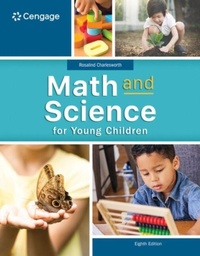
Math and Science for Young Children
9th Edition
Published on 1. May 2024
Book
Paperback/Softback
512 pages
978-0-357-63656-5 (ISBN)
Description
Howard/Charlesworth's MATH AND SCIENCE FOR YOUNG CHILDREN, 9th EDITION, introduces you to engaging math and science experiences for early childhood and early elementary education programs. It provides an organized, sequential approach to creating a developmentally appropriate STEM curriculum. The content aligns with key guidelines and standards, including The National Association for the Education of Young Children's (NAEYC) Professional Standards and Competencies (2020); Developmentally Appropriate Practice (DAP) guidelines (2021); Common Core Mathematics Standards; and Next Generation Science Standards (NGSS). This edition also addresses STEM/STEAM and the essential domains of child growth and development during the crucial birth-through-eight age range. A valuable resource for the student/future teacher, working professional or involved parent, this edition emphasizes the interrelatedness of STEM content and how the content can be integrated into all other curriculum areas.
More details
Edition
9th edition
Language
English
Place of publication
Belmont, CA
United States
Publishing group
Cengage Learning, Inc
Target group
College/higher education
Professional and scholarly
Dimensions
Height: 216 mm
Width: 277 mm
Thickness: 24 mm
Weight
1220 gr
ISBN-13
978-0-357-63656-5 (9780357636565)
Copyright in bibliographic data and cover images is held by Nielsen Book Services Limited or by the publishers or by their respective licensors: all rights reserved.
Schweitzer Classification
Other editions
Previous edition
Rosalind Charlesworth
Math and Science for Young Children
Book
02/2015
8th Edition
Wadsworth Publishing Co Inc
€275.50
Shipment within 15-20 days
Persons
Rebecca Howard, Ph.D., is an early childhood consultant, professional development trainer and university instructor. She was a faculty member at Miami University in Oxford, Ohio, where she held a variety of teaching and advising positions since 2000 in teacher education, educational leadership, interdisciplinary studies and theater. She founded the Oxford Early Childhood Center in 1986, and was owner/administrator and lead teacher until the program closed in 2014. While operating OECC, she created the OECC Integrated Curriculum, which was grounded in creativity and culturally responsive practice as foundational pedagogical components of a comprehensive approach to development across domains. She has presented at numerous professional conferences, provided extensive professional development trainings over a wide range of topics, published articles for Childhood Education and Journal of Dramatic Theory and Criticism and authored a chapter on dramatic play and gender performance in the book "Children Under Construction: Play as Curriculum" (2010). In 2023, she authored a major revision of the 12th edition of Mary Mayesky's "Creative Activities and Curriculum for Young Children," and in 2025 authored a major revision of the 9th edition of Rosalind Charlesworth's "Math and Science for Young Children," both for Cengage. Rosalind Charlesworth, Ph.D., was professor emerita and retired department chair in the Department of Child and Family Studies at Weber State University in Ogden, Utah. Dr. Charlesworth's career in early childhood education included experiences with both typical and non-typical young children in laboratory schools, public schools and day care centers, plus research in social and cognitive development and behavior. Throughout her career, she was known for her contributions to research on early childhood teachers' beliefs and practices. In 1999, she was the co-recipient of the NAECTE/Allyn & Bacon Outstanding Early Childhood Teacher Educator award. In 2014, she received the Legacy Award from the Weber State University Child and Family Studies Department in recognition of her contributions to early childhood education. Dr. Charlesworth passed away in 2021, and leaves behind a legacy as a deeply respected and valued early childhood educator, author, advocate, mentor and inspiration to many in the field.
Content
Part I: CONCEPT DEVELOPMENT IN SCIENCE, TECHNOLOGY, ENGINEERING, AND MATHEMATICS.
1. Development, Acquisition, Problem Solving, and Assessment.
2. Basics of Science, Technology, and Engineering.
Part II: FUNDAMENTAL CONCEPTS AND SKILLS.
3. Prekindergarten and Kindergarten Concepts and Skills: Mathematics-One-to-One Correspondence, Number Sense, Logic/Classification, Comparison, Early Geometry.
4. Prekindergarten and Kindergarten Concepts and Skills: Spatial Sense, Parts and Wholes, and Applications of Fundamental Concepts to Science and Engineering.
5. Pre-K-Kindergarten: Ordering, Measurement, and Data Collection and Analysis.
Part III: INTEGRATING STEAM ACROSS THE CURRICULUM.
6. Integrating the Curriculum.
Part IV: HIGHER LEVEL CONCEPTS AND ACTIVITIES.
7. Transitioning from Preschool to Kindergarten to Primary.
Part V: MATHEMATICS CONCEPTS AND OPERATIONS FOR THE PRIMARY GRADES.
8. Whole Number Operations, Patterns and Fractions.
9. Place Value, Geometry and Data Analysis, and Measurement.
Part VI: SCIENCE, TECHNOLOGY, AND ENGINEERING FOR THE PRIMARY GRADES.
10. Overview of Primary Science, Life Science, and Physical Science.
11. Earth and Space Sciences, Environmental Awareness, Engineering, Technology and Science Applications.
Part VII: THE STEM ENVIRONMENT.
12. Materials and Resources for supporting STEM in the Classroom and in the Home.
1. Development, Acquisition, Problem Solving, and Assessment.
2. Basics of Science, Technology, and Engineering.
Part II: FUNDAMENTAL CONCEPTS AND SKILLS.
3. Prekindergarten and Kindergarten Concepts and Skills: Mathematics-One-to-One Correspondence, Number Sense, Logic/Classification, Comparison, Early Geometry.
4. Prekindergarten and Kindergarten Concepts and Skills: Spatial Sense, Parts and Wholes, and Applications of Fundamental Concepts to Science and Engineering.
5. Pre-K-Kindergarten: Ordering, Measurement, and Data Collection and Analysis.
Part III: INTEGRATING STEAM ACROSS THE CURRICULUM.
6. Integrating the Curriculum.
Part IV: HIGHER LEVEL CONCEPTS AND ACTIVITIES.
7. Transitioning from Preschool to Kindergarten to Primary.
Part V: MATHEMATICS CONCEPTS AND OPERATIONS FOR THE PRIMARY GRADES.
8. Whole Number Operations, Patterns and Fractions.
9. Place Value, Geometry and Data Analysis, and Measurement.
Part VI: SCIENCE, TECHNOLOGY, AND ENGINEERING FOR THE PRIMARY GRADES.
10. Overview of Primary Science, Life Science, and Physical Science.
11. Earth and Space Sciences, Environmental Awareness, Engineering, Technology and Science Applications.
Part VII: THE STEM ENVIRONMENT.
12. Materials and Resources for supporting STEM in the Classroom and in the Home.