

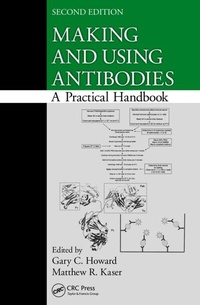
Making and Using Antibodies
A Practical Handbook, Second Edition
2nd Edition
Published on 29. July 2013
Book
Paperback/Softback
460 pages
978-1-4398-6908-6 (ISBN)
Description
Antibodies protect us from a wide range of infectious diseases and cancers and have become an indispensable tool in science-both for conventional immune response research as well as other areas related to protein identification analysis. This second edition of Making and Using Antibodies: A Practical Handbook provides clear guidance on all aspects of how to make and use antibodies for research along with their commercial and industrial applications.
Keeping pace with new developments in this area, all chapters in this new edition have been revised, updated, or expanded. Along with discussions of current applications, new material in the book includes chapters on western blotting, aptamers, antibodies as therapeutics, quantitative production, and humanization of antibodies. The authors present clear descriptions of basic methods for making and using antibodies and supply detailed descriptions of basic laboratory techniques. Each chapter begins with introductory material, allowing for a better understanding of each concept, and practical examples are included to help readers grasp the real-world scenarios in which antibodies play a part.
From the eradication of smallpox to combating cancer, antibodies present an attractive solution to a range of biomedical problems. They are relatively easy to make and use, have great flexibility in applications, and are cost effective for most labs. This volume will assist biomedical researchers and students and pave the way for future discovery of new methods for making and using antibodies for a host of applications.
Keeping pace with new developments in this area, all chapters in this new edition have been revised, updated, or expanded. Along with discussions of current applications, new material in the book includes chapters on western blotting, aptamers, antibodies as therapeutics, quantitative production, and humanization of antibodies. The authors present clear descriptions of basic methods for making and using antibodies and supply detailed descriptions of basic laboratory techniques. Each chapter begins with introductory material, allowing for a better understanding of each concept, and practical examples are included to help readers grasp the real-world scenarios in which antibodies play a part.
From the eradication of smallpox to combating cancer, antibodies present an attractive solution to a range of biomedical problems. They are relatively easy to make and use, have great flexibility in applications, and are cost effective for most labs. This volume will assist biomedical researchers and students and pave the way for future discovery of new methods for making and using antibodies for a host of applications.
More details
Edition
2nd edition
Language
English
Place of publication
Bosa Roca
United States
Publishing group
Taylor & Francis Inc
Target group
Professional and scholarly
Academic and Professional Practice & Development
Illustrations
90 s/w Abbildungen, 4 farbige Abbildungen, 32 s/w Tabellen
32 Tables, black and white; 4 Illustrations, color; 90 Illustrations, black and white
Dimensions
Height: 234 mm
Width: 156 mm
Weight
816 gr
ISBN-13
978-1-4398-6908-6 (9781439869086)
Copyright in bibliographic data and cover images is held by Nielsen Book Services Limited or by the publishers or by their respective licensors: all rights reserved.
Schweitzer Classification
Other editions
Additional editions
Book
03/2021
2nd Edition
CRC Press
€215.41
The article will not be published
E-Book
07/2013
2nd Edition
CRC Press
€225.99
Available for download
E-Book
07/2013
2nd Edition
CRC Press
€225.99
Available for download
Previous edition
Book
10/2006
1st Edition
CRC Press
€159.70
Article exhausted; check for reprint
Persons
Matthew R. Kaser, DPhil, earned his DPhil in biochemistry from Oxford University (UK) in 1988. After postdoctoral positions at the University of California, the University of Texas, and at REI Harbor-UCLA Medical Center, he was appointed to a faculty position at the University of California, San Francisco, Department of Pediatrics, then served as a scientist and patent agent at Incyte Genomics in Palo Alto, California, and a lecturer at California Sate University East Bay, Hayward. Dr. Kaser has been practicing as a patent agent since 1999, was associate director of intellectual property at Mendel Biotechnology, Hayward, and is a senior partner at Bell & Associates in San Francisco. He has presented research papers at a number of regional, national, and international conferences and coauthored more than a dozen publications.
Gary C. Howard, PhD, earned his PhD in biological sciences from Carnegie Mellon University in 1979. He completed his postdoctoral training at Harvard University and The Johns Hopkins University and was a research assistant biochemist at the University of California, San Francisco. He then joined Vector Laboratories in Burlingame as a biochemist and Medix Biotech (a subsidiary of Genzyme) in Foster City, California, as chemistry manager and operations manager. Currently, he is manager of scientific editing at The Gladstone Institutes, a private biomedical research institute affiliated with the University of California, San Francisco.
Gary C. Howard, PhD, earned his PhD in biological sciences from Carnegie Mellon University in 1979. He completed his postdoctoral training at Harvard University and The Johns Hopkins University and was a research assistant biochemist at the University of California, San Francisco. He then joined Vector Laboratories in Burlingame as a biochemist and Medix Biotech (a subsidiary of Genzyme) in Foster City, California, as chemistry manager and operations manager. Currently, he is manager of scientific editing at The Gladstone Institutes, a private biomedical research institute affiliated with the University of California, San Francisco.
Content
Antibodies. Antigens and Adjuvants. Production of Polyclonal Antibodies. Purification and Characterization of Antibodies. Production of Monoclonal Antibodies. Quantitative Production of Monoclonal Antibodies. Making Antibodies in Bacteria. Selection of Aptamers. Chemical and Proteolytic Modification of Antibodies. Western Blots and Other Applications. Immunohistochemical Methods. Immunoelectron Microscopy. Flow Cytometry. ELISAs. Humanization of Antibodies. Antibodies in the Future: Challenges and Opportunities. Index.