

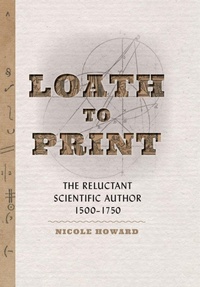
Loath to Print
The Reluctant Scientific Author, 1500-1750
Published on 31. May 2022
Book
Hardback
232 pages
978-1-4214-4368-3 (ISBN)
Description
Why did so many early modern scientific authors dislike and distrust the printing press?
While there is no denying the importance of the printing press to the scientific and medical advances of the early modern era, a closer look at authorial attitudes toward this technology refutes simplistic interpretations of how print was viewed at the time. Rather than embracing the press, scientific authors often disliked and distrusted it. In many cases, they sought to avoid putting their work into print altogether.
In Loath to Print, Nicole Howard takes a fresh look at early modern printing technology from the perspective of the natural philosophers and physicians who relied on it to share ideas. She offers a new perspective on scientific publishing in the early modern period, one that turns the celebration of print on its head. Exploring both these scholars' attitudes and their strategies for navigating the publishing world, Howard argues that scientists had many concerns, including the potential for errors to be introduced into their works by printers, the prospect of having their work pirated, and most worrisome, the likelihood that their works would be misunderstood by an audience ill-prepared to negotiate the complexities of the ideas, particularly those that were mathematical or philosophical.
Revealing how these concerns led authors in the sciences to develop strategies for controlling, circumventing, or altogether avoiding the broad readership that print afforded, Loath to Print explains how quickly a gap opened between those with scientific knowledge and a lay public-and how such a gap persists today. Scholars of the early modern period and the history of the book, as well as those interested in communication and technology studies, will find this an accessible and engaging look at the complexities of sharing scientific ideas in this rich period.
While there is no denying the importance of the printing press to the scientific and medical advances of the early modern era, a closer look at authorial attitudes toward this technology refutes simplistic interpretations of how print was viewed at the time. Rather than embracing the press, scientific authors often disliked and distrusted it. In many cases, they sought to avoid putting their work into print altogether.
In Loath to Print, Nicole Howard takes a fresh look at early modern printing technology from the perspective of the natural philosophers and physicians who relied on it to share ideas. She offers a new perspective on scientific publishing in the early modern period, one that turns the celebration of print on its head. Exploring both these scholars' attitudes and their strategies for navigating the publishing world, Howard argues that scientists had many concerns, including the potential for errors to be introduced into their works by printers, the prospect of having their work pirated, and most worrisome, the likelihood that their works would be misunderstood by an audience ill-prepared to negotiate the complexities of the ideas, particularly those that were mathematical or philosophical.
Revealing how these concerns led authors in the sciences to develop strategies for controlling, circumventing, or altogether avoiding the broad readership that print afforded, Loath to Print explains how quickly a gap opened between those with scientific knowledge and a lay public-and how such a gap persists today. Scholars of the early modern period and the history of the book, as well as those interested in communication and technology studies, will find this an accessible and engaging look at the complexities of sharing scientific ideas in this rich period.
More details
Language
English
Place of publication
Baltimore, MD
United States
Target group
Professional and scholarly
Illustrations
12 s/w Abbildungen
12 Illustrations, black and white
Dimensions
Height: 160 mm
Width: 237 mm
Thickness: 24 mm
Weight
482 gr
ISBN-13
978-1-4214-4368-3 (9781421443683)
DOI
10.1353/book.100158
Copyright in bibliographic data and cover images is held by Nielsen Book Services Limited or by the publishers or by their respective licensors: all rights reserved.
Schweitzer Classification
Other editions
Additional editions
E-Book
05/2022
Johns Hopkins University Press
€53.49
Available for download
Person
Nicole Howard is a professor of history at Eastern Oregon University. She is the author of The Book: The Life Story of a Technology.
Content
Acknowledgments
Introduction. "A Vast Ocean of Books"
1. Authorial Attitudes toward Print
2. "To the Unprejudiced Reader": The Rhetoric of Prefaces in Early Modern Science
3. The Controlled Distribution of Scientific Works
4. "A True and Ingenious Discovery": New Print Technologies and the Sciences
5. Silent Midwives: The Role of Editors in Early Modern Science
Conclusion. Reluctance Overcome
Notes
Index
Introduction. "A Vast Ocean of Books"
1. Authorial Attitudes toward Print
2. "To the Unprejudiced Reader": The Rhetoric of Prefaces in Early Modern Science
3. The Controlled Distribution of Scientific Works
4. "A True and Ingenious Discovery": New Print Technologies and the Sciences
5. Silent Midwives: The Role of Editors in Early Modern Science
Conclusion. Reluctance Overcome
Notes
Index