

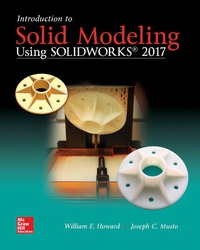
Introduction to Solid Modeling Using SolidWorks 2017
13th Edition
Published on 16. June 2017
Book
Paperback/Softback
400 pages
978-1-259-69654-1 (ISBN)
Description
Introduction to Solid Modeling using SolidWorks primarily consists of chapter-long tutorials, which introduce both basic concepts in solid modeling (such as part modeling, drawing creation, and assembly modeling) and more advanced applications of solid modeling in engineering analysis and design (such as mechanism modeling, mold creation, sheet metal bending, and rapid prototyping). Each tutorial is organized as "keystroke-level" instructions, designed to teach the use of the software.
More details
Edition
13th edition
Language
English
Place of publication
OH
United States
Target group
College/higher education
US School Grade: From College Freshman to College Graduate Student
Illustrations
1050 Illustrations
Dimensions
Height: 252 mm
Width: 203 mm
Thickness: 15 mm
Weight
714 gr
ISBN-13
978-1-259-69654-1 (9781259696541)
Copyright in bibliographic data and cover images is held by Nielsen Book Services Limited or by the publishers or by their respective licensors: all rights reserved.
Schweitzer Classification
Persons
William "Ed" Howard holds a B.S. in civil engineering and an M.S. in engineering mechanics from Virginia Tech, and a Ph.D. in mechanical engineering from Marquette University. He is an associate professor in the East Carolina University Department of Engineering, where he teaches solid modeling, engineering computations, solid mechanics, and composite materials. Before beginning his academic career, Dr. Howard worked in industry for 14 years in design, analysis, and project engineering at Thiokol Corporation (Brigham City, UT), Spaulding Composites Company (Smyrna, TN), and Sta-Rite Industries (Delavan, WI). He is a registered professional engineer in the state of Wisconsin.
Joseph Musto holds a B.S. from Clarkson University, and an M.Eng. and Ph.D. from Rensselaer Polytechnic Institute, all in mechanical engineering. Before beginning his academic career, Dr. Musto worked in industry in held industrial positions with Brady Corporation (Milwaukee, WI) and Eastman Kodak Company (Rochester, NY). He is a registered professional engineer in the state of Wisconsin. He has been using and teaching solid modeling using SOLIDWORKS since 1998.
Joseph Musto holds a B.S. from Clarkson University, and an M.Eng. and Ph.D. from Rensselaer Polytechnic Institute, all in mechanical engineering. Before beginning his academic career, Dr. Musto worked in industry in held industrial positions with Brady Corporation (Milwaukee, WI) and Eastman Kodak Company (Rochester, NY). He is a registered professional engineer in the state of Wisconsin. He has been using and teaching solid modeling using SOLIDWORKS since 1998.
Content
Part One - Learning SolidWorks
1) Basic Part Modeling Techniques
2) Engineering Drawings
3) Additional Part Modeling Techniques
4) Advanced Part Modeling
5) Parametric Modeling Techniques
6) Creation of Assembly Models
7) Advanced Assembly Operations
8) Assembly Drawings
Part Two - Applications of SolidWorks
9) Generation of 2-D Layouts
10) Solution of Vector Problems
11) Analysis of Mechanisms
12) Design of Molds and Sheet Metal Parts
13) The Use of SolidWorks to Accelerate the Product Development Cycle
Appendix
A) Recommended Settings
B) The SolidWorks Interface: Use and Customization
1) Basic Part Modeling Techniques
2) Engineering Drawings
3) Additional Part Modeling Techniques
4) Advanced Part Modeling
5) Parametric Modeling Techniques
6) Creation of Assembly Models
7) Advanced Assembly Operations
8) Assembly Drawings
Part Two - Applications of SolidWorks
9) Generation of 2-D Layouts
10) Solution of Vector Problems
11) Analysis of Mechanisms
12) Design of Molds and Sheet Metal Parts
13) The Use of SolidWorks to Accelerate the Product Development Cycle
Appendix
A) Recommended Settings
B) The SolidWorks Interface: Use and Customization