

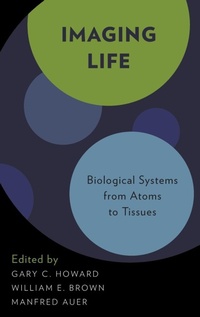
Imaging Life
Biological Systems from Atoms to Tissues
Published on 11. September 2014
Book
Hardback
498 pages
978-0-19-531443-4 (ISBN)
Description
This volume provides an overview of a variety of approaches to biological image analysis, which allow for the study of living organisms at all levels of complexity and organization. These organisms range from individual macromolecules to subcellular and cellular volumes, tissues and microbial communities. Such a "systems biology" understanding of life requires the combination of a variety of imaging techniques, and with it an in-depth understanding of their respective strengths and limitations, as well as their intersection with other techniques. Howard, Brown, and Auer show us that the integration of these imaging techniques will allow us to overcome the reductionist approach to biology that dominated the twentieth century, which was aimed at examining the physical and chemical properties of life's constituents, one macromolecule at a time. However, while based on the laws of physics and chemistry, life is not simply a set of chemical reactions and physical forces; it features an exquisite spatiotemporal organization that allows an inconceivably large number of chemical processes to coexist, refined by billions of years of evolutionary experimentation.
And yet, many fundamental questions remain largely unanswered; Imaging Life argues that we are just now beginning to address the spatiotemporal organizational component of living processes. "Imaging" is needed in order to reveal the spatiotemporal relationships between components, and thus to understand organizational guiding principles of living systems. Only through imaging will we be able to decipher the mechanisms and the marvelous organization that enable and sustain the mystery of life. Imaging Life shows us how biology is beginning to do just that.
And yet, many fundamental questions remain largely unanswered; Imaging Life argues that we are just now beginning to address the spatiotemporal organizational component of living processes. "Imaging" is needed in order to reveal the spatiotemporal relationships between components, and thus to understand organizational guiding principles of living systems. Only through imaging will we be able to decipher the mechanisms and the marvelous organization that enable and sustain the mystery of life. Imaging Life shows us how biology is beginning to do just that.
Reviews / Votes
"The detailed presentation of the imaging techniques makes the book most appropriate for experts in the field. Recommended." --ChoiceMore details
Language
English
Place of publication
New York
United States
Target group
College/higher education
Professional and scholarly
Illustrations
116 illustrations
Dimensions
Height: 240 mm
Width: 161 mm
Thickness: 31 mm
Weight
907 gr
ISBN-13
978-0-19-531443-4 (9780195314434)
Copyright in bibliographic data and cover images is held by Nielsen Book Services Limited or by the publishers or by their respective licensors: all rights reserved.
Schweitzer Classification
Other editions
Additional editions
Gary C. Howard | William E. Brown | Manfred Auer
Imaging Life
Biological Systems from Atoms to Tissues
E-Book
07/2014
1st Edition
OUP eBook
€61.99
Available for download
Persons
Throughout his career, Gary Howard has been a part of the academic, biotech, and publishing scientific communities. In addition, he has experience in multiple experimental systems, including mouse, human, and Drosophila.
Since 2004, Manfried Auer has been a staff scientist at the Lawrence Berkeley National Laboratory, and has been the Director of Physical Analysis at the Joint Bioenergy Institute since 2008. Throughout his career, he has been researching protein structures, cellular and tissue structures using advanced electron microscopy techniques. The late William E. Brown was professor of biological sciences at Carnegie Mellon University. From 1993 to 2000, he served as department head. Dr. Brown received his doctorate in biochemistry in the laboratory of Finn Wold at the University of Minnesota and completed a postdoctoral fellowship in biophysics in the laboratory of Fred Richards at Yale University.
Since 2004, Manfried Auer has been a staff scientist at the Lawrence Berkeley National Laboratory, and has been the Director of Physical Analysis at the Joint Bioenergy Institute since 2008. Throughout his career, he has been researching protein structures, cellular and tissue structures using advanced electron microscopy techniques. The late William E. Brown was professor of biological sciences at Carnegie Mellon University. From 1993 to 2000, he served as department head. Dr. Brown received his doctorate in biochemistry in the laboratory of Finn Wold at the University of Minnesota and completed a postdoctoral fellowship in biophysics in the laboratory of Fred Richards at Yale University.
Editor
Manager of Scientific EditingManager of Scientific Editing, The Gladstone Institutes (University of California--San Francisco)
Former Head of Department of Biological SciencesFormer Head of Department of Biological Sciences, Carnegie Mellon University
Principal InvestigatorPrincipal Investigator, MRC Laboratory of Molecular Biology, University of Hannover
Content
Contents ; 1. Imaging life ; Manfred Auer and Gary C. Howard ; Part I: Imaging the Macromolecular Inventory ; Structure and Mechanistic Function of the Building Blocks ; Introduction to Section 1 ; Manfred Auer, Natalia Pinzon, and Gary Howard ; 2. Protein crystallography and x-ray diffraction ; John P. Rose, M. Gary Newton and Bi-Cheng Wang ; 3. Magnetic resonance in structural biology ; G. Marius Clore ; 4. Cryo-electron microscopy ; Phoebe Stewart ; 5. Single-molecule imaging and force spectroscopy by atomic force microscopy ; K. Tanuj Sapra and Daniel J. Muller ; 6. Coherent x-ray diffraction imaging with free-electron lasers ; Stefan Hau-Riege ; Imaging Cellular and Tissue Architecture ; How It All Fits Together to Sustain Life ; Introduction to Section 2 ; Manfred Auer, Natalia Pinzon, and Gary Howard ; 7. Bridging the resolution gap: Electron tomography and advanced three-dimensional SEM approaches for cellular volumes ; Manfred Auer ; 8. Correlated soft x-ray tomography and cryo-light microscopy ; Elizabeth A. Smith, Bertrand P. Cinquin, Gerry McDermott, Mark A. Le Gros and Carolyn A. Larabell ; 9. Breaking Abbe's law: Super-accuracy and super-resolution fluorescence microscopy based on single molecule detection ; Sethuramasundaram Pitchiaya, John R. Androsavich and Nils G. Walter ; 10. Superresolution STED microscopy ; Valentin Nagerl ; 11. Imaging the (macro)molecular composition: Mass spectrometry imaging ; Brendan Prideaux ; 12. Non-destructive molecular mapping and imaging: Synchotron FTIR spectral imaging ; Hoi-Ying Holman and Liang Chen ; 13. Raman spectroscopic imaging of biological systems ; Martin Schmidt, Pradeep N. Perera, Alexander Weber-Bargioni, Paul D. Adams, and P. James Schuck ; 14. Automated microscopic imaging and survival statistics ; Steven Finkbeiner ; Modeling of Complex Biological Functions ; Introduction to Section 3 ; Manfred Auer, Natalia Pinzon, and Gary Howard ; 15. From voxel maps to models ; Chandrajit Bajaj ; 16. Building and using 3D digital atlases of complex model animals at single-cell resolution ; Hanchuan Peng ; Conclusions ; 17. Quo vadis, imaging ; Manfred Auer and Gary C. Howard