


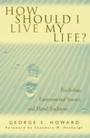
How Should I Live My Life?
Psychology, Environmental Science, and Moral Traditions
Published on 25. June 2002
Book
Paperback/Softback
208 pages
978-0-7425-2207-7 (ISBN)
Description
A truly cross-disciplinary study of psychology, theology, economics, and environmental science, How Should I Live My Life presents an overview of human beliefs and institutions that have led to the emerging global ecological threats. By viewing societal institutions and the psychology that spawns them, George S. Howard gets to the root causes of global ecological crises and provides an effective roadmap for changing the disastrous course that humans face. With detailed descriptions of economic and psycological methods that lead to the choices that society has made, Howard puts forth his vision for society's path in a well-rounded argument for changing the course of economic and environmental policies practiced by the governments of the world today.
Reviews / Votes
George Howard is one of the most insightful people in the broad field of contemporary psychology. I always benefit from reading his work, and this was a deeply moving experience for me. In this book, Howard's wisdom and understanding of a balanced and rational life call softly and persuasively to the reader from every page. With every chapter dawns a greater and more complete vision of a world we would be proud to pass on to our children. -- Fred J. Hanna, Johns Hopkins University Professor George Howard's new book, How Should I Live My Life?, is a typically delightful read. Dr. Howard is one of the best people writing today for the undemanding public in psychology. -- William Bevan, William P. Few Professor of Psychology and provost emeritus, Duke University George Howard's latest book, How Should I Live My Life, is an outstanding contribution to our understanding of the human condition. George is one of this generation's most creative researchers and thinkers and this book provides an integration and further extension of his latest views. I strongly urge all to treat yourself by reading this thought provoking contribution. I believe this book is destined to become a classic. -- James H. Bray, Baylor College of Medicine Howard's book is a revolutionary act-in it he makes clear the ties between personal values, moral traditions and the looming environmental crisis in an intelligent, accessible, personal and thought provoking manner. Rather than assault the reader with pessimism and doom, Howard provides the reader with hope and a blueprint for a healthy future. -- Edward A. Delgado-Romero, Ph.D., Indiana UniversityMore details
Language
English
Place of publication
United States
Publishing group
Bloomsbury Publishing Plc
Dimensions
Height: 225 mm
Width: 151 mm
Thickness: 11 mm
Weight
254 gr
ISBN-13
978-0-7425-2207-7 (9780742522077)
Copyright in bibliographic data and cover images is held by Nielsen Book Services Limited or by the publishers or by their respective licensors: all rights reserved.
Schweitzer Classification
Other editions
Additional editions
E-Book
06/2002
1st Edition
Rowman & Littlefield Publishers
€43.49
Available for download
Persons
George S. Howard is professor of psychology and Morahan Director of the Core Course Program at the University of Notre Dame. A researcher in applied psychology and research methods, he has written numerous books and articles inlcuding, Basic Research Methods in the Social Sciences and Ecological Psychology: Creating a More Earth-Friendly Human Nature. Howard is a Faculty Fellow in both the Kroc Institute for International Peace Studies and the Reilly Center for Science, Technology, and Values at the University of Notre Dame.
Content
Part 1 Possible Human Natures Chapter 2 Introduction: Why Change is Needed Chapter 3 Constructive Realism Chapter 4 Stories, Stories Everywhere; But Not a Truth to Think Chapter 5 The Perfect Class Chapter 6 The Tragedy of Maximization Part 7 Reengineering Wasteful Systems Chapter 8 Habits at First Are Silken Threads Chapter 9 Cheap is Beautiful: Is Your Money Working as Hard as You Are? Chapter 10 Green Taxes Chapter 11 Imagine! Part 12 Against the Idols of Our Day Chapter 13 In Praise of the Common Good Chapter 14 It Is Easier For a Camel . . . Chapter 15 Buddhist Economics Chapter 16 Ghandi's Seven Sins Chapter 17 Conclusion: Changing Human Societies