

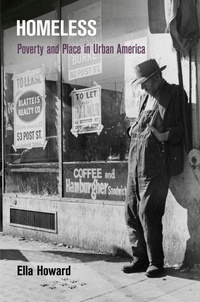
Homeless
Poverty and Place in Urban America
Published on 21. February 2013
Book
Hardback
288 pages
978-0-8122-4472-4 (ISBN)
Description
The homeless have the legal right to exist in modern American cities, yet antihomeless ordinances deny them access to many public spaces. How did previous generations of urban dwellers deal with the tensions between the rights of the homeless and those of other city residents? Ella Howard answers this question by tracing the history of skid rows from their rise in the late nineteenth century to their eradication in the mid-twentieth century.
Focusing on New York's infamous Bowery, Homeless analyzes the efforts of politicians, charity administrators, social workers, urban planners, and social scientists as they grappled with the problem of homelessness. The development of the Bowery from a respectable entertainment district to the nation's most infamous skid row offers a lens through which to understand national trends of homelessness and the complex relationship between poverty and place. Maintained by cities across the country as a type of informal urban welfare, skid rows anchored the homeless to a specific neighborhood, offering inhabitants places to eat, drink, sleep, and find work while keeping them comfortably removed from the urban middle classes. This separation of the homeless from the core of city life fostered simplistic and often inaccurate understandings of their plight. Most efforts to assist them centered on reforming their behavior rather than addressing structural economic concerns.
By midcentury, as city centers became more valuable, urban renewal projects and waves of gentrification destroyed skid rows and with them the public housing and social services they offered. With nowhere to go, the poor scattered across the urban landscape into public spaces, only to confront laws that effectively criminalized behavior associated with abject poverty. Richly detailed, Homeless lends insight into the meaning of homelessness and poverty in twentieth-century America and offers us a new perspective on the modern welfare system.
Focusing on New York's infamous Bowery, Homeless analyzes the efforts of politicians, charity administrators, social workers, urban planners, and social scientists as they grappled with the problem of homelessness. The development of the Bowery from a respectable entertainment district to the nation's most infamous skid row offers a lens through which to understand national trends of homelessness and the complex relationship between poverty and place. Maintained by cities across the country as a type of informal urban welfare, skid rows anchored the homeless to a specific neighborhood, offering inhabitants places to eat, drink, sleep, and find work while keeping them comfortably removed from the urban middle classes. This separation of the homeless from the core of city life fostered simplistic and often inaccurate understandings of their plight. Most efforts to assist them centered on reforming their behavior rather than addressing structural economic concerns.
By midcentury, as city centers became more valuable, urban renewal projects and waves of gentrification destroyed skid rows and with them the public housing and social services they offered. With nowhere to go, the poor scattered across the urban landscape into public spaces, only to confront laws that effectively criminalized behavior associated with abject poverty. Richly detailed, Homeless lends insight into the meaning of homelessness and poverty in twentieth-century America and offers us a new perspective on the modern welfare system.
Reviews / Votes
"Through thorough research, sound use of secondary sources, and a shrewd focus on America's first and largest skid row, the Bowery, Howard has produced a book that will be essential reading for scholars of homelessness and social welfare." (Todd DePastino, author of Citizen Hobo: How a Century of Homelessness Shaped America) "Howard seamlessly weaves larger issues of urban renewal, housing, alcohol research, the deinstitutionalization of the mentally ill, and gentrification into her history of the Bowery, which serves as a touchstone to which she returns. The result is a history of American policy on homelessness at the federal, state, and municipal levels that remains grounded in the lived experience of homeless men and women in the middle decades of the twentieth century." (Eric Schneider, author of Smack: Heroin and the American City)More details
Series
Language
English
Place of publication
Pennsylvania
United States
Target group
College/higher education
Product notice
Paper over boards
Illustrations
21 illus.
Dimensions
Height: 231 mm
Width: 160 mm
Thickness: 28 mm
Weight
612 gr
ISBN-13
978-0-8122-4472-4 (9780812244724)
Copyright in bibliographic data and cover images is held by Nielsen Book Services Limited or by the publishers or by their respective licensors: all rights reserved.
Schweitzer Classification
Other editions
Additional editions
E-Book
01/2013
1st Edition
University of Pennsylvania Press
€53.99
Available for download
Person
Ella Howard teaches urban history and material culture at Armstrong Atlantic State University.
Content
Introduction
Chapter 1. The Challenge of the Depression
Chapter 2. A New Deal for the Homeless
Chapter 3. Skid Row in an Era of Plenty
Chapter 4. Urban Renewal and the Challenge of Homelessness
Chapter 5. Operation Bowery and Social Scientific Inquiry
Chapter 6. The End of the Skid-Row Era
Conclusion. Whither the Homeless
Notes
Index
Acknowledgments
Chapter 1. The Challenge of the Depression
Chapter 2. A New Deal for the Homeless
Chapter 3. Skid Row in an Era of Plenty
Chapter 4. Urban Renewal and the Challenge of Homelessness
Chapter 5. Operation Bowery and Social Scientific Inquiry
Chapter 6. The End of the Skid-Row Era
Conclusion. Whither the Homeless
Notes
Index
Acknowledgments