

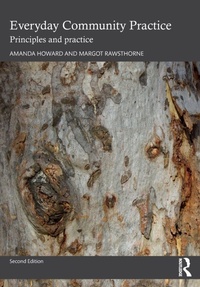
Everyday Community Practice
Principles and practice
2nd Edition
Published on 30. September 2025
Book
Paperback/Softback
142 pages
978-1-032-85723-7 (ISBN)
Description
This book provides a practical but sophisticated exploration of community development practice and is an accessible, relevant and contextualised guide for those studying social work and human services in Australia.
This fully revised and expanded second edition (including new insights from communities preparing for, responding to, and recovering from disasters) draws on the experiences of not only the authors but many current practitioners from diverse backgrounds working alongside communities to support socially just change. The perspectives of these practitioners are drawn on throughout the book as well as in the exemplary projects case studies at the end of the book. Blending practical skills and ideas with a solid theoretical foundation, each chapter includes reflective questions and examples which can be used both in the classroom and in the field.
Enabling students to feel better supported in challenging dominant individualised practice frameworks, it argues strongly that only collective action (supported by community development practice) can address significant social challenges such as those created by climate change, poverty and social exclusion.
This fully revised and expanded second edition (including new insights from communities preparing for, responding to, and recovering from disasters) draws on the experiences of not only the authors but many current practitioners from diverse backgrounds working alongside communities to support socially just change. The perspectives of these practitioners are drawn on throughout the book as well as in the exemplary projects case studies at the end of the book. Blending practical skills and ideas with a solid theoretical foundation, each chapter includes reflective questions and examples which can be used both in the classroom and in the field.
Enabling students to feel better supported in challenging dominant individualised practice frameworks, it argues strongly that only collective action (supported by community development practice) can address significant social challenges such as those created by climate change, poverty and social exclusion.
More details
Edition
2nd edition
Language
English
Place of publication
London
United Kingdom
Publishing group
Taylor & Francis Ltd
Target group
College/higher education
Postgraduate and Undergraduate Advanced
Illustrations
7 s/w Zeichnungen, 7 s/w Abbildungen
7 Line drawings, black and white; 7 Illustrations, black and white
Dimensions
Height: 244 mm
Width: 170 mm
Thickness: 8 mm
Weight
276 gr
ISBN-13
978-1-032-85723-7 (9781032857237)
Copyright in bibliographic data and cover images is held by Nielsen Book Services Limited or by the publishers or by their respective licensors: all rights reserved.
Schweitzer Classification
Other editions
Additional editions
E-Book
09/2025
2nd Edition
Routledge
€55.49
Available for download
E-Book
09/2025
2nd Edition
Routledge
€55.49
Available for download
Book
09/2025
2nd Edition
Routledge
€207.00
Shipment within 10-20 days
Previous edition
Book
07/2019
1st Edition
A&U Academic
€51.50
Article exhausted; check for reprint
Persons
Amanda Howard works as a Professor of Social Work in the Social Work and Policy Studies team at the University of Sydney. Areas of research include community development, disasters and climate change, inclusion and participatory action research.
Margot Rawsthorne works as an Associate Professor at the University of Sydney in the Social Work and Policy Studies team. Areas of research interest include inequality, the social impact of disasters and social change through community development.
Margot Rawsthorne works as an Associate Professor at the University of Sydney in the Social Work and Policy Studies team. Areas of research interest include inequality, the social impact of disasters and social change through community development.
Content
1.Introduction. 2.Everyday community practice is core professional practice. 3.Theoretical ideas that inform everyday community practice. 4.Listening, loitering and learning. 5.Being visible and invisible: Making space for participation. 6.Risk-taking and safety. 7.Networking, partnerships and collaboration. 8.Putting projects or taking action on the ground. 9.Taking stock, endings and renewal. 10.Building knowledge together. 11.Exemplar projects.