

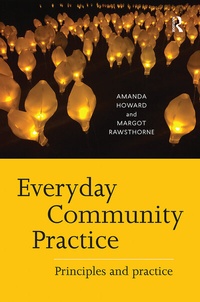
Everyday Community Practice
Principles and practice
1st Edition
Published on 31. March 2021
Book
Hardback
272 pages
978-0-367-71803-9 (ISBN)
Description
Increasingly students and practitioners in human services are asked or seek to include community engagement, participation and capacity building in their work with groups. In this book expert authors Amanda Howard and Margot Rawsthorne provide guidance on the theory and practice of working with communities, from preliminary planning and scoping before direct work with the community begins, through to evaluation. They explore key issues including developing an understanding of community life, facilitating and supporting community action, understanding and acting on structural inequity, managing negotiation and conflict, and building productive networks. They draw extensively on their own work with communities and research to create a dialogue with the reader on the interaction of task and process in everyday community practice.
Written in a friendly and accessible style and featuring the voices of community workers throughout, this is a vital guide for anyone seeking to encourage positive change in an important field of practice.
'This is a splendid addition to the community work literature, offering wise and judicious guidance for those engaged knee-deep in community practice aEUR| it acknowledges that the increasing emphasis on individualised service options has too often led to the neglect of understanding the benefits of collective action within diverse and dynamic communities.' - Dr Winsome Roberts, Honorary Senior Fellow, Department of Social Work, University of Melbourne
Written in a friendly and accessible style and featuring the voices of community workers throughout, this is a vital guide for anyone seeking to encourage positive change in an important field of practice.
'This is a splendid addition to the community work literature, offering wise and judicious guidance for those engaged knee-deep in community practice aEUR| it acknowledges that the increasing emphasis on individualised service options has too often led to the neglect of understanding the benefits of collective action within diverse and dynamic communities.' - Dr Winsome Roberts, Honorary Senior Fellow, Department of Social Work, University of Melbourne
More details
Language
English
Place of publication
London
United Kingdom
Publishing group
Taylor & Francis Ltd
Target group
College/higher education
Dimensions
Height: 234 mm
Width: 156 mm
Weight
660 gr
ISBN-13
978-0-367-71803-9 (9780367718039)
Copyright in bibliographic data and cover images is held by Nielsen Book Services Limited or by the publishers or by their respective licensors: all rights reserved.
Schweitzer Classification
Other editions
New editions

Book
09/2025
2nd Edition
Routledge
€207.00
Shipment within 10-20 days
Additional editions
Book
07/2019
1st Edition
A&U Academic
€51.50
Article exhausted; check for reprint
Persons
Amanda Howard is Associate Professor and Program Director, Bachelor of Social Work at the University of Sydney. Margot Rawsthorne is Associate Professor at the University of Sydney and lead researcher at the Glebe Community Development Project. Amanda and Margot both teach, research and publish on community development.
Content
Foreword: Anti-oppressive community development
Chapter 1 Introduction
Some thoughts for the beginning
Individual and collective ideas in practice
Ideas and concepts
What is in the book and how was it assembled?
How to use the book
Chapter 2 Moving beyond 'anything goes'
What does everyday practice add to professional practice?
Critical thinking as everyday community practice
Getting runs on the board-doing something
Systems knowledge and navigation
Letting things go . . . holding your breath
Chapter 3 Listening, loitering and learning
Listening for . . .
Listening to . . .
Loitering
Learning
Chapter 4 Being visible and invisible
Enabling participation
Bringing people together across difference
Organising
Chapter 5 Putting projects/work on the ground
Taking care of the internals
Taking care of the externals
Chapter 6 What change are we trying to achieve?
Modelling democratic practices
Education, particularly in relation to political systems
Skills development, particularly project management
Leadership
Conflict resolution
Chapter 7 Risk-taking and safety
Risk and innovation
Risk is decision-making
Mobilising community capacities and risk =
Making sense of risk in everyday community practice
A proviso: the role of trust and confidence
Chapter 8 Networking, partnerships and collaboration
Understand your own collaborative skill set
Cultivate a collaborative professional peer network
Support development of networks among residents and groups
Chapter 9 Taking stock, endings and renewal
What might reflection look and feel like?
Collective reflection
Reflective conversations are planned
Taking care of ourselves
Public reflection
Taking stock in other ways
Chapter 10 Research on whether we make a difference and research to make a difference
Are we making a difference?
Connecting with research
Community-based research and politics
Measuring what, for whom and why
Understanding changing measurement narratives
Reflecting on evidence and evidence-based practice
Research alliances and networks
Project evaluations
University-led research
Collaborative research projects
Collaborative research on collaboration
Picking a research strategy and method
Outsider and insider research
How will we resource the research?
Chapter 11 Why does everyday community practice matter?
Chapter 12 Exemplar projects
People experiencing mental distress and their carers
The Past & Present: A town's story
Community inclusion playgroups
The lawnmower bank: an example from Tracie
A final word
Acknowledgements
Useful resources
References
Index
Chapter 1 Introduction
Some thoughts for the beginning
Individual and collective ideas in practice
Ideas and concepts
What is in the book and how was it assembled?
How to use the book
Chapter 2 Moving beyond 'anything goes'
What does everyday practice add to professional practice?
Critical thinking as everyday community practice
Getting runs on the board-doing something
Systems knowledge and navigation
Letting things go . . . holding your breath
Chapter 3 Listening, loitering and learning
Listening for . . .
Listening to . . .
Loitering
Learning
Chapter 4 Being visible and invisible
Enabling participation
Bringing people together across difference
Organising
Chapter 5 Putting projects/work on the ground
Taking care of the internals
Taking care of the externals
Chapter 6 What change are we trying to achieve?
Modelling democratic practices
Education, particularly in relation to political systems
Skills development, particularly project management
Leadership
Conflict resolution
Chapter 7 Risk-taking and safety
Risk and innovation
Risk is decision-making
Mobilising community capacities and risk =
Making sense of risk in everyday community practice
A proviso: the role of trust and confidence
Chapter 8 Networking, partnerships and collaboration
Understand your own collaborative skill set
Cultivate a collaborative professional peer network
Support development of networks among residents and groups
Chapter 9 Taking stock, endings and renewal
What might reflection look and feel like?
Collective reflection
Reflective conversations are planned
Taking care of ourselves
Public reflection
Taking stock in other ways
Chapter 10 Research on whether we make a difference and research to make a difference
Are we making a difference?
Connecting with research
Community-based research and politics
Measuring what, for whom and why
Understanding changing measurement narratives
Reflecting on evidence and evidence-based practice
Research alliances and networks
Project evaluations
University-led research
Collaborative research projects
Collaborative research on collaboration
Picking a research strategy and method
Outsider and insider research
How will we resource the research?
Chapter 11 Why does everyday community practice matter?
Chapter 12 Exemplar projects
People experiencing mental distress and their carers
The Past & Present: A town's story
Community inclusion playgroups
The lawnmower bank: an example from Tracie
A final word
Acknowledgements
Useful resources
References
Index