

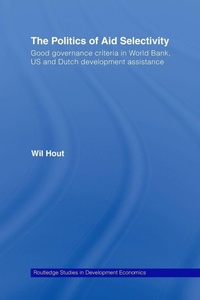
The Politics of Aid Selectivity
Good Governance Criteria in World Bank, U.S. and Dutch Development Assistance
1st Edition
Published on 23. December 2014
Book
Paperback/Softback
208 pages
978-0-415-51164-3 (ISBN)
Description
The first extended analysis of selectivity policies of important bilateral and multilateral aid donors, this book combines a policy-analytical with a quantitative-empirical approach.
Bringing out the conflicts that may exist between foreign assistance agendas and the desire of governments in developing countries to set priorities for their national development policies, the author:
describes in detail the policies of aid selectivity adopted by the World Bank, the Netherlands and the United States since the end of the 1990s including the underlying assumptions
looks at key decisions related to a selection of developing countries
compares policy-making and different approaches to selectivity in the United Kingdom with those in developing countries.
Critical and analytical in style, this book is, among other areas, an invaluable resource for students of various sub-fields of development studies and policy analysis as well as appealing to researchers and policy makers working in the area of foreign assistance across the globe.
Bringing out the conflicts that may exist between foreign assistance agendas and the desire of governments in developing countries to set priorities for their national development policies, the author:
describes in detail the policies of aid selectivity adopted by the World Bank, the Netherlands and the United States since the end of the 1990s including the underlying assumptions
looks at key decisions related to a selection of developing countries
compares policy-making and different approaches to selectivity in the United Kingdom with those in developing countries.
Critical and analytical in style, this book is, among other areas, an invaluable resource for students of various sub-fields of development studies and policy analysis as well as appealing to researchers and policy makers working in the area of foreign assistance across the globe.
More details
Series
Language
English
Place of publication
London
United Kingdom
Publishing group
Taylor & Francis Ltd
Target group
College/higher education
Professional and scholarly
Illustrations
2 s/w Abbildungen, 2 s/w Zeichnungen, 23 s/w Tabellen
23 Tables, black and white; 2 Line drawings, black and white; 2 Illustrations, black and white
Dimensions
Height: 234 mm
Width: 156 mm
Thickness: 12 mm
Weight
327 gr
ISBN-13
978-0-415-51164-3 (9780415511643)
Copyright in bibliographic data and cover images is held by Nielsen Book Services Limited or by the publishers or by their respective licensors: all rights reserved.
Schweitzer Classification
Other editions
Additional editions
Wil Hout
The Politics of Aid Selectivity
Good Governance Criteria in World Bank, U.S. and Dutch Development Assistance
Book
06/2007
1st Edition
Routledge
€231.50
Shipment within 15-20 days
Wil Hout
The Politics of Aid Selectivity
Good Governance Criteria in World Bank, U.S. and Dutch Development Assistance
E-Book
06/2007
Routledge
€72.49
Available for download
Wil Hout
The Politics of Aid Selectivity
Good Governance Criteria in World Bank, U.S. and Dutch Development Assistance
E-Book
06/2007
Routledge
€72.49
Available for download
Person
Wil Hout is an Associate Professor of World Development at the Institute of Social Studies in The Hague (The Netherlands) and currently serves as Dean of the Institute. He is the author of Capitalism and the Third World, co-editor (with Jean Grugel) of Regionalism Across the North-South Divide and co-editor of three Dutch-language volumes on issues of international relations and political science.
Content
1. Introduction 2.The Paradigm Shift in Development Assistance 3. The World Bank and Performance-based Allocation 4. The Netherlands and the Selection of Recipient Countries 5. The United States and the Millennium Challenge Account 6.Selectivity and Good Governance in the United Kingdom, Denmarkand the European Union 7. Quantitative-empirical Analyses of World Bank, Dutch and U.S. Aid Selectivity 8. Conclusion