

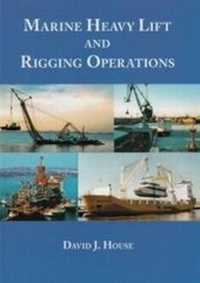
Marine Heavy Lift and Rigging Operations
Published on 24. April 2005
Book
Board book
216 pages
978-0-85174-720-0 (ISBN)
Description
This publication covers the topic of Heavy Lifts within the marine industry. It is profusely illustrated and is directly aimed at the many industry sectors including: salvage operations, the offshore section, with the ship building and repair sectors, as well as the cargo aspects of the maritime environment. The movement of bulk cargoes, both dry and liquid has expanded considerably alongside increased development in the third world. However, this expansion has not been limited to just bulk cargoes. Containerisation, roll on, roll off and designated project cargoes are all sectors which have seen increased activity in the field of heavy lifting practice.The lifting and transportation of heavy weights has always been inherent with the maritime industries. The purpose of this work is designed to show not only some of the many routine lift operations aboard ships, but also the specialist movements of excessive loads, in a highly competitive commercial market. The Offshore Industry in particular, generated probably the greatest interest in modular construction for oil and gas installations around the world.
It is from the origins of the early floating cranes, which later developed the multi-purpose crane barges, floating sheer legs and salvage craft that has led to the massive activity and development in our coastline regions. Installations being constructed to mammoth proportions dominate the skylines of the world. The rigging skills of personnel associated with a successful lift operation, should not be undermined. Their dedication to achieving what sometimes may appear as the impossible lift, is without equal. By the very nature of the task, the managers and operators have placed the safety of personnel and the protection of the environment at the forefront of the heavy-lift/transport industry. Nothing can expect to move without detailed 'Risk Assessment' and even then Project cargoes, heavy lift ships and major commercial operations all adhere to the first maritime principal for the Safety of Life at Sea.
It is from the origins of the early floating cranes, which later developed the multi-purpose crane barges, floating sheer legs and salvage craft that has led to the massive activity and development in our coastline regions. Installations being constructed to mammoth proportions dominate the skylines of the world. The rigging skills of personnel associated with a successful lift operation, should not be undermined. Their dedication to achieving what sometimes may appear as the impossible lift, is without equal. By the very nature of the task, the managers and operators have placed the safety of personnel and the protection of the environment at the forefront of the heavy-lift/transport industry. Nothing can expect to move without detailed 'Risk Assessment' and even then Project cargoes, heavy lift ships and major commercial operations all adhere to the first maritime principal for the Safety of Life at Sea.
More details
Language
English
Place of publication
Glasgow
United Kingdom
Target group
College/higher education
Professional and scholarly
Illustrations
Illustrations
Dimensions
Height: 300 mm
Width: 215 mm
Thickness: 20 mm
Weight
1100 gr
ISBN-13
978-0-85174-720-0 (9780851747200)
Copyright in bibliographic data and cover images is held by Nielsen Book Services Limited or by the publishers or by their respective licensors: all rights reserved.
Schweitzer Classification
Other editions
New editions
Book
11/2019
Brown, Son & Ferguson Ltd
€106.66
Shipment within 3-4 weeks