

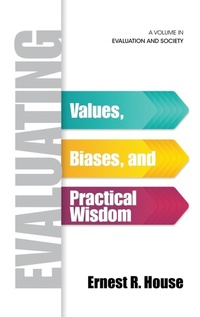
Evaluating
Values, Biases, and Practical Wisdom
Published on 16. December 2014
Book
Hardback
158 pages
978-1-62396-916-5 (ISBN)
Description
In this book, Ernie House reframes how we think about evaluation by reconsidering three key concepts of values, biases, and practical wisdom. The first part of the book reconstructs core evaluation concepts, with a focus on the origins of our values and biases. The second part explores how we handle values and biases in practice, and the third shows how we learn practical wisdom and use it in evaluations.
Value is the central concept in this volume, yet it's a fuzzy concept. In Part I, Ernie clarifies the concept of value by addressing basic questions: What are values? Where do they come from? Why do we have them? Why is our conception so confused? How do we handle values in evaluations?
In Part II, another central concept is added, that of biases. Prominent evaluation frameworks have focused on biases, including Campbell and Stanley's (1963) framework for validating causal inferences and Scriven's (1972) conception of objectivity, which is achieved by correcting for biases in general. In addition, research on thought processes has made progress by focusing on cognitive biases (Kahneman, 2011). Even so, through a case example, Ernie demonstrates that the concept of biases is under-appreciated and not well engaged in evaluation practice.
The third important concept, featured in Part III, is practical wisdom, which is the knowledge that evaluators acquire through experience. Practical wisdom informs what we do, possibly as much as theory. Experienced evaluators often conduct evaluations in similar ways, regardless of their theory, because practical wisdom determines much of what they do. Ernie provides concrete examples of practical wisdom and how we employ it. Throughout the book, he draws on the empirical research on thinking processes, especially Kahneman's Thinking Fast and Slow (2011).
This book will be of interest and relevance to all evaluation scholars and practitioners, as it thoughtfully engages core constructs of the field. The book can also well serve as a supplementary text in multiple evaluation courses, as it offers valuable conceptual and practical perspectives on our craft.
Value is the central concept in this volume, yet it's a fuzzy concept. In Part I, Ernie clarifies the concept of value by addressing basic questions: What are values? Where do they come from? Why do we have them? Why is our conception so confused? How do we handle values in evaluations?
In Part II, another central concept is added, that of biases. Prominent evaluation frameworks have focused on biases, including Campbell and Stanley's (1963) framework for validating causal inferences and Scriven's (1972) conception of objectivity, which is achieved by correcting for biases in general. In addition, research on thought processes has made progress by focusing on cognitive biases (Kahneman, 2011). Even so, through a case example, Ernie demonstrates that the concept of biases is under-appreciated and not well engaged in evaluation practice.
The third important concept, featured in Part III, is practical wisdom, which is the knowledge that evaluators acquire through experience. Practical wisdom informs what we do, possibly as much as theory. Experienced evaluators often conduct evaluations in similar ways, regardless of their theory, because practical wisdom determines much of what they do. Ernie provides concrete examples of practical wisdom and how we employ it. Throughout the book, he draws on the empirical research on thinking processes, especially Kahneman's Thinking Fast and Slow (2011).
This book will be of interest and relevance to all evaluation scholars and practitioners, as it thoughtfully engages core constructs of the field. The book can also well serve as a supplementary text in multiple evaluation courses, as it offers valuable conceptual and practical perspectives on our craft.
More details
Series
Language
English
Place of publication
Charlotte
United States
Publishing group
Emerald Publishing Inc
Target group
Professional and scholarly
Dimensions
Height: 240 mm
Width: 161 mm
Thickness: 13 mm
Weight
408 gr
ISBN-13
978-1-62396-916-5 (9781623969165)
Copyright in bibliographic data and cover images is held by Nielsen Book Services Limited or by the publishers or by their respective licensors: all rights reserved.
Schweitzer Classification
Person
Ernest R. House, University of Colorado at Boulder, USA
Content
Introduction: Reframing Evaluation.
Part I: Where Values Come From
Chapter 1. How Personal Values Affect Evaluations.
Chapter 2. Evaluating and Research on Thinking.
Chapter 3. Reframing Values.
Part II: Handling Values and Biases in Evaluations.
Chapter 4. An Evaluation Case Study.
Chapter 5. Democratizing Evaluation.
Chapter 6. Underlying Values and Influences.
Part III: Practical Wisdom in Evaluation
Chapter 7. Evaluating With Practical Wisdom.
Chapter 8. Learning Practical Wisdom.
Chapter 9. When to Rely on Practical Wisdom.
Chapter 10. Conclusion: Twenty-Five Ideas.
References.
Part I: Where Values Come From
Chapter 1. How Personal Values Affect Evaluations.
Chapter 2. Evaluating and Research on Thinking.
Chapter 3. Reframing Values.
Part II: Handling Values and Biases in Evaluations.
Chapter 4. An Evaluation Case Study.
Chapter 5. Democratizing Evaluation.
Chapter 6. Underlying Values and Influences.
Part III: Practical Wisdom in Evaluation
Chapter 7. Evaluating With Practical Wisdom.
Chapter 8. Learning Practical Wisdom.
Chapter 9. When to Rely on Practical Wisdom.
Chapter 10. Conclusion: Twenty-Five Ideas.
References.