

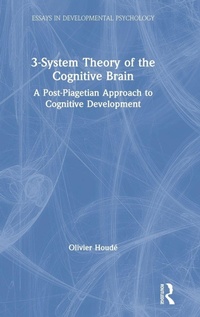
3-System Theory of the Cognitive Brain
A Post-Piagetian Approach to Cognitive Development
1st Edition
Published on 5. February 2019
Book
Hardback
134 pages
978-1-138-06969-5 (ISBN)
Description
3-System Theory of the Cognitive Brain: A Post-Piagetian Approach to Cognitive Development puts forward Olivier Houde's 3-System theory of the cognitive brain, based on numerous post-Piagetian psychological and brain imaging data acquired from children and adults. This ground-breaking theory simultaneously anchors itself in a deep understanding of the history of psychology and fuels current debates on thinking, reasoning and cognitive development.
Spanning the long-term history of psychology, from Plato and Aristotle to more current experimental psychology, this pioneering work goes beyond the approaches of Kahneman (i.e. System 1 theory) and Piaget (i.e. System 2 theory) to put forward a theory in which the inhibitory-control system (i.e. System 3) takes precedence. Houde argues that the brain contains a third control system located in the prefrontal cortex which is dedicated to inhibiting Kahneman's intuitive heuristics system and activating Piaget's logical algorithms system anywhere in the brain on a case-by-case basis, depending on the goal and context of the task. 3-System Theory of the Cognitive Brain simultaneously explains the early logical abilities discovered in babies, the dynamic, strategic and non-linear process of cognitive development in children, and the fast heuristics and biases observed in adults. Houde considers the exciting implications of this theory on neuro-education using examples from the classroom.
This book is essential reading for students and researchers in cognitive development and education, child psychology, reasoning and neurosciences.
Spanning the long-term history of psychology, from Plato and Aristotle to more current experimental psychology, this pioneering work goes beyond the approaches of Kahneman (i.e. System 1 theory) and Piaget (i.e. System 2 theory) to put forward a theory in which the inhibitory-control system (i.e. System 3) takes precedence. Houde argues that the brain contains a third control system located in the prefrontal cortex which is dedicated to inhibiting Kahneman's intuitive heuristics system and activating Piaget's logical algorithms system anywhere in the brain on a case-by-case basis, depending on the goal and context of the task. 3-System Theory of the Cognitive Brain simultaneously explains the early logical abilities discovered in babies, the dynamic, strategic and non-linear process of cognitive development in children, and the fast heuristics and biases observed in adults. Houde considers the exciting implications of this theory on neuro-education using examples from the classroom.
This book is essential reading for students and researchers in cognitive development and education, child psychology, reasoning and neurosciences.
More details
Series
Language
English
Place of publication
London
United Kingdom
Publishing group
Taylor & Francis Ltd
Target group
College/higher education
Dimensions
Height: 240 mm
Width: 161 mm
Thickness: 13 mm
Weight
399 gr
ISBN-13
978-1-138-06969-5 (9781138069695)
Copyright in bibliographic data and cover images is held by Nielsen Book Services Limited or by the publishers or by their respective licensors: all rights reserved.
Schweitzer Classification
Other editions
Additional editions
Olivier Houde
3-System Theory of the Cognitive Brain
A Post-Piagetian Approach to Cognitive Development
Book
02/2019
1st Edition
Routledge
€63.00
Shipment within 10-20 days
Olivier Houde
3-System Theory of the Cognitive Brain
A Post-Piagetian Approach to Cognitive Development
E-Book
01/2019
1st Edition
Routledge
€55.49
Available for download
Olivier Houde
3-System Theory of the Cognitive Brain
A Post-Piagetian Approach to Cognitive Development
E-Book
01/2019
1st Edition
Routledge
€55.49
Available for download
Person
Olivier Houde is Professor of Psychology at the University of Paris and the honorary director of the Laboratory for the Psychology of Child Development and Education (LaPsyDE) at the Sorbonne. He is the Editor-in-Chief of the Dictionary of Cognitive Science (Routledge, 2004) and the co-Editor-in-Chief of The Cambridge Handbook of Cognitive Development (forthcoming).
Content
Preface: One, two or three systems of thinking in human beings?
Part 1 Chapter 1: From Psyche to the Logos - Ancient times
Part 1 Chapter 2: Faith, Truth and Reasoning in The Middle Ages
Part 1 Chapter 3: The inconstancy of the human being: from the Renaissance to the Enlightenment
Part 1 Chapter 4: Towards a science of psychology: The nineteenth and twentieth centuries
Part 2: Introduction
Part 2 Chapter 5: Jean Piaget's theory or the logical system
Part 2 Chapter 6: The dual-system theories: System 1 (intuition) and System 2 (logic)
Part 2 Chapter 7: Inhibiting in order to reason: System 3 (executive)
Part 2 Chapter 8: The paradox of reasoning in infants
Conclusion
Bibliography
Part 1 Chapter 1: From Psyche to the Logos - Ancient times
Part 1 Chapter 2: Faith, Truth and Reasoning in The Middle Ages
Part 1 Chapter 3: The inconstancy of the human being: from the Renaissance to the Enlightenment
Part 1 Chapter 4: Towards a science of psychology: The nineteenth and twentieth centuries
Part 2: Introduction
Part 2 Chapter 5: Jean Piaget's theory or the logical system
Part 2 Chapter 6: The dual-system theories: System 1 (intuition) and System 2 (logic)
Part 2 Chapter 7: Inhibiting in order to reason: System 3 (executive)
Part 2 Chapter 8: The paradox of reasoning in infants
Conclusion
Bibliography