

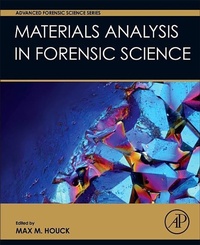
Materials Analysis in Forensic Science
Published on 21. June 2016
Book
Hardback
530 pages
978-0-12-800574-3 (ISBN)
Description
Materials Analysis in Forensic Science will serve as a graduate level text for those studying and teaching materials analysis in forensic science. In addition, it will prove an excellent library reference for forensic practitioners to use in their casework. Coverage includes methods, textiles, explosives, glass, coatings, geo-and bio-materials, and marks and impressions, as well as information on various other materials and professional issues the reader may encounter. Edited by a world-renowned leading forensic expert, the book is a long overdue solution for the forensic science community.
More details
Series
Language
English
Place of publication
San Diego
United States
Publishing group
Elsevier Science Publishing Co Inc
Target group
Professional and scholarly
Product notice
sewn/stitched
Cloth over boards
Dimensions
Height: 241 mm
Width: 195 mm
Thickness: 35 mm
Weight
1622 gr
ISBN-13
978-0-12-800574-3 (9780128005743)
Copyright in bibliographic data and cover images is held by Nielsen Book Services Limited or by the publishers or by their respective licensors: all rights reserved.
Schweitzer Classification
Other editions
Additional editions
Max M. Houck
Materials Analysis in Forensic Science
E-Book
05/2016
Academic Press
€71.95
Available for download
Person
Dr. Max M. Houck is an international forensic expert with over 25 years of experience. Houck has experience in the private sector, academia, local government, and worked at the Federal Bureau of Investigation Laboratory Division. He has worked as a forensic anthropologist, a trace evidence analyst, a researcher, and has managed millions of dollars in grants and awards. Most recently, he was the inaugural Director of the Department of Forensic Sciences in Washington, D.C., overseeing 150 employees and managing the forensic science laboratory, the public health laboratory, and crime scene sciences for the nation's capital. Houck has worked on a number of mass casualty scenes, including the Branch Davidian Investigation and the September 11, 2001 attack on the Pentagon.
Widely published, Houck has dozens of peer-reviewed journal articles and is the author and editor of numerous books. He is co-author of the best-selling Fundamentals of Forensic Science, Science of Crime Scenes, and Success with Expert Testimony, among others. He is the editor of the Advanced Forensic Science series of books. Houck is also founding co-editor of Forensic Science Policy and Management (the official journal of ASCLD), the only journal that addresses the management, policy, and administration of forensic science.
Houck has served on numerous committees, including for the National Academies of Science, NIST, Interpol, The Royal Society, the Director of the FBI, and the White House. He is a popular public speaker and has given presentations at NASA, the Max Planck Institute, an Oxford Roundtable, as well as keynote talks at numerous international conferences. Houck has taught at several universities, including West Virginia University and University of Tampa. His research topics include management, leadership, and policy implications for forensic organizations.
Houck has a Bachelors and Masters degree in anthropology from Michigan State University. He received his Ph.D. in Applied Chemistry Summa Cum Laude from Curtin University in Perth, Australia. He is a Fellow of the Royal Society of Chemistry.
Widely published, Houck has dozens of peer-reviewed journal articles and is the author and editor of numerous books. He is co-author of the best-selling Fundamentals of Forensic Science, Science of Crime Scenes, and Success with Expert Testimony, among others. He is the editor of the Advanced Forensic Science series of books. Houck is also founding co-editor of Forensic Science Policy and Management (the official journal of ASCLD), the only journal that addresses the management, policy, and administration of forensic science.
Houck has served on numerous committees, including for the National Academies of Science, NIST, Interpol, The Royal Society, the Director of the FBI, and the White House. He is a popular public speaker and has given presentations at NASA, the Max Planck Institute, an Oxford Roundtable, as well as keynote talks at numerous international conferences. Houck has taught at several universities, including West Virginia University and University of Tampa. His research topics include management, leadership, and policy implications for forensic organizations.
Houck has a Bachelors and Masters degree in anthropology from Michigan State University. He received his Ph.D. in Applied Chemistry Summa Cum Laude from Curtin University in Perth, Australia. He is a Fellow of the Royal Society of Chemistry.
Content
Section 1. Overview
Section 2. Methods
Section 3. Textiles
Section 4. Explosives
Section 5. Glass
Section 6. Coatings
Section 7. Geo- and Bio-Materials
Section 8. Marks and Impressions
Section 9. Other materials
Section 10. Professional Issues
Section 2. Methods
Section 3. Textiles
Section 4. Explosives
Section 5. Glass
Section 6. Coatings
Section 7. Geo- and Bio-Materials
Section 8. Marks and Impressions
Section 9. Other materials
Section 10. Professional Issues