

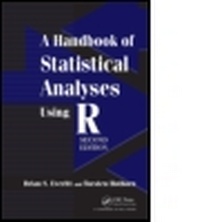
A Handbook of Statistical Analyses Using R, Second Edition
2nd Edition
Published on 22. July 2009
Book
Paperback/Softback
376 pages
978-1-4200-7933-3 (ISBN)
Description
A Proven Guide for Easily Using R to Effectively Analyze Data
Like its bestselling predecessor, A Handbook of Statistical Analyses Using R, Second Edition provides a guide to data analysis using the R system for statistical computing. Each chapter includes a brief account of the relevant statistical background, along with appropriate references.
New to the Second Edition
New chapters on graphical displays, generalized additive models, and simultaneous inference
A new section on generalized linear mixed models that completes the discussion on the analysis of longitudinal data where the response variable does not have a normal distribution
New examples and additional exercises in several chapters
A new version of the HSAUR package (HSAUR2), which is available from CRAN
This edition continues to offer straightforward descriptions of how to conduct a range of statistical analyses using R, from simple inference to recursive partitioning to cluster analysis. Focusing on how to use R and interpret the results, it provides students and researchers in many disciplines with a self-contained means of using R to analyze their data.
Like its bestselling predecessor, A Handbook of Statistical Analyses Using R, Second Edition provides a guide to data analysis using the R system for statistical computing. Each chapter includes a brief account of the relevant statistical background, along with appropriate references.
New to the Second Edition
New chapters on graphical displays, generalized additive models, and simultaneous inference
A new section on generalized linear mixed models that completes the discussion on the analysis of longitudinal data where the response variable does not have a normal distribution
New examples and additional exercises in several chapters
A new version of the HSAUR package (HSAUR2), which is available from CRAN
This edition continues to offer straightforward descriptions of how to conduct a range of statistical analyses using R, from simple inference to recursive partitioning to cluster analysis. Focusing on how to use R and interpret the results, it provides students and researchers in many disciplines with a self-contained means of using R to analyze their data.
Reviews / Votes
I find the book by Everitt and Hothorn quite pleasant and bound to fit its purpose. The layout and presentation [are] nice. It should appeal to all readers as it contains a wealth of information about the use of R for statistical analysis. Included seasoned R users: When reading the first chapters, I found myself scribbling small lightbulbs in the margin to point out features of R I was not aware of. In addition, the book is quite handy for a crash introduction to statistics for (well-enough motivated) nonstatisticians.-International Statistical Review (2011), 79
... an extensive selection of real data analyzed with [R] ... Viewed as a collection of worked examples, this book has much to recommend it. Each chapter addresses a specific technique. ... the examples provide a wide variety of partial analyses and the datasets cover a diversity of fields of study. ... This handbook is unusually free of the sort of errors spell checkers do not find. ...
-MAA Reviews, April 2011
Praise for the First Edition
...Brian Everitt has joined forces with a recognized expert who displays an impressive command of this powerful environment ... Much is to be learned in the small details that make this text interesting even for experienced users. ... Special attention is given to graphical methods ...
-Journal of Applied Statistics, May 2007
Useful examples are presented to assist understanding. ... Everitt and Hothorn have written an excellent tutorial on using R to analyze data using a wide range of standard statistical methods. ... I highly recommend the text for anyone learning R and who want to use it for the sophisticated analysis of data.
-Joseph M. Hilbe, Journal of Statistical Software, Vol. 16, August 2006
...a useful, compact introduction.
-Biometrics, December 2006
... This book, using analyses of real sets of data, takes the reader through many of the standard forms of statistical methodology using R. ... a very valuable reference. ...The book is particularly good at highlighting the graphical capabilities of the language. ...
-P. Marriott, ISI Short Book Reviews
More details
Edition
2nd New edition
Language
English
Place of publication
United Kingdom
Publishing group
Taylor & Francis Ltd
Target group
College/higher education
Edition type
New edition
Product notice
Paperback (UK-B)
Illustrations
135 s/w Abbildungen, 69 s/w Tabellen
200+; 69 Tables, black and white; 135 Illustrations, black and white
Dimensions
Height: 235 mm
Width: 156 mm
Weight
522 gr
ISBN-13
978-1-4200-7933-3 (9781420079333)
Copyright in bibliographic data and cover images is held by Nielsen Book Services Limited or by the publishers or by their respective licensors: all rights reserved.
Schweitzer Classification
Other editions
New editions
Torsten Hothorn | Brian S. Everitt
A Handbook of Statistical Analyses using R
Book
06/2014
3rd Edition
Chapman & Hall/CRC
€104.20
Article not available for order
Previous edition

Torsten Hothorn | Brian S. Everitt
A Handbook of Statistical Analyses Using R
Book
02/2006
1st Edition
CRC Press
€68.27
Article exhausted; check for reprint
Persons
Brian S. Everitt is Professor Emeritus at King's College, University of London.
Torsten Hothorn is Professor of Biostatistics in the Institut fuer Statistik at Ludwig-Maximilians-Universitaet Muenchen.
Torsten Hothorn is Professor of Biostatistics in the Institut fuer Statistik at Ludwig-Maximilians-Universitaet Muenchen.
Content
An Introduction to R
What Is R?
Installing R
Help and Documentation
Data Objects in R
Data Import and Export
Basic Data Manipulation
Computing with Data
Organizing an Analysis
Data Analysis Using Graphical Displays
Introduction
Initial Data Analysis
Analysis Using R
Simple Inference
Introduction
Statistical Tests
Analysis Using R
Conditional Inference
Introduction
Conditional Test Procedures
Analysis Using R
Analysis of Variance
Introduction
Analysis of Variance
Analysis Using R
Simple and Multiple Linear Regression
Introduction
Simple Linear Regression
Multiple Linear Regression
Analysis Using R
Logistic Regression and Generalized Linear Models
Introduction
Logistic Regression and Generalized Linear Models
Analysis Using R
Density Estimation
Introduction
Density Estimation
Analysis Using R
Recursive Partitioning
Introduction
Recursive Partitioning
Analysis Using R
Scatterplot Smoothers and Generalized Additive Models
Introduction
Scatterplot Smoothers and Generalized Additive Models
Analysis Using R
Survival Analysis
Introduction
Survival Analysis
Analysis Using R
Analyzing Longitudinal Data I
Introduction
Analyzing Longitudinal Data
Linear Mixed Effects Models
Analysis Using R
Prediction of Random Effects
The Problem of Dropouts
Analyzing Longitudinal Data II
Introduction
Methods for Nonnormal Distributions
Analysis Using R: GEE
Analysis Using R: Random Effects
Simultaneous Inference and Multiple Comparisons
Introduction
Simultaneous Inference and Multiple Comparisons
Analysis Using R
Meta-Analysis
Introduction
Systematic Reviews and Meta-Analysis
Statistics of Meta-Analysis
Analysis Using R
Meta-Regression
Publication Bias
Principal Component Analysis
Introduction
Principal Component Analysis
Analysis Using R
Multidimensional Scaling
Introduction
Multidimensional Scaling
Analysis Using R
Cluster Analysis
Introduction
Cluster Analysis
Analysis Using R
Bibliography
Index
A Summary appears at the end of each chapter.
What Is R?
Installing R
Help and Documentation
Data Objects in R
Data Import and Export
Basic Data Manipulation
Computing with Data
Organizing an Analysis
Data Analysis Using Graphical Displays
Introduction
Initial Data Analysis
Analysis Using R
Simple Inference
Introduction
Statistical Tests
Analysis Using R
Conditional Inference
Introduction
Conditional Test Procedures
Analysis Using R
Analysis of Variance
Introduction
Analysis of Variance
Analysis Using R
Simple and Multiple Linear Regression
Introduction
Simple Linear Regression
Multiple Linear Regression
Analysis Using R
Logistic Regression and Generalized Linear Models
Introduction
Logistic Regression and Generalized Linear Models
Analysis Using R
Density Estimation
Introduction
Density Estimation
Analysis Using R
Recursive Partitioning
Introduction
Recursive Partitioning
Analysis Using R
Scatterplot Smoothers and Generalized Additive Models
Introduction
Scatterplot Smoothers and Generalized Additive Models
Analysis Using R
Survival Analysis
Introduction
Survival Analysis
Analysis Using R
Analyzing Longitudinal Data I
Introduction
Analyzing Longitudinal Data
Linear Mixed Effects Models
Analysis Using R
Prediction of Random Effects
The Problem of Dropouts
Analyzing Longitudinal Data II
Introduction
Methods for Nonnormal Distributions
Analysis Using R: GEE
Analysis Using R: Random Effects
Simultaneous Inference and Multiple Comparisons
Introduction
Simultaneous Inference and Multiple Comparisons
Analysis Using R
Meta-Analysis
Introduction
Systematic Reviews and Meta-Analysis
Statistics of Meta-Analysis
Analysis Using R
Meta-Regression
Publication Bias
Principal Component Analysis
Introduction
Principal Component Analysis
Analysis Using R
Multidimensional Scaling
Introduction
Multidimensional Scaling
Analysis Using R
Cluster Analysis
Introduction
Cluster Analysis
Analysis Using R
Bibliography
Index
A Summary appears at the end of each chapter.