

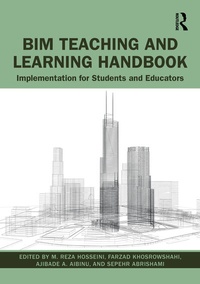
BIM Teaching and Learning Handbook
Implementation for Students and Educators
1st Edition
Published on 10. August 2021
Book
Hardback
354 pages
978-0-367-42795-5 (ISBN)
Description
This book is the essential guide to the pedagogical and industry-inspired considerations that must shape how BIM is taught and learned. It will help academics and professional educators to develop programmes that meet the competences required by professional bodies and prepare both graduates and existing practitioners to advance the industry towards higher efficiency and quality.
To date, systematic efforts to integrate pedagogical considerations into the way BIM is learned and taught remain non-existent. This book lays the foundation for forming a benchmark around which such an effort is made. It offers principles, best practices, and expected outcomes necessary to BIM curriculum and teaching development for construction-related programs across universities and professional training programmes. The aim of the book is to:
Highlight BIM skill requirements, threshold concepts, and dimensions for practice;
Showcase and introduce tried-and-tested practices and lessons learned in developing BIM-related curricula from leading educators;
Recognise and introduce the baseline requirements for BIM education from a pedagogical perspective;
Explore the challenges, as well as remedial solutions, pertaining to BIM education at tertiary education;
Form a comprehensive point of reference, covering the essential concepts of BIM, for students;
Promote and integrate pedagogical consideration into BIM education.
This book is essential reading for anyone involved in BIM education, digital construction, architecture, and engineering, and for professionals looking for guidance on what the industry expects when it comes to BIM competency.
To date, systematic efforts to integrate pedagogical considerations into the way BIM is learned and taught remain non-existent. This book lays the foundation for forming a benchmark around which such an effort is made. It offers principles, best practices, and expected outcomes necessary to BIM curriculum and teaching development for construction-related programs across universities and professional training programmes. The aim of the book is to:
Highlight BIM skill requirements, threshold concepts, and dimensions for practice;
Showcase and introduce tried-and-tested practices and lessons learned in developing BIM-related curricula from leading educators;
Recognise and introduce the baseline requirements for BIM education from a pedagogical perspective;
Explore the challenges, as well as remedial solutions, pertaining to BIM education at tertiary education;
Form a comprehensive point of reference, covering the essential concepts of BIM, for students;
Promote and integrate pedagogical consideration into BIM education.
This book is essential reading for anyone involved in BIM education, digital construction, architecture, and engineering, and for professionals looking for guidance on what the industry expects when it comes to BIM competency.
More details
Language
English
Place of publication
London
United Kingdom
Publishing group
Taylor & Francis Ltd
Target group
College/higher education
Professional and scholarly
Postgraduate, Professional, and Professional Practice & Development
Illustrations
19 s/w Abbildungen, 37 farbige Abbildungen, 3 s/w Photographien bzw. Rasterbilder, 20 Farbfotos bzw. farbige Rasterbilder, 16 s/w Zeichnungen, 17 farbige Zeichnungen, 21 s/w Tabellen, 1 farbige Tabelle
1 Tables, color; 21 Tables, black and white; 17 Line drawings, color; 16 Line drawings, black and white; 20 Halftones, color; 3 Halftones, black and white; 37 Illustrations, color; 19 Illustrations, black and white
Dimensions
Height: 246 mm
Width: 174 mm
Weight
980 gr
ISBN-13
978-0-367-42795-5 (9780367427955)
Copyright in bibliographic data and cover images is held by Nielsen Book Services Limited or by the publishers or by their respective licensors: all rights reserved.
Schweitzer Classification
Other editions
Additional editions
M. Reza Hosseini | Farzad Khosrowshahi | Ajibade Aibinu
BIM Teaching and Learning Handbook
Implementation for Students and Educators
Book
01/2024
1st Edition
Routledge
€64.00
Shipment within 10-20 days
M. Reza Hosseini | Farzad Khosrowshahi | Ajibade Aibinu
BIM Teaching and Learning Handbook
Implementation for Students and Educators
E-Book
08/2021
1st Edition
Routledge
€64.49
Available for download
M. Reza Hosseini | Farzad Khosrowshahi | Ajibade Aibinu
BIM Teaching and Learning Handbook
Implementation for Students and Educators
E-Book
08/2021
1st Edition
Routledge
€64.49
Available for download
Persons
M. Reza Hosseini is currently the associate head of school (research) at the School of Architecture and Built Environment, Deakin University; a research fellow of the Centre for Research in Assessment and Digital Learning (CRADLE); and the founder and leader of the Australian BIM Academic Forum (ABAF). He had 12 years of experience working in various areas of the construction industry prior to joining the academic world. His main research and teaching areas are building information modelling (BIM) and digital engineering, and he has written around 190 published papers and book chapters.
Farzad Khosrowshahi is dean of the College of Engineering and Science at Victoria University, Melbourne, and Fellow of the Chartered Institute of Building. He is the founder of the BIM Academic Forum, Information Visualisation Society, and Uniting Construction Information. Farzad has previously served as the director of Construct IT, chair of ARCOM (Association of Researchers in Construction Management), and chair of IV Society. He has served on a number of committees including The European Council for Construction Research, Development and Innovation, buildingSMART UK, and the Construction Industry Council Research & Innovation.
Ajibade A. Aibinu is an associate professor at the Faculty of Architecture, Building and Planning, The University of Melbourne, Australia, where he was the Assistant Dean, Research Training. His research interests cut across the built environment project and asset management, from design and construction to operations, particularly data-driven processes to ensure value for money. He is the founder of Intelligent Cost Manager, a cloud-based cost-management solution that leverages deep learning and predictive modelling to generate cost estimates with greater accuracy using historical data. Ajibade is a member of the Australian Institute of Quantity Surveyors and was previously an associate of the Chartered Institute of Arbitrators (2008-2013).
Sepehr Abrishami is a BIM programme leader and senior lecturer in the School of Civil Engineering and Surveying at the University of Portsmouth, UK. He has carried out extensive research in the field of BIM, automation in design and construction, and environmental design. His areas of expertise include building information modelling (BIM), generative and parametric evolutionary design, artificial intelligence (AI), digital design and construction, integrated design, design for manufacturing and assembly (DfMA), offsite manufacturing, Big Data, blockchain, Internet of Things (IoT), and IT integrated architectural design.
Farzad Khosrowshahi is dean of the College of Engineering and Science at Victoria University, Melbourne, and Fellow of the Chartered Institute of Building. He is the founder of the BIM Academic Forum, Information Visualisation Society, and Uniting Construction Information. Farzad has previously served as the director of Construct IT, chair of ARCOM (Association of Researchers in Construction Management), and chair of IV Society. He has served on a number of committees including The European Council for Construction Research, Development and Innovation, buildingSMART UK, and the Construction Industry Council Research & Innovation.
Ajibade A. Aibinu is an associate professor at the Faculty of Architecture, Building and Planning, The University of Melbourne, Australia, where he was the Assistant Dean, Research Training. His research interests cut across the built environment project and asset management, from design and construction to operations, particularly data-driven processes to ensure value for money. He is the founder of Intelligent Cost Manager, a cloud-based cost-management solution that leverages deep learning and predictive modelling to generate cost estimates with greater accuracy using historical data. Ajibade is a member of the Australian Institute of Quantity Surveyors and was previously an associate of the Chartered Institute of Arbitrators (2008-2013).
Sepehr Abrishami is a BIM programme leader and senior lecturer in the School of Civil Engineering and Surveying at the University of Portsmouth, UK. He has carried out extensive research in the field of BIM, automation in design and construction, and environmental design. His areas of expertise include building information modelling (BIM), generative and parametric evolutionary design, artificial intelligence (AI), digital design and construction, integrated design, design for manufacturing and assembly (DfMA), offsite manufacturing, Big Data, blockchain, Internet of Things (IoT), and IT integrated architectural design.
Content
SECTION 1: FOR STUDENTS AND TRAINEES
Section 1-1: Foundations and threshold concepts
1. Foundational concepts for BIM
Rafael Sacks and Ergo Pikas
2. BIM technologies, tools, and skills
Hamid Abdirad and Carrie Sturts Dossick
3. Understanding BIM to translate it into action
Cenk Budayan and Yusuf Arayici
4. Collaboration in BIM-based construction networks
Bimal Kumar and Benny Raphael
Section 1-2: BIM applications
5. Towards adopting 4D BIM in construction management curriculums: A teaching map
Faris Elghaish, Sepehr Abrishami, Salam Al-Bizri, Saeed Talebi, Sandra Matarneh, and Song Wu
6. Cost management-based BIM: Skills, implementation, and teaching map
Faris Elghaish, Saeed Talebi, and Song Wu
7. Building information modelling for facilities management: Skills, implementation, and teaching map
Sandra Matarneh and Faris Elghaish
8. BIM, sustainability and energy optimization
Zeynep Isik, Yusuf Arayici, Hande Aladag, Goekhan Demirdoegen, and Farzad Khosrowshahi
9. BIM for safety planning and management
Sambo Zulu, Allen Wan, Farzad Khosrowshahi, and Mark Swallow
Section 1-3: Advanced discussions
10. Understanding BIM information management processes through international BIM standards
Mohammad Alhusban
11. Scholarship of BIM and construction law: Myths, realities, and future directions
Oluwole Alfred Olatunji and Abiola Akanmu
12. Interoperability and emerging smart technologies
Goekhan Demirdoegen, Zeynep Isik, Yusuf Arayici, and Hande Aladag
13. BIM and ethics
Nicholas Nisbet
SECTION 2: FOR EDUCATORS AND TRAINERS
14. BIM teaching and learning frameworks in construction-related domains: What the literature says
Reza Taban, Mohsen Kalantari, and Elisa Lumantarna
15. Educating the "T-shaped" BIM professional: Lessons from academia
Igor Martek, Wei Wu, Mehran Oraee, and M. Reza Hosseini
16. Developing digerati leaders: Education beyond the building information modelling (BIM) ecosystem
Eleni Papadonikolaki
17. Incorporating collaborative problem solving (CPS) principles in BIM education
Abbas Mehrabi Boshrabadi, Mehran Oraee, Igor Martek, and M. Reza Hosseini
18. BIM education assessment: Guidelines for making it authentic
Abbas Mehrabi Boshrabadi, Mehran Oraee, Igor Martek, and M. Reza Hosseini
19. Using gamification and competitions to enhance BIM learning experience
Ajibade A. Aibinu, Teo Ai Lin Evelyn, Juan S. Rojas-Quintero, M. Reza Hosseini, Chiranjib Dey, Reza Taban, and Tayyab Ahmad
20. An Australian consolidated framework for BIM teaching and learning
Sas Mihindu and Professor Farzad Khosrowshahi
Section 1-1: Foundations and threshold concepts
1. Foundational concepts for BIM
Rafael Sacks and Ergo Pikas
2. BIM technologies, tools, and skills
Hamid Abdirad and Carrie Sturts Dossick
3. Understanding BIM to translate it into action
Cenk Budayan and Yusuf Arayici
4. Collaboration in BIM-based construction networks
Bimal Kumar and Benny Raphael
Section 1-2: BIM applications
5. Towards adopting 4D BIM in construction management curriculums: A teaching map
Faris Elghaish, Sepehr Abrishami, Salam Al-Bizri, Saeed Talebi, Sandra Matarneh, and Song Wu
6. Cost management-based BIM: Skills, implementation, and teaching map
Faris Elghaish, Saeed Talebi, and Song Wu
7. Building information modelling for facilities management: Skills, implementation, and teaching map
Sandra Matarneh and Faris Elghaish
8. BIM, sustainability and energy optimization
Zeynep Isik, Yusuf Arayici, Hande Aladag, Goekhan Demirdoegen, and Farzad Khosrowshahi
9. BIM for safety planning and management
Sambo Zulu, Allen Wan, Farzad Khosrowshahi, and Mark Swallow
Section 1-3: Advanced discussions
10. Understanding BIM information management processes through international BIM standards
Mohammad Alhusban
11. Scholarship of BIM and construction law: Myths, realities, and future directions
Oluwole Alfred Olatunji and Abiola Akanmu
12. Interoperability and emerging smart technologies
Goekhan Demirdoegen, Zeynep Isik, Yusuf Arayici, and Hande Aladag
13. BIM and ethics
Nicholas Nisbet
SECTION 2: FOR EDUCATORS AND TRAINERS
14. BIM teaching and learning frameworks in construction-related domains: What the literature says
Reza Taban, Mohsen Kalantari, and Elisa Lumantarna
15. Educating the "T-shaped" BIM professional: Lessons from academia
Igor Martek, Wei Wu, Mehran Oraee, and M. Reza Hosseini
16. Developing digerati leaders: Education beyond the building information modelling (BIM) ecosystem
Eleni Papadonikolaki
17. Incorporating collaborative problem solving (CPS) principles in BIM education
Abbas Mehrabi Boshrabadi, Mehran Oraee, Igor Martek, and M. Reza Hosseini
18. BIM education assessment: Guidelines for making it authentic
Abbas Mehrabi Boshrabadi, Mehran Oraee, Igor Martek, and M. Reza Hosseini
19. Using gamification and competitions to enhance BIM learning experience
Ajibade A. Aibinu, Teo Ai Lin Evelyn, Juan S. Rojas-Quintero, M. Reza Hosseini, Chiranjib Dey, Reza Taban, and Tayyab Ahmad
20. An Australian consolidated framework for BIM teaching and learning
Sas Mihindu and Professor Farzad Khosrowshahi