

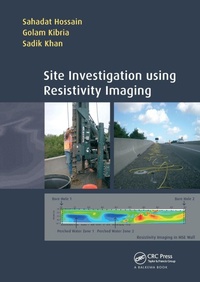
Site Investigation using Resistivity Imaging
1st Edition
Published on 30. June 2020
Book
Paperback/Softback
244 pages
978-0-367-57124-5 (ISBN)
Description
Subsurface investigation is the most important phase of any civil engineering construction or development activities. The geologic conditions can be extremely complex, variable, and subject to change with time; soil test borings and in-situ tests are employed to obtain subsoil information. Resistivity Imaging (RI) is a non-destructive, fast and cost-effective method of site investigation and soil characterization.
Site Investigation using Resistivity Imaging aims to summarize pertinent details of RI in site investigation for geotechnical and geo-environmental applications. It aims to bridge the gap that currently exists between the geotechnical/geo-environmental and geophysical engineering community. The geotechnical and geo-environmental engineers will be able to use annd understand geophysical data and utilize the information for their design.
Features:
First comprehensive handbook aimed at engineers that summarises pertinent details of Resitivity Imaging (RI) in site investigation for geotechnical and geo-environmental applications.
for geotechnical and geoenvironmental engineers, making it possible to interpret geophysical data and utilize the information for their design.
explanining the advantages of RI over conventional site investigations: continuous image, large coverage, low cost, quick and easy data processing.
It will be a comprehensive handbook for the application of RI in geotechnical and geo-environmental site investigations.
Site Investigation using Resistivity Imaging aims to summarize pertinent details of RI in site investigation for geotechnical and geo-environmental applications. It aims to bridge the gap that currently exists between the geotechnical/geo-environmental and geophysical engineering community. The geotechnical and geo-environmental engineers will be able to use annd understand geophysical data and utilize the information for their design.
Features:
First comprehensive handbook aimed at engineers that summarises pertinent details of Resitivity Imaging (RI) in site investigation for geotechnical and geo-environmental applications.
for geotechnical and geoenvironmental engineers, making it possible to interpret geophysical data and utilize the information for their design.
explanining the advantages of RI over conventional site investigations: continuous image, large coverage, low cost, quick and easy data processing.
It will be a comprehensive handbook for the application of RI in geotechnical and geo-environmental site investigations.
More details
Language
English
Place of publication
London
United Kingdom
Publishing group
Taylor & Francis Ltd
Target group
Professional and scholarly
College/higher education
Postgraduate, Professional, and Professional Practice & Development
Product notice
Paperback (trade)
Unsewn / adhesive bound
Dimensions
Height: 251 mm
Width: 175 mm
Thickness: 13 mm
Weight
567 gr
ISBN-13
978-0-367-57124-5 (9780367571245)
Copyright in bibliographic data and cover images is held by Nielsen Book Services Limited or by the publishers or by their respective licensors: all rights reserved.
Schweitzer Classification
Other editions
Additional editions
Sahadat Hossain | Golam Kibria | Sadik Khan
Site Investigation using Resistivity Imaging
Book
08/2018
1st Edition
CRC Press
€259.98
Shipment within 10-20 days
Sahadat Hossain | Golam Kibria | Sadik Khan
Site Investigation using Resistivity Imaging
E-Book
08/2018
CRC Press
€64.49
Available for download
Sahadat Hossain | Golam Kibria | Sadik Khan
Site Investigation using Resistivity Imaging
E-Book
08/2018
1st Edition
CRC Press
€64.49
Available for download
Persons
Sahadat Hossain, Golam Kibria, Sadik Khan
Content
1 Introduction
2 Background: electrical resistivity of geomaterials and measurement methods
3 Geotechnical properties affecting electrical resistivity
4 Electrical mixing models: bridging the gap between geophysical and geotechnical engineering
5 Electrical resistivity of municipal solid waste (MSW)
6 Case studies on the application of resistivity imaging
2 Background: electrical resistivity of geomaterials and measurement methods
3 Geotechnical properties affecting electrical resistivity
4 Electrical mixing models: bridging the gap between geophysical and geotechnical engineering
5 Electrical resistivity of municipal solid waste (MSW)
6 Case studies on the application of resistivity imaging