

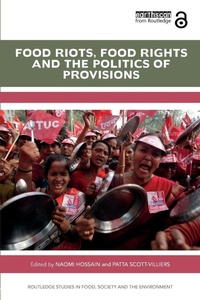
Food Riots, Food Rights and the Politics of Provisions
1st Edition
Published on 21. May 2019
Book
Paperback/Softback
198 pages
978-0-367-35215-8 (ISBN)
Description
Thousands of people in dozens of countries took to the streets when world food prices spiked in 2008 and 2011. What does the persistence of popular mobilization around food tell us about the politics of subsistence in an era of integrated food markets and universal human rights? This book interrogates this period of historical rupture in the global system of subsistence, getting behind the headlines and inside the politics of food for people on low incomes.
The half decade of 2007-2012 was a period of intensely volatile food prices as well as unusual levels of popular mobilization, including protests and riots. Detailed case studies are included here from Bangladesh, Cameroon, India, Kenya and Mozambique. The case studies illustrate that political cultures and ways of organizing around food share much across geography and history, indicating common characteristics of the popular politics of provisions under capitalism. However, all politics are ultimately local, and it is demonstrated how the historic fallout of a subsistence crisis depends ultimately on how the actors and institutions articulate, negotiate and reassert their specific claims within the peculiarities of each policy.
A key conclusion of the book is that the politics of provisions remain essential to the right to food and that they involve unruliness. In other words, food riots work. The book explains how and why they continue to do so even in the globalized food system of the 21st century. Food riots signal a state unable to meet a principal condition of its social contract, and create powerful pressure to address that most fundamental of failings.
.
The half decade of 2007-2012 was a period of intensely volatile food prices as well as unusual levels of popular mobilization, including protests and riots. Detailed case studies are included here from Bangladesh, Cameroon, India, Kenya and Mozambique. The case studies illustrate that political cultures and ways of organizing around food share much across geography and history, indicating common characteristics of the popular politics of provisions under capitalism. However, all politics are ultimately local, and it is demonstrated how the historic fallout of a subsistence crisis depends ultimately on how the actors and institutions articulate, negotiate and reassert their specific claims within the peculiarities of each policy.
A key conclusion of the book is that the politics of provisions remain essential to the right to food and that they involve unruliness. In other words, food riots work. The book explains how and why they continue to do so even in the globalized food system of the 21st century. Food riots signal a state unable to meet a principal condition of its social contract, and create powerful pressure to address that most fundamental of failings.
.
More details
Series
Language
English
Place of publication
London
United Kingdom
Publishing group
Taylor & Francis Ltd
Target group
College/higher education
Illustrations
18 s/w Abbildungen
18 Illustrations, black and white
Dimensions
Height: 234 mm
Width: 156 mm
Weight
400 gr
ISBN-13
978-0-367-35215-8 (9780367352158)
Copyright in bibliographic data and cover images is held by Nielsen Book Services Limited or by the publishers or by their respective licensors: all rights reserved.
Schweitzer Classification
Other editions
Additional editions
Naomi Hossain | Patta Scott-Villiers
Food Riots, Food Rights and the Politics of Provisions
E-Book
09/2017
Routledge
€0.00
Available for download
Naomi Hossain | Patta Scott-Villiers
Food Riots, Food Rights and the Politics of Provisions
E-Book
09/2017
Routledge
€0.00
Available for download
Naomi Hossain | Patta Scott-Villiers
Food Riots, Food Rights and the Politics of Provisions
Book
09/2017
1st Edition
Routledge
€191.50
Shipment within 10-20 days
Persons
Naomi Hossain is a political sociologist at the Institute of Development Studies at the University of Sussex, UK. Her most recent book is The Aid Lab: Understanding Bangladesh's Unexpected Success (Oxford University Press, 2017).
Patta Scott-Villiers is a political sociologist and convenes the Power and Popular Politics Cluster at the Institute of Development Studies at the University of Sussex, UK. She is lead author of Precarious Lives: Food Work and Care after the Global Food Crisis (Institute of Development Studies, 2016).
Patta Scott-Villiers is a political sociologist and convenes the Power and Popular Politics Cluster at the Institute of Development Studies at the University of Sussex, UK. She is lead author of Precarious Lives: Food Work and Care after the Global Food Crisis (Institute of Development Studies, 2016).
Content
1. Introduction 2. A World In Protest 3. Framing 'food riots': subsistence protests in international and national media, 2007-12 4. Food riots in Bangladesh? Garments worker protests and globalized subsistence crises 5. "We eat what we have, not what we want": The policy effects of food riots and eating after the 2008 crisis in Cameroon 6. Demanding accountability for hunger in India 7. The Constitution Lies to Us! Food Protests in Kenya 2008-2013 8. Authoritarian responsiveness and the greve in Mozambique 9. How 'food riots' work, and what they mean for development