

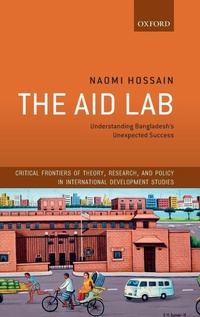
The Aid Lab
Understanding Bangladesh's Unexpected Success
Published on 23. February 2017
Book
Hardback
262 pages
978-0-19-878550-7 (ISBN)
Description
From an unpromising start as 'the basket-case' to present day plaudits for its human development achievements, Bangladesh plays an ideological role in the contemporary world order, offering proof that the neo-liberal development model works under the most testing conditions. How were such rapid gains possible in a context of chronically weak governance? The Aid Lab subjects this so-called 'Bangladesh paradox' to close scrutiny, evaluating public policies and their outcomes for poverty and development since Bangladesh's independence in 1971. Countering received wisdom that its gains owe to an early shift to market-oriented economic reform, it argues that a binding political settlement, a social contract to protect against the crises of subsistence and survival, united the elite, the masses, and their aid donors in the wake of the devastating famine of 1974. This laid resilient foundations for human development, fostering a focus on the poorest and most precarious, and in particular on the concerns of women.
In chapters examining the environmental, political and socioeconomic crisis of the 1970s, the book shows how the lessons of the famine led to a robustly pro-poor growth and social policy agenda, empowering the Bangladeshi state and its non-governmental organizations to protect and enable its population to thrive in its engagements in the global economy. Now a middle-income country, Bangladesh's role as the world's laboratory for aided development has generated lessons well beyond its borders, and Bangladesh continues to carve a pioneering pathway through the risks of global economic integration and climate change.
In chapters examining the environmental, political and socioeconomic crisis of the 1970s, the book shows how the lessons of the famine led to a robustly pro-poor growth and social policy agenda, empowering the Bangladeshi state and its non-governmental organizations to protect and enable its population to thrive in its engagements in the global economy. Now a middle-income country, Bangladesh's role as the world's laboratory for aided development has generated lessons well beyond its borders, and Bangladesh continues to carve a pioneering pathway through the risks of global economic integration and climate change.
Reviews / Votes
An excellent new book * Duncan Green, Strategic Adviser for Oxfam GB and author of How Change Happens *More details
Series
Language
English
Place of publication
Oxford
United Kingdom
Target group
College/higher education
Professional and scholarly
Illustrations
11 Figures, 3 Tables
Dimensions
Height: 240 mm
Width: 161 mm
Thickness: 19 mm
Weight
561 gr
ISBN-13
978-0-19-878550-7 (9780198785507)
Copyright in bibliographic data and cover images is held by Nielsen Book Services Limited or by the publishers or by their respective licensors: all rights reserved.
Schweitzer Classification
Other editions
Additional editions
E-Book
02/2017
1st Edition
OUP eBook
€72.49
Available for download
E-Book
02/2017
1st Edition
OUP eBook
€72.49
Available for download
Person
Naomi Hossain is a Research Fellow at the Institute of Development Studies (IDS) at the University of Sussex. She previously worked at BRAC's Research and Evaluation Division in Bangladesh, and led on BRAC University's first State of Governance in Bangladesh report in 2006. She now focuses on the popular politics of subsistence crises around the world, leading major studies on food riots and on everyday life in a time of food price volatility. She is the author of Elite Perceptions of Poverty in Bangladesh (2005; Dhaka: University Press Limited).
Content
PART 1: THE PARADOX; PART 2: THE BASKET CASE; PART 3: THE TEST CASE FOR DEVELOPMENT; PART 4: THE BENGAL TIGER