

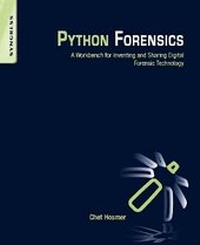
Python Forensics
A Workbench for Inventing and Sharing Digital Forensic Technology
Published on 9. June 2014
Book
Paperback/Softback
352 pages
978-0-12-418676-7 (ISBN)
Description
Python Forensics provides many never-before-published proven forensic modules, libraries, and solutions that can be used right out of the box. In addition, detailed instruction and documentation provided with the code samples will allow even novice Python programmers to add their own unique twists or use the models presented to build new solutions.
Rapid development of new cybercrime investigation tools is an essential ingredient in virtually every case and environment. Whether you are performing post-mortem investigation, executing live triage, extracting evidence from mobile devices or cloud services, or you are collecting and processing evidence from a network, Python forensic implementations can fill in the gaps.
Drawing upon years of practical experience and using numerous examples and illustrative code samples, author Chet Hosmer discusses how to:
Develop new forensic solutions independent of large vendor software release schedules
Participate in an open-source workbench that facilitates direct involvement in the design and implementation of new methods that augment or replace existing tools
Advance your career by creating new solutions along with the construction of cutting-edge automation solutions to solve old problems
Rapid development of new cybercrime investigation tools is an essential ingredient in virtually every case and environment. Whether you are performing post-mortem investigation, executing live triage, extracting evidence from mobile devices or cloud services, or you are collecting and processing evidence from a network, Python forensic implementations can fill in the gaps.
Drawing upon years of practical experience and using numerous examples and illustrative code samples, author Chet Hosmer discusses how to:
Develop new forensic solutions independent of large vendor software release schedules
Participate in an open-source workbench that facilitates direct involvement in the design and implementation of new methods that augment or replace existing tools
Advance your career by creating new solutions along with the construction of cutting-edge automation solutions to solve old problems
Reviews / Votes
"Covering a panoply of techniques from search to network forensics, reading this book will expand the reader's understanding of both forensics and the Python libraries." --Computing Reviews, December 2014"Overall, the book is well laid out. The first few chapters cover some important forensic challenges. The code is easy to follow and well commented." --Help Net Security, December 2014
More details
Language
English
Place of publication
Rockland, MA
United States
Target group
Professional and scholarly
Cybercrime and digital forensic investigators, forensic analysts, software developers, e-discovery researchers, security managers. Secondary audience post graduate and undergraduate students.
Dimensions
Height: 235 mm
Width: 191 mm
Weight
730 gr
ISBN-13
978-0-12-418676-7 (9780124186767)
Copyright in bibliographic data and cover images is held by Nielsen Book Services Limited or by the publishers or by their respective licensors: all rights reserved.
Schweitzer Classification
Other editions
New editions
Book
11/2024
2nd Edition
Syngress
€90.31
Shipment within 15-20 days
Additional editions
E-Book
05/2014
Syngress
€52.95
Available for download
Person
Chet Hosmer serves as an Assistant Professor of Practice at the University of Arizona in the Cyber Operations program, where he is teaching and researching the application of Python and Machine Learning to advanced cybersecurity challenges. Chet is also the founder of Python Forensics, Inc. a non-profit organization focused on the collaborative development of open-source investigative technologies using Python and other popular scripting languages. Chet has made numerous appearances to discuss emerging cyber threats including NPR, ABC News, Forbes, IEEE, The New York Times, The Washington Post, Government Computer News, Salon.com, and Wired Magazine. He has 7 published books with Elsevier and Apress that focus on data hiding, passive network defense strategies, Python Forensics, PowerShell, and IoT.
Content
1. Why Python Forensics
2. creating a Python Forensics Workbench
3. Let's Write Our First Python Forensics App
4. Effective Forensic Searching and Indexing using Python
5. Evidence Carving with Python
6. Timeline Evidence with Python
7. Natural Language Processing of Evidence using Python
8. Examining Mobile Device Evidence with Python
9. Log File Analysis
10. Python Scripts for Network Investigation
11. Investigating the Cloud
12. Future Expansion
2. creating a Python Forensics Workbench
3. Let's Write Our First Python Forensics App
4. Effective Forensic Searching and Indexing using Python
5. Evidence Carving with Python
6. Timeline Evidence with Python
7. Natural Language Processing of Evidence using Python
8. Examining Mobile Device Evidence with Python
9. Log File Analysis
10. Python Scripts for Network Investigation
11. Investigating the Cloud
12. Future Expansion