

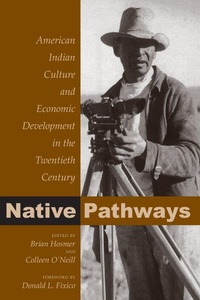
Native Pathways
American Indian Culture and Economic Development in the Twentieth Century
Published on 15. November 2004
Book
Paperback/Softback
368 pages
978-0-87081-775-5 (ISBN)
Description
How has American Indians' participation in the broader market - as managers of casinos, negotiators of oil leases, or commercial fishermen - challenged the U.S. paradigm of economic development? Have American Indians paid a cultural price for the chance at a paycheck? How have gender and race shaped their experiences in the marketplace? Contributors to Native Pathways ponder these and other questions, highlighting how indigenous peoples have simultaneously adopted capitalist strategies and altered them to suit their own distinct cultural beliefs and practices. Including contributions from historians, anthropologists, and sociologists, Native Pathways offers fresh viewpoints on economic change and cultural identity in twentieth-century Native American communities. Foreword by Donald L. Fixico.
Reviews / Votes
"Federal policy makers and 'development' experts have steadfastly insisted that Native American cultural assimilation follows from heavy-handed manipulation of the tribes' economic bases. And Native cultures have in fact adjusted. But they have not assimilated. Brian Hosmer and Colleen O'Neill have edited an important collection of essays that examines this dynamic. The book's major theme is that imposed (and voluntary) economic changes often have strengthened, not erased, Native cultural identity. An important contributing factor to this result is a second theme: Natives have integrated work and economic development with other components of their own distinctive world views such as kinship and spirituality. . . . This anthology is clearly important for scholars of Native American life. Beyond that, it should be required reading for any nonacademics involved in Native 'development' and its policy infrastructure."-The Journal of American History "[An] excellent edited volume about economic development and modernization in Native American societies during the twentieth century. This book is clearly important for providing a panoply of examples of how the dualisms in these theories fail to describe historical changes in Native American communities. . . . insightful and well-argued case studies defy the old dualistic assumptions and help move the larger theoretical discussion along. . . . I highly recommend this volume for both undergraduate and graduate classes in anthropology, Native American studies, and history, but also in sociology and political science."
-Journal of Anthropological Research "An important, indeed pivotal, work, which brings together Native American culture and economic theory. It should be of interest to students of Indian history and cultures as well as economists, development specialists, tribal leaders, and the business community."
-Rennard Strickland, University of Oregon
More details
Language
English
Place of publication
Colorado
United States
Target group
College/higher education
Interest Age: From 18 to 99 years
Product notice
Paperback (trade)
Unsewn / adhesive bound
Dimensions
Height: 230 mm
Width: 153 mm
Thickness: 19 mm
Weight
494 gr
ISBN-13
978-0-87081-775-5 (9780870817755)
Copyright in bibliographic data and cover images is held by Nielsen Book Services Limited or by the publishers or by their respective licensors: all rights reserved.
Schweitzer Classification
Other editions
Additional editions
Hosmer Brian Hosmer | O'Neill Colleen O'Neill
Native Pathways
American Indian Culture and Economic Development in the Twentieth Century
E-Book
11/2004
University Press of Colorado
€35.49
Available for download
Persons
Brian Hosmer is associate professor of history and American Indian studies at the University of Illinois at Chicago and director of The Newberry Library's D'Arcy McNickle Center for American Indian History. Colleen O'Neill is associate professor of history at Utah State University and associate editor of Western Historical Quarterly.
Content
CONTENTS Foreword Donald L. Fixico Acknowledgements 1. Rethinking Modernity and the Discourse of Development in American Indian History, an Introduction Colleen O'Neill Part I: Commerce and Incorporation 2. Searching for Salvation and Sovereignty: The Cultural Economy of Blackfeet Oil Leasing, 1914-1955 Paul C. Rosier 3. The Comanche-Kiowa Business Council of the Early 1900s David LaVere 4. Casino Roots: The Cultural Production of Twentieth-Century Seminole Economic Development Jessica R. Cattelino 5. The Dawning of a New Day? Notes on Indian Gaming in Southern California Nicolas G. Rosenthal 6. The Devil's in the Details: Tracing the Fingerprints of Free Trade and its Effects on Navajo Weavers Kathy M'Closkey Part II: Wage Work "All we needed was our gardens": Women's work and welfare reform in the reservation economy Tressa Berman 7. Work and Culture in Southeastern Alaska: Tlingit Indians and the Industrial Fisheries, 1880-1940 David Arnold 8. Five Dollars a Week to Be a 'Regular Indian': Shows, Exhibitions, and the Economics of Indian Dancing, 1880-1930 Clyde Ellis 9. Land, Labor and Leadership: The Political Economy of Hualapai Community Building, 1910-1940 Jeffrey P. Shepherd 10. Working for Identity: Race, Ethnicity and the Market Economy in Northern California, 1875-1936 William Bauer Part III: Methodology and Theoretical Implications 11. Local Knowledge as Traditional Ecological Knowledge: Definition and Ownership Chris Paci and Lisa Krebs 12. Work Relief on the Wind River Indian Reservation: An Exploration into Cultural Identity, Social Memory, and Economic Change Brian Hosmer 13. Tribal Capitalism and Native Capitalists: Multiple Pathways of Native Economy Duane Champagne 14. Conclusion Brian Hosmer and Colleen O'Neill Contributors Index