

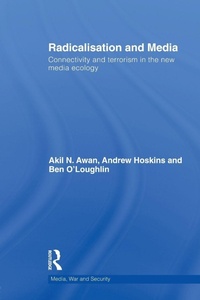
Radicalisation and Media
Connectivity and Terrorism in the New Media Ecology
1st Edition
Published on 23. July 2012
Book
Paperback/Softback
162 pages
978-0-415-64199-9 (ISBN)
Description
This book examines the circulation and effects of radical discourse by analysing the role of mass media coverage in promoting or hindering radicalisation and acts of political violence.
There is a new environment of conflict in the post-9/11 age, in which there appears to be emerging threats to security and stability in the shape of individuals and groups holding or espousing radical views about religion, ideology, often represented in the media as oppositional to Western values. This book asks what, if anything is new about these radicalising discourses, how and why they relate to political acts of violence and terror, and what the role of the mass media is in promoting or hindering them.
This includes exploring how the acts themselves and explanations for them on the web are picked up and represented in mainstream television news media or Big Media, through the journalistic and editorial uses of words, phrases, graphics, images, and videos. It analyses how interpretations of the term 'radicalisation' are shaped by news representations through investigating audience responses, understandings and misunderstandings. Transnational in scope, this book seeks to contribute to an understanding of the connectivity and relationships that make up the new media ecology, especially those that appear to transcend the local and the global, accelerate the dissemination of radicalising discourses, and amplify media/public fears of political violence.
This book will be of interest to students of security studies, media studies, terrorism studies, political science and sociology.
There is a new environment of conflict in the post-9/11 age, in which there appears to be emerging threats to security and stability in the shape of individuals and groups holding or espousing radical views about religion, ideology, often represented in the media as oppositional to Western values. This book asks what, if anything is new about these radicalising discourses, how and why they relate to political acts of violence and terror, and what the role of the mass media is in promoting or hindering them.
This includes exploring how the acts themselves and explanations for them on the web are picked up and represented in mainstream television news media or Big Media, through the journalistic and editorial uses of words, phrases, graphics, images, and videos. It analyses how interpretations of the term 'radicalisation' are shaped by news representations through investigating audience responses, understandings and misunderstandings. Transnational in scope, this book seeks to contribute to an understanding of the connectivity and relationships that make up the new media ecology, especially those that appear to transcend the local and the global, accelerate the dissemination of radicalising discourses, and amplify media/public fears of political violence.
This book will be of interest to students of security studies, media studies, terrorism studies, political science and sociology.
Reviews / Votes
'Given the extensive scope of the authors' research and their clear and insightful analysus of the content and discourses of radicalization across media platforms, Radicalisation and Media: connectivity and terrorism in the new media ecology is a must read for scholars, security policy makers and general readers who will each find something to learn from, something to think about and something to be a little more 'uncertain' about.' - Hiba Ghanem, Journal of International Relations Research, Violence and Terrorism, Issue 1, January 2012'...this is a first-rate book that furthers in significant ways our understanding of the interconnectivity between old-timers and newcomers in the new media/communication ecology and how these linkages influence the information that influences how citizens think about radicalisation and the threat of terrorist violence. While recommended for those involved in the study of terrorism, counterterrorism, media and communication, the volume is equally informative for those working in the media and public officials who deal with the causes and consequences of radicalisation.' Critical Studies on Terrorism, 4 (3)
More details
Series
Language
English
Place of publication
London
United Kingdom
Publishing group
Taylor & Francis Ltd
Target group
College/higher education
Professional and scholarly
Dimensions
Height: 234 mm
Width: 156 mm
Thickness: 9 mm
Weight
266 gr
ISBN-13
978-0-415-64199-9 (9780415641999)
Copyright in bibliographic data and cover images is held by Nielsen Book Services Limited or by the publishers or by their respective licensors: all rights reserved.
Schweitzer Classification
Other editions
Additional editions
Andrew Hoskins | Akil Awan | Ben O'Loughlin
Radicalisation and Media
Connectivity and Terrorism in the New Media Ecology
E-Book
02/2011
Routledge
€72.49
Available for download
Andrew Hoskins | Akil Awan | Ben O'Loughlin
Radicalisation and Media
Connectivity and Terrorism in the New Media Ecology
E-Book
02/2011
Routledge
€72.49
Available for download
Andrew Hoskins | Akil Awan | Ben O'Loughlin
Radicalisation and Media
Connectivity and Terrorism in the New Media Ecology
Book
02/2011
1st Edition
Routledge
€231.20
Shipment within 15-20 days
Persons
Akil N. Awan is a Lecturer in Contemporary Islam and the current RCUK Fellow in the 'Contemporary History of Faith, Power and Terror' in the Departments of History at Royal Holloway, University of London.
Andrew Hoskins is Interdisciplinary Research Professor of Global Security in the College of Social Sciences at the University of Glasgow.
Ben O'Loughlin is Reader in International Relations at Royal Holloway University of London and Associate Director of the New Political Communication Unit.
Andrew Hoskins is Interdisciplinary Research Professor of Global Security in the College of Social Sciences at the University of Glasgow.
Ben O'Loughlin is Reader in International Relations at Royal Holloway University of London and Associate Director of the New Political Communication Unit.
Content
1. Media and Radicalization: Grappling Uncertainties in the New Media Ecology 2. Legitimising Jihadist ideology 3. Media Jihad 4. Media Events: Televisual Connections 2004-2006 5. The Mainstream Nexus of Radicalization: The 2008-09 Gaza Conflict 6. Audience Uncertainties: Imagining the Mainstream and Extremes 7. Conclusion: The New Media Ecology Model