

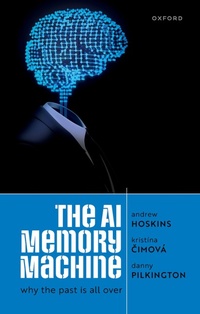
The AI Memory Machine
Why the past is all over
Will be published approx. on 8. October 2026
Book
Hardback
192 pages
978-0-19-899590-6 (ISBN)
Description
The AI Memory Machine tells the story of the forces and consequences of the twenty-first century's AI machinic revolution of memory.
Generative AI has turbocharged the technologies of memory to find, capture, and mine the individual as the pre-eminent commodity of this age. It is a paradoxical set of social and technological conditions for memory, guided by the framework of capitalism. Your past is already digitally marketed and exploited, with every message, like, and swipe accumulating a life already shared, traceable, hackable, saleable, and memorable.
This new AI industry of memory determines who controls the memory machine, through the apps, platforms, devices, and services, which enable our capturing, sharing, and re-generation of data and information about ourselves and experiences. This work tackles these machinic and human transformations through engaging in interdisciplinary sociological and human science approaches to memory studies. Drawing on interviews with experts in the industry of memory, it shows how memory technologies and wider algorithmic processes of data, duplicate, displace, and substitute for the once human.
As the AI Memory Machine messes with the cognitive and social forces and boundaries of remembering, is the past already all over? Or does it give new hope in the revelatory potential of what can now be found and seen anew?
Generative AI has turbocharged the technologies of memory to find, capture, and mine the individual as the pre-eminent commodity of this age. It is a paradoxical set of social and technological conditions for memory, guided by the framework of capitalism. Your past is already digitally marketed and exploited, with every message, like, and swipe accumulating a life already shared, traceable, hackable, saleable, and memorable.
This new AI industry of memory determines who controls the memory machine, through the apps, platforms, devices, and services, which enable our capturing, sharing, and re-generation of data and information about ourselves and experiences. This work tackles these machinic and human transformations through engaging in interdisciplinary sociological and human science approaches to memory studies. Drawing on interviews with experts in the industry of memory, it shows how memory technologies and wider algorithmic processes of data, duplicate, displace, and substitute for the once human.
As the AI Memory Machine messes with the cognitive and social forces and boundaries of remembering, is the past already all over? Or does it give new hope in the revelatory potential of what can now be found and seen anew?
More details
Language
English
Place of publication
Oxford
United Kingdom
Dimensions
Height: 216 mm
Width: 138 mm
ISBN-13
978-0-19-899590-6 (9780198995906)
Copyright in bibliographic data and cover images is held by Nielsen Book Services Limited or by the publishers or by their respective licensors: all rights reserved.
Schweitzer Classification
Persons
Andrew Hoskins is Professor of AI, Memory & War at the University of Edinburgh. His research focuses on digital participation in war, AI, media and memory, and digital anonymity. He leads the ERC advanced grant/UKRI-funded project WARSHARE: The New War Front: Digital Participation in War (2025^-^30), focusing on the Russian war against Ukraine. He is founding Co-Editor-in-Chief of Memory, Mind & Media, and founding Editor-in-Chief of Memory Studies. His articles include AI and memory, AI and collective memory, and Fall of Living Memory.
Kristina Cimova was a Postgraduate Research Associate and a Graduate Teaching Assistant for Central and Eastern European Studies at the University of Glasgow. She has since moved to geopolitical intelligence analysis and business resilience testing in the private sector. Her PhD focused on a discussion of corruption in real-life transactions in Central Europe, addressing the role played by collective memory in the understanding and taxonomy of corrupt acts in everyday contexts. She then completed several postdoctoral research roles, including a project with Prof. Hoskins, focusing on the role played by the digital in generating, curating, and retaining memories.
Danny Pilkington is a Postgraduate Researcher and a Graduate Teaching Assistant in Sociology at the University of Glasgow. His PhD focuses on ideology, hegemony, and British media coverage of twenty-first century Latin American politics. He has separately published work on the relationship between capitalism, AI, and memory. Danny teaches across a range of topics in the Media, Culture & Society subject group at the University of Glasgow and is a Research Assistant on different projects exploring the role of the media in elections.
Kristina Cimova was a Postgraduate Research Associate and a Graduate Teaching Assistant for Central and Eastern European Studies at the University of Glasgow. She has since moved to geopolitical intelligence analysis and business resilience testing in the private sector. Her PhD focused on a discussion of corruption in real-life transactions in Central Europe, addressing the role played by collective memory in the understanding and taxonomy of corrupt acts in everyday contexts. She then completed several postdoctoral research roles, including a project with Prof. Hoskins, focusing on the role played by the digital in generating, curating, and retaining memories.
Danny Pilkington is a Postgraduate Researcher and a Graduate Teaching Assistant in Sociology at the University of Glasgow. His PhD focuses on ideology, hegemony, and British media coverage of twenty-first century Latin American politics. He has separately published work on the relationship between capitalism, AI, and memory. Danny teaches across a range of topics in the Media, Culture & Society subject group at the University of Glasgow and is a Research Assistant on different projects exploring the role of the media in elections.