

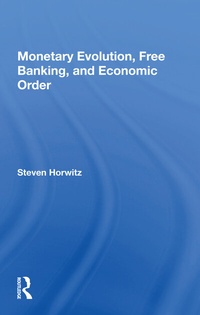
Monetary Evolution, Free Banking, And Economic Order
1st Edition
Published on 7. December 2020
Book
Paperback/Softback
228 pages
978-0-367-15774-6 (ISBN)
Description
This book emphasizes the role of money and banking in the promotion of economic order. It argues that an appreciation of the spontaneous evolutionary processes that produce and maintain monetary institutions should make skeptical of attempts to plan or regulate the production of money.
More details
Language
English
Place of publication
London
United Kingdom
Publishing group
Taylor & Francis Ltd
Target group
College/higher education
Dimensions
Height: 222 mm
Width: 148 mm
Weight
450 gr
ISBN-13
978-0-367-15774-6 (9780367157746)
Copyright in bibliographic data and cover images is held by Nielsen Book Services Limited or by the publishers or by their respective licensors: all rights reserved.
Schweitzer Classification
Other editions
Additional editions
Steven Horwitz
Monetary Evolution, Free Banking, And Economic Order
Book
06/2019
1st Edition
Routledge
€167.13
Shipment within 15-20 days
Steven Horwitz
Monetary Evolution, Free Banking, And Economic Order
E-Book
06/2019
1st Edition
Routledge
€59.49
Available for download
Steven Horwitz
Monetary Evolution, Free Banking, And Economic Order
E-Book
06/2019
1st Edition
Routledge
€59.49
Available for download
Person
Steven Horwitz is assistant professor of economics and Dana Fellow at St. Lawrence University, Canton, New York. He is the author of numerous articles on monetary economics and the Austrian School. His research has appeared in Review of Social Economy, Southern Economic Journal , and Critical Review . He is also a contributing editor of Critical Review and an academic advisor to the Heartland Institute.
Content
0. Introduction 1. Problems with Formal Models of Monetary Exchange 2. Rules, Institutions, and the Evolution of Economic Order 3. Money as the Language of the Market Process 4. The Evolution of Monetary Order 5. Regulatory Chaos and Spontaneous Order Under the National Banking System 6. Conclusion: Money in a Nonrationalist Approach to Economic Systems