

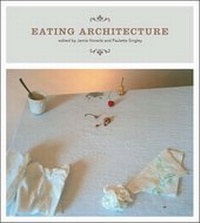
Eating Architecture
Published on 21. May 2004
Book
Hardback
380 pages
978-0-262-08322-5 (ISBN)
Description
The contributors to this highly original collection of essays explore the
relationship between food and architecture, asking what can be learned by examining the (often
metaphorical) intersection of the preparation of meals and the production of space. In a culture
that includes the Food Channel and the knife-juggling chefs of Benihana, food has become not only an
obsession but an alternative art form. The nineteen essays and "Gallery of Recipes" in Eating
Architecture seize this moment to investigate how art and architecture engage issues of identity,
ideology, conviviality, memory, and loss that cookery evokes. This is a book for all those who opt
for the "combination platter" of cultural inquiry as well as for the readers of M. F. K. Fisher and
Ruth Reichl.The essays are organized into four sections that lead the reader from the landscape to
the kitchen, the table, and finally the mouth. The essays in "Place Settings" examine the
relationships between food and location that arise in culinary colonialism and the global economy of
tourism. "Philosophy in the Kitchen" traces the routines that create a site for aesthetic
experimentation, including an examination of gingerbread houses as art, food, and architectural
space. The essays in "Table Rules" consider the spatial and performative aspects of eating and the
ways in which shared meals are among the most perishable and preserved cultural artifacts. Finally,
"Embodied Taste" considers the sensual apprehension of food and what it means to consume a work of
art. The "Gallery of Recipes" contains images by contemporary architects on the subject of eating
architecture.
relationship between food and architecture, asking what can be learned by examining the (often
metaphorical) intersection of the preparation of meals and the production of space. In a culture
that includes the Food Channel and the knife-juggling chefs of Benihana, food has become not only an
obsession but an alternative art form. The nineteen essays and "Gallery of Recipes" in Eating
Architecture seize this moment to investigate how art and architecture engage issues of identity,
ideology, conviviality, memory, and loss that cookery evokes. This is a book for all those who opt
for the "combination platter" of cultural inquiry as well as for the readers of M. F. K. Fisher and
Ruth Reichl.The essays are organized into four sections that lead the reader from the landscape to
the kitchen, the table, and finally the mouth. The essays in "Place Settings" examine the
relationships between food and location that arise in culinary colonialism and the global economy of
tourism. "Philosophy in the Kitchen" traces the routines that create a site for aesthetic
experimentation, including an examination of gingerbread houses as art, food, and architectural
space. The essays in "Table Rules" consider the spatial and performative aspects of eating and the
ways in which shared meals are among the most perishable and preserved cultural artifacts. Finally,
"Embodied Taste" considers the sensual apprehension of food and what it means to consume a work of
art. The "Gallery of Recipes" contains images by contemporary architects on the subject of eating
architecture.
More details
Language
English
Place of publication
Cambridge, Mass.
United States
Publishing group
MIT Press Ltd
Target group
Professional and scholarly
US School Grade: College Graduate Student and over
Illustrations
47 farbige Bildtafeln, 83 s/w Abbildungen
83 b&w illus., 47 color plates
Dimensions
Height: 229 mm
Width: 203 mm
Thickness: 0 mm
Weight
907 gr
ISBN-13
978-0-262-08322-5 (9780262083225)
Copyright in bibliographic data and cover images is held by Nielsen Book Services Limited or by the publishers or by their respective licensors: all rights reserved.
Schweitzer Classification
Persons
Paulette Singley is Associate Professor of Architecture at Woodbury University and in the Department of Arts and Sciences at Art Center College of Design.
Yoshinori Amagai received an M.A. from the GraduateSchool of Art and Design, the University of Tsykuba,Japan. He is currently teaching and researching JapaneseArt and Design History at Akita city College of Arts andCrafts in Japan.
Jamie Horwitz is Associate Professor of Architecture at Iowa State University.
Yoshinori Amagai received an M.A. from the GraduateSchool of Art and Design, the University of Tsykuba,Japan. He is currently teaching and researching JapaneseArt and Design History at Akita city College of Arts andCrafts in Japan.
Jamie Horwitz is Associate Professor of Architecture at Iowa State University.