

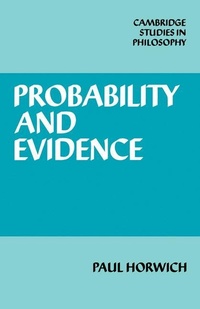
Probability and Evidence
Published on 16. June 2011
Book
Paperback/Softback
158 pages
978-0-521-28336-6 (ISBN)
Description
In this volume, which was originally published in 1982, Paul Horwich presents a clear and unified approach to a number of problems in the philosophy of science. He diagnoses the failure of other attempts to resolve them as stemming from a too-rigid, all-or-nothing conception of belief, and adopts instead a Bayesian strategy, emphasising the degree of confidence to which we are entitled the light of scientific evidence. This probabilistic approach, he argues, yields a more complete understanding of the assumptions and procedures characteristic of scientific reasoning. It also accounts for the merits of simplicity, severe tests and surprising predictions, and provides a way in which the dispute between the realist and instrumentalist views of science might be resolved. The result is a crisp, well-focused contribution to the philosophy of science. The elaboration of an important conception of probability will stimulate anyone with an interest in the field.
More details
Series
Language
English
Place of publication
Cambridge
United Kingdom
Target group
Professional and scholarly
Product notice
Paperback (trade)
Illustrations
Worked examples or Exercises
Dimensions
Height: 216 mm
Width: 140 mm
Thickness: 9 mm
Weight
208 gr
ISBN-13
978-0-521-28336-6 (9780521283366)
Copyright in bibliographic data and cover images is held by Nielsen Book Services Limited or by the publishers or by their respective licensors: all rights reserved.
Schweitzer Classification
Other editions
Additional editions
Paul Horwich
Probability and Evidence
Book
07/1982
Cambridge University Press
€27.86
Article exhausted; check for reprint
Previous edition
Paul Horwich
Probability and Evidence
Book
07/1982
Cambridge University Press
€27.86
Article exhausted; check for reprint
Content
Preface; Part I. Methodology: 1. Introduction; 2. Aspects of the scientific method; 3. A taste of Bayesianism; Part II. Probability: 4. The primitive theory; 5. Subjectivism; 6. The rationalist interpretation; 7. The logical interpretation; 8. The evidential state; 9. The empirical interpretation; Part III. Confirmation: 10. Explications; 11. The paradox; 12. A Bayesian pseudo-solution to the problem of induction; 13. Projection; Part IV. Induction; Section 1. The Nature of Inductive Inference; Section 2. Conditions of Rationality: 14. Demonstrable reliability; 15. The demonstrable reliability of c+; 16. Immodesty; 17. Audacity; Section 3. The Justification of Induction: 18. The impossibility of a noncircular rationale; 19. Inductive demonstration of reliability; 20. Semantic justification; Part V. Prediction: 21. Surprise; 22. Severe tests; 23. Ad hoc hypothesis; 24. Prediction versus accommodation; Part VI. Evidence: 25. The evidential value of varied data; 26. The value of further data; Part VII. Realism: 27. Popper; 28. Realism versus instrumentalism; 29. Putnam; 30. Glymour; 31. Conclusion; Bibliography; Index.