

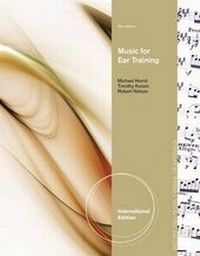
Music for Ear Training
Published on 1. May 2012
Book
Mixed media product
576 pages
978-1-133-30868-3 (ISBN)
Description
The standard in ear training instruction is Horvit/Koozin/Nelson MUSIC FOR EAR TRAINING, 4E, International Edition. The Fourth Edition workbook and CD take a hybrid approach to deliver a wealth of practical material that will help students quickly improve their listening and ear training skills. The CD-ROM is easy to use and includes high-quality recordings of various instruments playing each exercise. The dictation repertoire includes basic rudiments (intervals, chords, and scales), melodies, four-part harmonic settings, and varied textures from musical literature.
The standard in ear training instruction is Horvit/Koozin/Nelson MUSIC FOR EAR TRAINING, 4E, International Edition. The Fourth Edition workbook and CD take a hybrid approach to deliver a wealth of practical material that will help students quickly improve their listening and ear training skills. The CD-ROM is easy to use and includes high-quality recordings of various instruments playing each exercise. The dictation repertoire includes basic rudiments (intervals, chords, and scales), melodies, four-part harmonic settings, and varied textures from musical literature.
The standard in ear training instruction is Horvit/Koozin/Nelson MUSIC FOR EAR TRAINING, 4E, International Edition. The Fourth Edition workbook and CD take a hybrid approach to deliver a wealth of practical material that will help students quickly improve their listening and ear training skills. The CD-ROM is easy to use and includes high-quality recordings of various instruments playing each exercise. The dictation repertoire includes basic rudiments (intervals, chords, and scales), melodies, four-part harmonic settings, and varied textures from musical literature.
Reviews / Votes
1. Intervals, Triads, and Scales. 2. Rhythmic Dictation: Simple Meters. 3. Melodic Dictation: Fifths, Sixths, and Octaves. 4. Rhythmic Dictation: Beat Subdivision by 2. 5. Rhythmic Dictation: Beat Subdivision by 4: Anacrusis. 6. Rhythmic Dictation: Dots and Ties. 7. Melodic Dictation: The Supertonic Triad. 8. Rhythmic Dictation: Compound Meter. 9. Rhythmic Dictation: Triplets. 10. Examples from Literature. 11. Rhythmic Dictation: Syncopation. 12. Melodic Dictation: Scalar Variants, Modal Borrowing, and Decorative Chromaticism. 13. Melodic Dictation: Secondary Dominants. 14. Examples from Music Literature. 15. Melodic Dictation: Modulation to Closely Related Keys. 16. Rhythmic Dictation: Quintuple Meter. 17. Examples from Music Literature. 18. Rhythm: Irregular Meters.Pitch: Diatonic Modes. Pitch: Changing Clefs. Part Music. 19. Rhythm: Changing Meters.Pitch: Pandiatonicism. 20. Rhythm: Syncopation Including Irregular and Mixed Meters. Pitch: Extended and Altered Tertian Harmony. 21. Pitch: Exotic Scales. 22. Rhythm: Complex Divisions of the Beat. Melodic Dictation: Quartal Harmony. 23. Rhythm: Polyrhythms and Polymeters. Music Dictation: Polyharmony and Polytonality. 24. Melodic Dictation: Interval Music. 25. Melodic Dictation: Serial Music.1. Intervals, Triads, and Scales. 2. Rhythmic Dictation: Simple Meters. 3. Melodic Dictation: Fifths, Sixths, and Octaves. 4. Rhythmic Dictation: Beat Subdivision by 2. 5. Rhythmic Dictation: Beat Subdivision by 4: Anacrusis. 6. Rhythmic Dictation: Dots and Ties. 7. Melodic Dictation: The Supertonic Triad. 8. Rhythmic Dictation: Compound Meter. 9. Rhythmic Dictation: Triplets. 10. Examples from Literature. 11. Rhythmic Dictation: Syncopation. 12. Melodic Dictation: Scalar Variants, Modal Borrowing, and Decorative Chromaticism. 13. Melodic Dictation: Secondary Dominants. 14. Examples from Music Literature. 15. Melodic Dictation: Modulation to Closely Related Keys. 16. Rhythmic Dictation: Quintuple Meter. 17. Examples from Music Literature. 18. Rhythm: Irregular Meters.Pitch: Diatonic Modes. Pitch: Changing Clefs. Part Music. 19. Rhythm: Changing Meters.Pitch: Pandiatonicism. 20. Rhythm: Syncopation Including Irregular and Mixed Meters. Pitch: Extended and Altered Tertian Harmony. 21. Pitch: Exotic Scales. 22. Rhythm: Complex Divisions of the Beat. Melodic Dictation: Quartal Harmony. 23. Rhythm: Polyrhythms and Polymeters. Music Dictation: Polyharmony and Polytonality. 24. Melodic Dictation: Interval Music. 25. Melodic Dictation: Serial Music.
More details
Edition
International ed of 4th revised ed
Language
English
Place of publication
Belmont, CA
United States
Publishing group
Cengage Learning, Inc
Target group
College/higher education
Illustrations
Illustrations
Dimensions
Height: 277 mm
Width: 232 mm
Thickness: 30 mm
Weight
1170 gr
ISBN-13
978-1-133-30868-3 (9781133308683)
Copyright in bibliographic data and cover images is held by Nielsen Book Services Limited or by the publishers or by their respective licensors: all rights reserved.
Schweitzer Classification
Persons
Michael Horvit is Professor Emeritus of Composition and Theory at the Moores School of Music, University of Houston. His works range from solo instrumental and vocal pieces to large symphonic and choral compositions and operas, all widely performed in the United States, Europe, Japan, and Israel. He has published with C.F. Peters, MorningStar, Recital Publications, Shawnee Press, E.C. Schirmer, Southern, and Transcontinental, and has CDs with the Albany label. Horvit's awards include the Martha Baird Rockefeller Award as well as the National Endowment for the Arts. Robert Nelson teaches music theory and composition at the Moores School of Music, University of Houston. A composer in residence and music director of the Houston Shakespeare Festival for 17 seasons, he has also received numerous commissions for compositions and arrangements for the Houston Symphony Orchestra. Timothy Koozin is known internationally as a specialist in music instructional technology. Dr. Koozin is editor of the electronic journal, MUSIC THEORY ONLINE. His writings appear in PERSPECTIVES OF NEW MUSIC, CONTEMPORARY MUSIC REVIEW, MUSIC THEORY ONLINE, COLLEGE MUSIC SYMPOSIUM, NOTES AND COMPUTERS IN MUSIC RESEARCH. He teaches courses in music theory, analysis, and music technology at the University of Houston, Moores School of Music.
Michael Horvit is Professor Emeritus of Composition and Theory at the Moores School of Music, University of Houston. His works range from solo instrumental and vocal pieces to large symphonic and choral compositions and operas, all widely performed in the United States, Europe, Japan, and Israel. He has published with C.F. Peters, MorningStar, Recital Publications, Shawnee Press, E.C. Schirmer, Southern, and Transcontinental, and has CDs with the Albany label. Horvit's awards include the Martha Baird Rockefeller Award as well as the National Endowment for the Arts. Robert Nelson teaches music theory and composition at the Moores School of Music, University of Houston. A composer in residence and music director of the Houston Shakespeare Festival for 17 seasons, he has also received numerous commissions for compositions and arrangements for the Houston Symphony Orchestra. Timothy Koozin is known internationally as a specialist in music instructional technology. Dr. Koozin is editor of the electronic journal, MUSIC THEORY ONLINE. His writings appear in PERSPECTIVES OF NEW MUSIC, CONTEMPORARY MUSIC REVIEW, MUSIC THEORY ONLINE, COLLEGE MUSIC SYMPOSIUM, NOTES AND COMPUTERS IN MUSIC RESEARCH. He teaches courses in music theory, analysis, and music technology at the University of Houston, Moores School of Music.
Michael Horvit is Professor Emeritus of Composition and Theory at the Moores School of Music, University of Houston. His works range from solo instrumental and vocal pieces to large symphonic and choral compositions and operas, all widely performed in the United States, Europe, Japan, and Israel. He has published with C.F. Peters, MorningStar, Recital Publications, Shawnee Press, E.C. Schirmer, Southern, and Transcontinental, and has CDs with the Albany label. Horvit's awards include the Martha Baird Rockefeller Award as well as the National Endowment for the Arts. Robert Nelson teaches music theory and composition at the Moores School of Music, University of Houston. A composer in residence and music director of the Houston Shakespeare Festival for 17 seasons, he has also received numerous commissions for compositions and arrangements for the Houston Symphony Orchestra. Timothy Koozin is known internationally as a specialist in music instructional technology. Dr. Koozin is editor of the electronic journal, MUSIC THEORY ONLINE. His writings appear in PERSPECTIVES OF NEW MUSIC, CONTEMPORARY MUSIC REVIEW, MUSIC THEORY ONLINE, COLLEGE MUSIC SYMPOSIUM, NOTES AND COMPUTERS IN MUSIC RESEARCH. He teaches courses in music theory, analysis, and music technology at the University of Houston, Moores School of Music.
Content
1. Intervals, Triads, and Scales. 2. Rhythmic Dictation: Simple Meters. 3. Melodic Dictation: Fifths, Sixths, and Octaves. 4. Rhythmic Dictation: Beat Subdivision by 2. 5. Rhythmic Dictation: Beat Subdivision by 4: Anacrusis. 6. Rhythmic Dictation: Dots and Ties. 7. Melodic Dictation: The Supertonic Triad. 8. Rhythmic Dictation: Compound Meter. 9. Rhythmic Dictation: Triplets. 10. Examples from Literature. 11. Rhythmic Dictation: Syncopation. 12. Melodic Dictation: Scalar Variants, Modal Borrowing, and Decorative Chromaticism. 13. Melodic Dictation: Secondary Dominants. 14. Examples from Music Literature. 15. Melodic Dictation: Modulation to Closely Related Keys. 16. Rhythmic Dictation: Quintuple Meter. 17. Examples from Music Literature. 18. Rhythm: Irregular Meters.Pitch: Diatonic Modes. Pitch: Changing Clefs. Part Music. 19. Rhythm: Changing Meters.Pitch: Pandiatonicism. 20. Rhythm: Syncopation Including Irregular and Mixed Meters. Pitch: Extended and Altered Tertian Harmony. 21. Pitch: Exotic Scales. 22. Rhythm: Complex Divisions of the Beat. Melodic Dictation: Quartal Harmony. 23. Rhythm: Polyrhythms and Polymeters. Music Dictation: Polyharmony and Polytonality. 24. Melodic Dictation: Interval Music. 25. Melodic Dictation: Serial Music.