

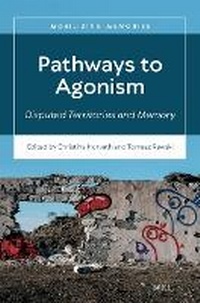
Pathways to Agonism
Disputed Territories and Memory
Published on 7. August 2025
Book
Paperback/Softback
384 pages
978-90-04-73682-5 (ISBN)
Description
This book focuses on managing competing memories of disputed territories in Eastern and Central Europe, the Caucasus and South Asia. Through an empirical, practice-oriented approach it explores memory work undertaken by institutions and social actors in different cultural and national settings. The book identifies examples of agonistic engagement with the memory of disputed territories that have the potential to build trust-based relationships between divided communities and overcome antagonistic separation through mutually beneficial joint enterprises. The volume also highlights blind spots and shortcomings of the agonistic approach by focusing on socio-political conditions that might hinder or prevent the broader dissemination of this memory mode.
More details
Series
Language
English
Place of publication
Leiden
Netherlands
Target group
Professional and scholarly
Product notice
Paperback (trade)
Unsewn / adhesive bound
Dimensions
Height: 235 mm
Width: 155 mm
Thickness: 20 mm
Weight
540 gr
ISBN-13
978-90-04-73682-5 (9789004736825)
Copyright in bibliographic data and cover images is held by Nielsen Book Services Limited or by the publishers or by their respective licensors: all rights reserved.
Schweitzer Classification
Persons
Christina Horvath, Ph.D. (2003), is a Reader of French Politics at the University of Bath. She has widely published on cities, urban marginality and memory, including Breaking the Dead Silence: Engaging with the Legacies of Slave Ownership in Bath and Bristol (2024).
Tomasz Rawski, Ph.D. (2018), is an Assistant Professor at the Faculty of Sociology, University of Warsaw. He is a political and cultural sociologist. He has published on memory politics, nationalism, war and state socialism in contemporary Eastern Europe and beyond.
Tomasz Rawski, Ph.D. (2018), is an Assistant Professor at the Faculty of Sociology, University of Warsaw. He is a political and cultural sociologist. He has published on memory politics, nationalism, war and state socialism in contemporary Eastern Europe and beyond.
Content
Acknowledgements
List of Figures and Tables
Abbreviations and Acronyms
Notes on Contributors
Pathways to Agonism: Memory Practices in Disputed Territories
?Christina Horvath and Tomasz Rawski
part 1: Pathways to Agonism
1 Performance and Peacebuilding, between Consensus and Agonism: The Sejny Chronicles and Moush, Sweet Moush
?David Clarke, Weronika Czyzewska-Poncyljusz and Nina Parish
2 Participatory Walking as an Alternative Heritage Practice in Two UNESCO World Heritage Cities: Bath and Lahore
?Christina Horvath and Mudassir Farooqi
3 Reinforcers and Challengers: War-Related Street Art in Contemporary Poland and Armenia
?Tomasz Rawski and Nelly Manucharyan
4 Liminal Spaces of Memory and Remembrance: Realignment of Agonistic Interpretations at Sites of Complex Histories in Sarajevo
?Selma Catovic Hughes and Sabina Tanovic
5 Culture of Remembrance and the Use of the Repertory Grid Technique (RGT): Preparing for a Design Approach
?Thomas Duschlbauer
part 2: Mnemonic Responses to Wars
6 Curating Mnemonic Security: Museum Responses to War in Armenia and Poland
?Joanna Wawrzyniak and Ruzanna Tsaturyan
7 Military Museums in Postcolonial Countries: Vytautas the Great War Museum in Kaunas and the Army Museum in Lahore
?Agnieszka Nowakowska and Umber bin Ibad
8 Commemorative Practices and Memorial Sites: The Armenian Genocide Memorial
?Harutyun Marutyan
9 The Second Nagorno-Karabakh War: from War to Postwar Memory Politics
?Arsen Hakobyan
part 3: International Pressures and Local Memoryscapes
10 The Memory of Neighbours: Lithuania and Poland in School Textbooks of Both Countries
?Tomasz Blaszczak, Malgorzata Glowacka-Grajper, Rustis Kamuntavicius and Agnieszka Nowakowska
11 Burgenland: Agonistic Memory in an Acknowledged Multicultural Borderland?
?Melinda Harlov-Csortan
12 Translating the International to the Local: the Case of the Women, Peace and Security Agenda in Poland and Armenia
?Sophie Whiting and Ruzanna Tsaturyan
Index
List of Figures and Tables
Abbreviations and Acronyms
Notes on Contributors
Pathways to Agonism: Memory Practices in Disputed Territories
?Christina Horvath and Tomasz Rawski
part 1: Pathways to Agonism
1 Performance and Peacebuilding, between Consensus and Agonism: The Sejny Chronicles and Moush, Sweet Moush
?David Clarke, Weronika Czyzewska-Poncyljusz and Nina Parish
2 Participatory Walking as an Alternative Heritage Practice in Two UNESCO World Heritage Cities: Bath and Lahore
?Christina Horvath and Mudassir Farooqi
3 Reinforcers and Challengers: War-Related Street Art in Contemporary Poland and Armenia
?Tomasz Rawski and Nelly Manucharyan
4 Liminal Spaces of Memory and Remembrance: Realignment of Agonistic Interpretations at Sites of Complex Histories in Sarajevo
?Selma Catovic Hughes and Sabina Tanovic
5 Culture of Remembrance and the Use of the Repertory Grid Technique (RGT): Preparing for a Design Approach
?Thomas Duschlbauer
part 2: Mnemonic Responses to Wars
6 Curating Mnemonic Security: Museum Responses to War in Armenia and Poland
?Joanna Wawrzyniak and Ruzanna Tsaturyan
7 Military Museums in Postcolonial Countries: Vytautas the Great War Museum in Kaunas and the Army Museum in Lahore
?Agnieszka Nowakowska and Umber bin Ibad
8 Commemorative Practices and Memorial Sites: The Armenian Genocide Memorial
?Harutyun Marutyan
9 The Second Nagorno-Karabakh War: from War to Postwar Memory Politics
?Arsen Hakobyan
part 3: International Pressures and Local Memoryscapes
10 The Memory of Neighbours: Lithuania and Poland in School Textbooks of Both Countries
?Tomasz Blaszczak, Malgorzata Glowacka-Grajper, Rustis Kamuntavicius and Agnieszka Nowakowska
11 Burgenland: Agonistic Memory in an Acknowledged Multicultural Borderland?
?Melinda Harlov-Csortan
12 Translating the International to the Local: the Case of the Women, Peace and Security Agenda in Poland and Armenia
?Sophie Whiting and Ruzanna Tsaturyan
Index