

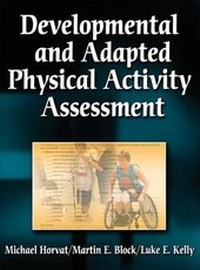
Developmental and Adapted Physical Activity Assessment
Published on 1. February 2007
Book
Hardback
264 pages
978-0-7360-5107-1 (ISBN)
Description
This work serves as a reference for students and practitioners working in the field of adapted physical education. It provides practical guidance for the assessment of individuals with disabilities in physical education programmes. The reader will learn to maximise participant skills and success through accurate assessment. It includes key terms, review questions and practical case studies to reinforce theory.
More details
Language
English
Place of publication
Champaign
United States
Target group
Professional and scholarly
Illustrations
26 illustrations, 24 photos
Dimensions
Height: 280 mm
Width: 216 mm
ISBN-13
978-0-7360-5107-1 (9780736051071)
Copyright in bibliographic data and cover images is held by Nielsen Book Services Limited or by the publishers or by their respective licensors: all rights reserved.
Schweitzer Classification
Other editions
New editions
Michael Horvat | Luke Kelly | Martin Block
Developmental and Adapted Physical Activity Assessment 2nd Edition With Web Resource
Book
03/2018
Human Kinetics
€85.61
Shipment within 15-20 days
Persons
Michael Horvat is a professor of adapted physical education at the University of Georgia and a member of the International Society of Adapted Physical Activity. He has published many journal articles on the subject of adapted physical education and presented papers at numerous US and international conferences. Martin Block is an associate professor of kinesiology at the University of Virginia. From 1988 to 1999, he served as consultant and director of the Special Olympics Motor Activities Training Programme, creating assessment tools and adapted equipment for athletes with severe disabilities. Luke Kelly is a professor of kinesiology at the University of Virginia. He has 25 years of experience working with public schools in evaluating and revising their physical education curricula to meet the needs of students with disabilities.
Content
Chapter 1. Who You Are Assessing; Chapter 2. Why You Are Assessing; Chapter 3. Getting to Know the Child; Chapter 4. Understanding Assessment Instruments; Chapter 5. Selecting and Administering Tests; Chapter 6. Assessing Motor Development and Motor Skill Performance; Chapter 7. Assessing Physical Fitness; Chapter 8. Assessing Posture and Gait; Chapter 9. Assessing Behavior and Social Competencies; Chapter 10. Translating Assessment Into Action: A Team Approach.