

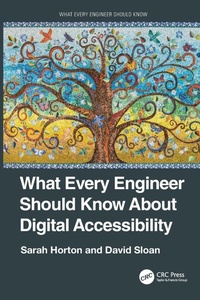
What Every Engineer Should Know About Digital Accessibility
1st Edition
Published on 30. April 2024
Book
Paperback/Softback
244 pages
978-1-032-26386-1 (ISBN)
Description
Accessibility is a core quality of digital products to be deliberately addressed throughout the development lifecycle. What Every Engineer Should Know About Digital Accessibility will prepare readers to integrate digital accessibility into their engineering practices. Readers will learn how to accurately frame accessibility as an engineering challenge so they are able to address the correct problems in the correct way.
Illustrated with diverse perspectives from accessibility practitioners and advocates, this book describes how people with disabilities use technology, the nature of accessibility barriers in the digital world, and the role of engineers in breaking down those barriers. Accessibility competence for current, emerging, and future technologies is addressed through a combination of guiding principles, core attributes and requirements, and accessibility-informed engineering practices.
FEATURES
Discusses how technology can support inclusion for people with disabilities and how rigorous engineering processes help create quality user experiences without introducing accessibility barriers
Explains foundational principles and guidelines that build core competency in digital accessibility as they are applied across diverse and emerging technology platforms
Highlights practical insights into how engineering teams can effectively address accessibility throughout the technology development lifecycle
Uses international standards to define and measure accessibility quality
Written to be accessible to non-experts in the subject area, What Every Engineer Should Know About Digital Accessibility is aimed at students, professionals, and researchers in the field of software engineering.
A companion site supporting and extending the themes and topics from the book can be found at https://knowaboutaccessibility.org/
Illustrated with diverse perspectives from accessibility practitioners and advocates, this book describes how people with disabilities use technology, the nature of accessibility barriers in the digital world, and the role of engineers in breaking down those barriers. Accessibility competence for current, emerging, and future technologies is addressed through a combination of guiding principles, core attributes and requirements, and accessibility-informed engineering practices.
FEATURES
Discusses how technology can support inclusion for people with disabilities and how rigorous engineering processes help create quality user experiences without introducing accessibility barriers
Explains foundational principles and guidelines that build core competency in digital accessibility as they are applied across diverse and emerging technology platforms
Highlights practical insights into how engineering teams can effectively address accessibility throughout the technology development lifecycle
Uses international standards to define and measure accessibility quality
Written to be accessible to non-experts in the subject area, What Every Engineer Should Know About Digital Accessibility is aimed at students, professionals, and researchers in the field of software engineering.
A companion site supporting and extending the themes and topics from the book can be found at https://knowaboutaccessibility.org/
More details
Series
Language
English
Place of publication
London
United Kingdom
Publishing group
Taylor & Francis Ltd
Target group
College/higher education
Professional and scholarly
Professional Practice & Development
Illustrations
11 s/w Abbildungen, 11 s/w Photographien bzw. Rasterbilder, 19 s/w Tabellen
19 Tables, black and white; 11 Halftones, black and white; 11 Illustrations, black and white
Dimensions
Height: 234 mm
Width: 156 mm
Thickness: 15 mm
Weight
415 gr
ISBN-13
978-1-032-26386-1 (9781032263861)
Copyright in bibliographic data and cover images is held by Nielsen Book Services Limited or by the publishers or by their respective licensors: all rights reserved.
Schweitzer Classification
Other editions
Additional editions
Sarah Horton | David Sloan
What Every Engineer Should Know About Digital Accessibility
E-Book
04/2024
1st Edition
CRC Press
€41.99
Available for download
Sarah Horton | David Sloan
What Every Engineer Should Know About Digital Accessibility
Book
04/2024
1st Edition
CRC Press
€186.30
Shipment within 10-20 days
Sarah Horton | David Sloan
What Every Engineer Should Know About Digital Accessibility
E-Book
04/2024
1st Edition
CRC Press
€41.99
Available for download
Persons
Sarah Horton (she/her) has over 20 years of experience helping organizations create "born accessible" technology. She is an author of books, articles, and papers on designing technology to improve quality of life. She is current UX Strategy and Accessibility Lead at Harvard University, a Visiting Research Fellow at the University of Southampton, and an Invited Expert with Teach Access and the W3C's Accessibility Guidelines Working Group.
David Sloan (he/him) is Chief Accessibility Officer and UX Practice Manager at TPGi, a specialist digital accessibility services provider, and works with a range of clients to help them create accessible digital user experiences and build accessibility capacity in a sustainable way. He became interested in digital accessibility at the end of the 1990s as a postgraduate researcher at the University of Dundee, focusing on improving technology design for disabled and older people, and earned a PhD on web accessibility in 2006. While at Dundee, he taught classes on human-computer interaction and web design, co-founded the Digital Media Access Group, one of the world's first digital accessibility consultancy groups, and drafted the University's first accessibility policy.
David Sloan (he/him) is Chief Accessibility Officer and UX Practice Manager at TPGi, a specialist digital accessibility services provider, and works with a range of clients to help them create accessible digital user experiences and build accessibility capacity in a sustainable way. He became interested in digital accessibility at the end of the 1990s as a postgraduate researcher at the University of Dundee, focusing on improving technology design for disabled and older people, and earned a PhD on web accessibility in 2006. While at Dundee, he taught classes on human-computer interaction and web design, co-founded the Digital Media Access Group, one of the world's first digital accessibility consultancy groups, and drafted the University's first accessibility policy.
Content
Part 1: Foundations of Accessibility. 1. Introduction to Digital Accessibility. 2. Disability and Digital Inclusion. 3. User Accessibility Needs. 4. Assistive Technology. 5. Core Attributes. 6. Guiding Principles. 7. Accessibility in Practice. Part 2: Methods for Engineering Digital Accessibility. 8. Requirements Specification. 9. Core Requirements. 10. Design and Development. 11. Testing and Evaluation. 12. Documentation and Support. 13. The Future of Digital Accessibility.