

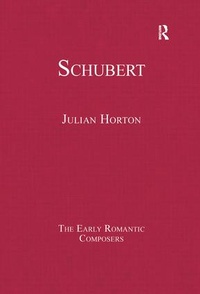
Schubert
1st Edition
Published on 11. December 2015
Book
Hardback
516 pages
978-1-4724-3937-6 (ISBN)
Description
The collection of essays in this volume offer an overview of Schubertian reception, interpretation and analysis. Part I surveys the issue of Schubert's alterity concentrating on his history and biography. Following on from the overarching dualities of Schubert explored in the first section, Part II focuses on interpretative strategies and hermeneutic positions. Part III assesses the diversity of theoretical approaches concerning Schubert's handling of harmony and tonality whereas the last two parts address the reception of his instrumental music and song. This volume highlights the complexity and diversity of Schubertian scholarship as well as the overarching concerns raised by discrete fields of research in this area.
More details
Series
Language
English
Place of publication
London
United Kingdom
Publishing group
Taylor & Francis Ltd
Target group
Professional and scholarly
Dimensions
Height: 244 mm
Width: 169 mm
Weight
1188 gr
ISBN-13
978-1-4724-3937-6 (9781472439376)
Copyright in bibliographic data and cover images is held by Nielsen Book Services Limited or by the publishers or by their respective licensors: all rights reserved.
Schweitzer Classification
Other editions
Person
Julian Horton is Professor and Head of the Department of Music at Durham University, UK and President of the Society for Music Analysis.
Content
Contents: Introduction. Part I History and Biography: Poor Schubert: images and legends of the composer, Christopher H. Gibbs; Franz Schubert and the peacocks of Benvenuto Cellini, Maynard Soloman; The peacock's tale: Schubert's sexuality reconsidered, Rita Steblin; Constructing a Victorian Schubert: music, biography and cultural values, David Gramit; Unfinished considerations: Schubert's 'unfinished' symphony in the context of his Beethoven project, John Gingerich. Part II Reception and Interpretation: Schubert's Symphony in C, Robert Schumann; Schubert (1928), Theodor W. Adorno; Schubert's promissory note: an exercise in musical hermeneutics, Edward T. Cone; Schubert and the sound of memory, Scott Burnham. Part III Harmony and Tonality: Tonality, Donald Francis Tovey; As wonderful as star clusters: instruments for gazing at tonality in Schubert, Richard L. Cohn; Three examples of functional chromatic mediant relations in Schubert, David Kopp; 'Die junge Nonne' (D. 828), David Damschroder with David Kopp. Part IV Instrumental Music: Schubert's sonata form and Brahms's first maturity, James Webster; Sonata form in Schubert: the first movement of the G-Major String Quartet, Op. 161 (D. 887), Carl Dahlhaus; On the subject of Schubert's 'unfinished' symphony: was bedeutet die Bewegung?, Richard Kurth; Schubert's homecoming, Nicholas Marston; Schubert's sonata forms and the poetics of the lyric, Su Yin Mak. Part V Song: A romantic detail in Schubert's Schwanengesang, Joseph Kerman; 'Auf dem Flusse': image and background in a Schubert song, David Lewin; Behind the scenes: die schoene Muellerin before Schubert, Susan Youens; The Schubert Lied: romantic form and romantic consciousness, Lawrence Kramer; The shadow of midnight in Schubert's 'Gondelfahrer' settings, David T. Bretherton. Name index.