

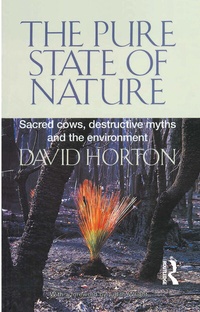
The Pure State of Nature
Sacred cows, destructive myths and the environment
1st Edition
Published on 31. March 2021
Book
Hardback
208 pages
978-0-367-71988-3 (ISBN)
Description
'Aborigines did not cause the extinction of the megafauna . . . and it is unlikely that they have caused the extinction of any element of the fauna and flora.'
'If you want to practise control burning in order to protect houses or farms, then do it in the same way as you would use a bulldozer to clear a firebreak, but don't pretend that you are doing anything but damage to the environment.'
'If you commercialise an environmental resource you do so to make money. Don't pretend that it also benefits the environment.'
Spanning fifty thousand years and an entire continent, The Pure State of Nature presents a passionate account of the Australian environment. The myths that abound in popular and scientific writing, the 'theories' and fancies about the place of humans in the ecology of this vast landmass, are subjected to scrutiny. In particular, the author demolishes the widely accepted orthodoxy about the use of fire by Aborigines and their supposed part in the extinction of the Australian megafauna.
From the ruins of those myths The Pure State of Nature offers lessons for the new millennium. In turns provocative, humorous, impassioned and gentle, this is a bold book of ideas about the past and present, a book about how we can shape the future.
To The Pure State of Nature Dr David Horton brings many years' experience as scientist, farmer and archaeologist. Among his publications are Recovering the Tracks and The Encyclopaedia of Aboriginal Australia. He now writes and consults from his stud sheep farm in New South Wales.
'If you want to practise control burning in order to protect houses or farms, then do it in the same way as you would use a bulldozer to clear a firebreak, but don't pretend that you are doing anything but damage to the environment.'
'If you commercialise an environmental resource you do so to make money. Don't pretend that it also benefits the environment.'
Spanning fifty thousand years and an entire continent, The Pure State of Nature presents a passionate account of the Australian environment. The myths that abound in popular and scientific writing, the 'theories' and fancies about the place of humans in the ecology of this vast landmass, are subjected to scrutiny. In particular, the author demolishes the widely accepted orthodoxy about the use of fire by Aborigines and their supposed part in the extinction of the Australian megafauna.
From the ruins of those myths The Pure State of Nature offers lessons for the new millennium. In turns provocative, humorous, impassioned and gentle, this is a bold book of ideas about the past and present, a book about how we can shape the future.
To The Pure State of Nature Dr David Horton brings many years' experience as scientist, farmer and archaeologist. Among his publications are Recovering the Tracks and The Encyclopaedia of Aboriginal Australia. He now writes and consults from his stud sheep farm in New South Wales.
More details
Language
English
Place of publication
London
United Kingdom
Publishing group
Taylor & Francis Ltd
Target group
College/higher education
Dimensions
Height: 216 mm
Width: 138 mm
Weight
540 gr
ISBN-13
978-0-367-71988-3 (9780367719883)
Copyright in bibliographic data and cover images is held by Nielsen Book Services Limited or by the publishers or by their respective licensors: all rights reserved.
Schweitzer Classification
Other editions
Additional editions
E-Book
07/2020
1st Edition
Routledge
€44.99
Available for download
E-Book
07/2020
1st Edition
Routledge
€44.99
Available for download
Book
03/2000
1st Edition
Allen & Unwin
€48.80
Article not available at the moment
Person
Dr. David Horton has had four successful professional careers as, in turn, biologist, archaeologist, publisher and farmer. He has worked in the field for over twenty-five years and has published widely in academic literature.
Content
Foreword
Acknowledgments
1 'Paved with good intentions': Theories on Aborigines and the environment
2 'An unchanging people in an unchanging land': Archaeology and the past
3 'A slow strangulation of the mind?': Eating fish is wrong
4 'A people so inclined': To farm or not to farm
5 'Opened up a landscape': Firestick farming and the control burners
6 'The extinction of such pachyderms': The great megafauna debate
7 'Most enlightened conservationists'
8 Convicts dilemma
9 Ghosts
10 Theses nailed to the door
Notes
Index
Acknowledgments
1 'Paved with good intentions': Theories on Aborigines and the environment
2 'An unchanging people in an unchanging land': Archaeology and the past
3 'A slow strangulation of the mind?': Eating fish is wrong
4 'A people so inclined': To farm or not to farm
5 'Opened up a landscape': Firestick farming and the control burners
6 'The extinction of such pachyderms': The great megafauna debate
7 'Most enlightened conservationists'
8 Convicts dilemma
9 Ghosts
10 Theses nailed to the door
Notes
Index