

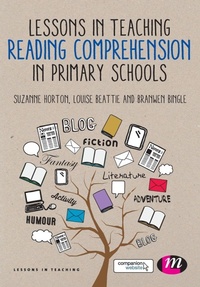
Lessons in Teaching Reading Comprehension in Primary Schools
1st Edition
Published on 27. July 2015
Book
Paperback/Softback
176 pages
978-1-4739-1614-2 (ISBN)
Description
Lesson planning in line with the new Primary National Curriculum!
Why do we teach children to read? It is not merely to decode the words. We teach them to derive meaning from the text, to comprehend it. To not just read the lines, but to read between the lines and even read beyond the lines. So how can you make teaching comprehension in primary schools effective and engaging? How are you ensuring that children are finding meaning in what they read and how do we support more able readers to learn more? What does a good 'reading' lesson look like? This book demonstrates the effective teaching of reading through exemplar lessons. It discusses what makes them good lesson plans and how they can be adapted to suit different classes and different schools.
In particular, this book helps you to meet the needs of more able readers particularly in years 5 and 6, outlining ways to challenge more able pupils to support them with the level 6 tests in Year 6. It helps you to cultivate your subject knowledge and invigorate your classroom teaching through focusing on what children need to learn and how to teach it. Did you know that this book is part of the Lessons in Teaching series?
WHAT IS THE LESSONS IN TEACHING SERIES?
Suitable for any teacher at any stage of their career, the books in this series are packed with great ideas for teaching engaging, outstanding lessons in your primary classroom. The Companion Website accompanying the series includes extra resources including tips, lesson starters, videos and Pinterest boards.
Books in this series: Lessons in Teaching Grammar in Primary Schools, Lessons in Teaching Computing in Primary Schools, Lessons in Teaching Number and Place Value in Primary Schools, Lessons in Teaching Reading Comprehension in Primary Schools, Lesson in Teaching Phonics in Primary Schools
Why do we teach children to read? It is not merely to decode the words. We teach them to derive meaning from the text, to comprehend it. To not just read the lines, but to read between the lines and even read beyond the lines. So how can you make teaching comprehension in primary schools effective and engaging? How are you ensuring that children are finding meaning in what they read and how do we support more able readers to learn more? What does a good 'reading' lesson look like? This book demonstrates the effective teaching of reading through exemplar lessons. It discusses what makes them good lesson plans and how they can be adapted to suit different classes and different schools.
In particular, this book helps you to meet the needs of more able readers particularly in years 5 and 6, outlining ways to challenge more able pupils to support them with the level 6 tests in Year 6. It helps you to cultivate your subject knowledge and invigorate your classroom teaching through focusing on what children need to learn and how to teach it. Did you know that this book is part of the Lessons in Teaching series?
WHAT IS THE LESSONS IN TEACHING SERIES?
Suitable for any teacher at any stage of their career, the books in this series are packed with great ideas for teaching engaging, outstanding lessons in your primary classroom. The Companion Website accompanying the series includes extra resources including tips, lesson starters, videos and Pinterest boards.
Books in this series: Lessons in Teaching Grammar in Primary Schools, Lessons in Teaching Computing in Primary Schools, Lessons in Teaching Number and Place Value in Primary Schools, Lessons in Teaching Reading Comprehension in Primary Schools, Lesson in Teaching Phonics in Primary Schools
More details
Series
Language
English
Place of publication
Exeter
United Kingdom
Publishing group
SAGE Publications Ltd
Target group
Professional and scholarly
Dimensions
Height: 244 mm
Width: 170 mm
Thickness: 10 mm
Weight
315 gr
ISBN-13
978-1-4739-1614-2 (9781473916142)
Copyright in bibliographic data and cover images is held by Nielsen Book Services Limited or by the publishers or by their respective licensors: all rights reserved.
Schweitzer Classification
Other editions
Additional editions
Suzanne Horton | Louise Beattie | Branwen Bingle
Lessons in Teaching Reading Comprehension in Primary Schools
Book
07/2015
1st Edition
Learning Matters Ltd
€124.20
Shipment within 15-20 days
Suzanne Horton | Louise Beattie | Branwen Bingle
Lessons in Teaching Reading Comprehension in Primary Schools
E-Book
07/2015
1st Edition
Learning Matters Ltd
€51.99
Available for download
Suzanne Horton | Louise Beattie | Branwen Bingle
Lessons in Teaching Reading Comprehension in Primary Schools
E-Book
07/2015
1st Edition
Learning Matters Ltd
€51.99
Available for download
Persons
Suzanne Horton is subject leader for Primary English at the University of Worcester and teaches on a range of postgraduate and undergraduate modules. She is currently involved in the Lifelong Readers Project in cooperation with a number of European partners, funded with support from the European Commission. Louise Beattie is Senior Lecturer in Secondary English at the University of Worcester. Branwen Bingle is Senior Lecturer in Primary Education at the University of Worcester. In addition to her lecturing role, Branwen is currently working on doctoral research into children's literature and its potential influence on professional identity construction/aspiration.
Content
What is reading?
Reading in context
Year 1: Using questioning with picture books
Year 2: Developing reading comprehension through poetry
Year 3: Oral storytelling and reading comprehension
Year 3: Reading non-fiction
Year 4: Identifying themes
Year 4: Playing with plays
Year 5: Using drama with a class novel
Year 5: Using moving image to develop critical reading
Year 6: Using drama to analyse a Shakespeare text
Year 6: Analysing pre-twentieth century literature
Moving on: Reading for pleasure
Reading in context
Year 1: Using questioning with picture books
Year 2: Developing reading comprehension through poetry
Year 3: Oral storytelling and reading comprehension
Year 3: Reading non-fiction
Year 4: Identifying themes
Year 4: Playing with plays
Year 5: Using drama with a class novel
Year 5: Using moving image to develop critical reading
Year 6: Using drama to analyse a Shakespeare text
Year 6: Analysing pre-twentieth century literature
Moving on: Reading for pleasure