

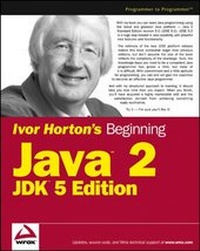
Ivor Horton's Beginning Java 2
JDK 5 Edition
1st Edition
Published on 1. January 2005
Book
Paperback/Softback
1512 pages
978-0-7645-6874-9 (ISBN)
Description
What is this book about?
This book is a comprehensive introduction to the Java programming language, updated thoroughly (more than 35% new and updated) for the latest SDK 1.5 release. This book shows readers how to build real-world Java applications using the Java SDK. No previous programming experience is required. The author uses numerous step-by-step programming examples to guide readers through the ins and outs of Java development. In addition to fully covering new features of SDK 1.5, such as generic types, the author has also added new chapters on Java database programming with JDBC and Java programming with XML.
This book is a comprehensive introduction to the Java programming language, updated thoroughly (more than 35% new and updated) for the latest SDK 1.5 release. This book shows readers how to build real-world Java applications using the Java SDK. No previous programming experience is required. The author uses numerous step-by-step programming examples to guide readers through the ins and outs of Java development. In addition to fully covering new features of SDK 1.5, such as generic types, the author has also added new chapters on Java database programming with JDBC and Java programming with XML.
More details
Other editions
Additional editions
Ivor Horton
Ivor Horton's Beginning Java 2, JDK 5 Edition
E-Book
12/2004
Wrox
€32.99
Available for download
Person
Ivor Horton started out as a mathematician, but shortly after graduating, he was lured into messing about with computers by a well-known manufacturer. He has spent many happy years programming occasionally useful applications in a variety of languages as well as teaching mainly scientists and engineers to do likewise. He has extensive experience in applying computers to problems in engineering design and to manufacturing operations in a wide range of industries. He is the author of a number of tutorial books on programming in C, C++, and Java. When not writing programming books or providing advice to others, he leads a life of leisure.
Content
About the Author.
Foreword.
Acknowledgments.
Introduction.
Chapter 1: Introducing Java.
Chapter 2: Programs, Data, Variables, and Calculation.
Chapter 3: Loops and Logic.
Chapter 4: Arrays and Strings.
Chapter 5: Defining Classes.
Chapter 6: Extending Classes and Inheritance.
Chapter 7: Exceptions.
Chapter 8: Understanding Streams.
Chapter 9: Accessing Files and Directories.
Chapter 10: Writing Files.
Chapter 11: Reading Files.
Chapter 12: Serializing Objects.
Chapter 13: Generic Class Types.
Chapter 14: The Collections Framework.
Chapter 15: A Collection of Useful Classes.
Chapter 16: Threads.
Chapter 17: Creating Windows.
Chapter 18: Handling Events.
Chapter 19: Drawing in a Window.
Chapter 20: Extending the GUI.
Chapter 21: Filing and Printing Documents.
Chapter 22: Java and XML.
Chapter 23: Creating and Modifying XML Documents.
Chapter 24: Talking to Databases.
Chapter 25: The JDBC in Action.
Appendix A: Keywords.
Appendix B: Computer Arithmetic.
Index.
Foreword.
Acknowledgments.
Introduction.
Chapter 1: Introducing Java.
Chapter 2: Programs, Data, Variables, and Calculation.
Chapter 3: Loops and Logic.
Chapter 4: Arrays and Strings.
Chapter 5: Defining Classes.
Chapter 6: Extending Classes and Inheritance.
Chapter 7: Exceptions.
Chapter 8: Understanding Streams.
Chapter 9: Accessing Files and Directories.
Chapter 10: Writing Files.
Chapter 11: Reading Files.
Chapter 12: Serializing Objects.
Chapter 13: Generic Class Types.
Chapter 14: The Collections Framework.
Chapter 15: A Collection of Useful Classes.
Chapter 16: Threads.
Chapter 17: Creating Windows.
Chapter 18: Handling Events.
Chapter 19: Drawing in a Window.
Chapter 20: Extending the GUI.
Chapter 21: Filing and Printing Documents.
Chapter 22: Java and XML.
Chapter 23: Creating and Modifying XML Documents.
Chapter 24: Talking to Databases.
Chapter 25: The JDBC in Action.
Appendix A: Keywords.
Appendix B: Computer Arithmetic.
Index.