

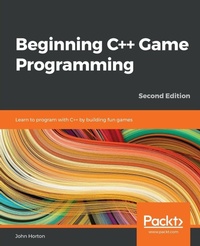
Beginning C++ Game Programming
Learn to program with C++ by building fun games
2nd Edition
Published on 31. October 2019
Book
Paperback/Softback
746 pages
978-1-83864-857-2 (ISBN)
Description
Get to grips with programming techniques and game development using C++ libraries and Visual Studio 2019
Key Features
Learn game development and C++ with a fun, example-driven approach
Build clones of popular games such as Timberman, Zombie Survival Shooter, a co-op puzzle platformer, and Space Invaders
Discover tips to expand your finished games by thinking critically, technically, and creatively
Book DescriptionThe second edition of Beginning C++ Game Programming is updated and improved to include the latest features of Visual Studio 2019, SFML, and modern C++ programming techniques. With this book, you'll get a fun introduction to game programming by building five fully playable games of increasing complexity. You'll learn to build clones of popular games such as Timberman, Pong, a Zombie survival shooter, a coop puzzle platformer and Space Invaders.
The book starts by covering the basics of programming. You'll study key C++ topics, such as object-oriented programming (OOP) and C++ pointers, and get acquainted with the Standard Template Library (STL). The book helps you learn about collision detection techniques and game physics by building a Pong game. As you build games, you'll also learn exciting game programming concepts such as particle effects, directional sound (spatialization), OpenGL programmable shaders, spawning objects, and much more. Finally, you'll explore game design patterns to enhance your C++ game programming skills.
By the end of the book, you'll have gained the knowledge you need to build your own games with exciting features from scratch.What you will learn
Set up your game development project in Visual Studio 2019 and explore C++ libraries such as SFML
Explore C++ OOP by building a Pong game
Understand core game concepts such as game animation, game physics, collision detection, scorekeeping, and game sound
Use classes, inheritance, and references to spawn and control thousands of enemies and shoot rapid-fire machine guns
Add advanced features to your game using pointers, references, and the STL
Scale and reuse your game code by learning modern game programming design patterns
Who this book is forThis book is perfect for you if you have no C++ programming knowledge, you need a beginner-level refresher course, or you want to learn how to build games or just use games as an engaging way to learn C++. Whether you aspire to publish a game (perhaps on Steam) or just want to impress friends with your creations, you'll find this book useful.
Key Features
Learn game development and C++ with a fun, example-driven approach
Build clones of popular games such as Timberman, Zombie Survival Shooter, a co-op puzzle platformer, and Space Invaders
Discover tips to expand your finished games by thinking critically, technically, and creatively
Book DescriptionThe second edition of Beginning C++ Game Programming is updated and improved to include the latest features of Visual Studio 2019, SFML, and modern C++ programming techniques. With this book, you'll get a fun introduction to game programming by building five fully playable games of increasing complexity. You'll learn to build clones of popular games such as Timberman, Pong, a Zombie survival shooter, a coop puzzle platformer and Space Invaders.
The book starts by covering the basics of programming. You'll study key C++ topics, such as object-oriented programming (OOP) and C++ pointers, and get acquainted with the Standard Template Library (STL). The book helps you learn about collision detection techniques and game physics by building a Pong game. As you build games, you'll also learn exciting game programming concepts such as particle effects, directional sound (spatialization), OpenGL programmable shaders, spawning objects, and much more. Finally, you'll explore game design patterns to enhance your C++ game programming skills.
By the end of the book, you'll have gained the knowledge you need to build your own games with exciting features from scratch.What you will learn
Set up your game development project in Visual Studio 2019 and explore C++ libraries such as SFML
Explore C++ OOP by building a Pong game
Understand core game concepts such as game animation, game physics, collision detection, scorekeeping, and game sound
Use classes, inheritance, and references to spawn and control thousands of enemies and shoot rapid-fire machine guns
Add advanced features to your game using pointers, references, and the STL
Scale and reuse your game code by learning modern game programming design patterns
Who this book is forThis book is perfect for you if you have no C++ programming knowledge, you need a beginner-level refresher course, or you want to learn how to build games or just use games as an engaging way to learn C++. Whether you aspire to publish a game (perhaps on Steam) or just want to impress friends with your creations, you'll find this book useful.
More details
Edition
2nd Revised edition
Language
English
Place of publication
Birmingham
United Kingdom
Target group
Professional and scholarly
US School Grade: College Graduate Student
Edition type
Revised edition
Dimensions
Height: 235 mm
Width: 191 mm
Thickness: 40 mm
Weight
1367 gr
ISBN-13
978-1-83864-857-2 (9781838648572)
Copyright in bibliographic data and cover images is held by Nielsen Book Services Limited or by the publishers or by their respective licensors: all rights reserved.
Schweitzer Classification
Other editions
Additional editions
E-Book
09/2024
2nd Edition
Packt Publishing
€35.49
Available for download
Person
John Horton is a programming and gaming enthusiast based in the UK. He has a passion for writing apps, games, books, and blog articles. He is the founder of Game Code School.
Content
Table of Contents
C++, SFML, Visual Studio, and Starting the First Game
Variables, Operators, and Decisions
C++ Strings and SFML Time
Loops, Arrays, Switches, Enumerations, and Functions
Collisions, Sound, and End Conditions
Object-Oriented Programming
Dynamic Collision Detection and Physics
SFML Views
C++ References, Sprite Sheets, and Vertex Arrays
Pointers, the Standard Template Library, and Texture Management
Collision Detection, Pickups, and Bullets
Layering Views and Implementing the HUD
Sound E?ects, File I/O, and Finishing the Game
Abstraction and Code Management
Advanced OOP
Building Playable Levels and Collision Detection
Sound Spatialization and the HUD
Particle Systems and Shaders
Game Programming Design Patterns
Game Objects and Components
File I/O and the Game Object Factory
Using Game Objects and Building a Game
Before You Go...
C++, SFML, Visual Studio, and Starting the First Game
Variables, Operators, and Decisions
C++ Strings and SFML Time
Loops, Arrays, Switches, Enumerations, and Functions
Collisions, Sound, and End Conditions
Object-Oriented Programming
Dynamic Collision Detection and Physics
SFML Views
C++ References, Sprite Sheets, and Vertex Arrays
Pointers, the Standard Template Library, and Texture Management
Collision Detection, Pickups, and Bullets
Layering Views and Implementing the HUD
Sound E?ects, File I/O, and Finishing the Game
Abstraction and Code Management
Advanced OOP
Building Playable Levels and Collision Detection
Sound Spatialization and the HUD
Particle Systems and Shaders
Game Programming Design Patterns
Game Objects and Components
File I/O and the Game Object Factory
Using Game Objects and Building a Game
Before You Go...