

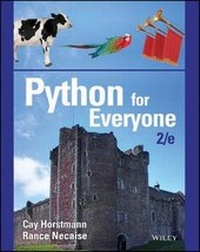
Python for Everyone
2nd Edition
Published on 26. February 2016
Book
Paperback/Softback
752 pages
978-1-119-05655-3 (ISBN)
Unfortunately, price unknown
Article is exhausted; no reprint
Description
Cay Horstmann's Python for Everyone, 2nd Edition provides a comprehensive and approachable introduction to fundamental programming techniques and design skills, and helps students master basic concepts and become competent coders. The inclusion of advanced chapters makes the text suitable for a 2 or 3-term sequence, or as a comprehensive reference to programming in Python. Major rewrites and an updated visual design make this student-friendly text even more engaging. Filled with realistic programming examples, a great quantity and variety of homework assignments, and lab exercises that build student problem-solving abilities, it is no surprise Python for Everyone is the number one text for early objects in the Python market.
More details
Other editions
Previous edition
Cay Horstmann | Rance D. Necaise
Python for Everyone
Book
03/2013
Wiley
€94.00
Article exhausted; check for reprint
Persons
Cay Horstmann grew up in Northern Germany and attended the Christian-Albrechts-Universitat in Kiel, a harbor town at the Baltic sea. He received a M.S. in computer science from Syracuse University, and a Ph.D. in mathematics from the University of Michigan in Ann Arbor. For four years, he was VP and CTO of an Internet startup that went from 3 people in a tiny office to a public company. He now teaches computer science at San Jose State University. Cay also writes books and articles on programming languages and computer science education.
Content
Chapter 1: Introduction
1.1 Computer Programs
1.2 The Anatomy of a Computer
1.3 The Python Programming Language
1.4 Becoming Familiar with Your Programming Environment
1.5 Analyzing Your First Program
1.6 Errors
1.7 Problem Solving: Algorithm Design
Chapter 2: Programming with Numbers and Strings
2.1 Variables
2.2 Arithmetic
2.3 Problem Solving: First Do It By Hand
2.4 Strings
2.5 Input and Output
2.6 Graphics: Simple Drawings
Chapter 3: Decisions
3.1 The if Statement
3.2 Relational Operators
3.3 Nested Branches
3.4 Multiple Alternatives
3.5 Problem Solving: Flowcharts
3.6 Problem Solving: Test Cases
3.7 Boolean Variables and Operators
3.8 Analyzing Strings
3.9 Application: Input Validation
Chapter 4: Loops
4.1 The while Loop
4.2 Problem Solving: Hand-Tracing
4.3 Application: Processing Sentinel Values
4.4 Problem Solving: Storyboards
4.5 Common Loop Algorithms
4.6 The for Loop
4.7 Nested Loops
4.8 Processing Strings
4.9 Application: Random Numbers and Simulations
4.10 Graphics: Digital Image Processing
4.11 Problem Solving: Solve a Simpler Problem First
Chapter 5: Functions
5.1 Functions as Black Boxes
5.2 Implementing and Testing Functions
5.3 Parameter Passing
5.4 Return Values
5.5 Functions Without Return Values
5.6 Problem Solving: Reusable Functions
5.7 Problem Solving: Stepwise Refinement
5.8 Variable Scope
5.9 Graphics: Building an Image Processing Toolkit
5.10 Recursive Functions (Optional)
Chapter 6: Lists
6.1 Basic Properties of Lists
6.2 List Operations
6.3 Common List Algorithms
6.4 Using Lists with Functions
6.5 Problem Solving: Adapting Algorithms
6.6 Problem Solving: Discovering Algorithms by Manipulating Physical Objects
6.7 Tables
Chapter 7: Files and Exceptions
7.1 Reading and Writing Text Files
7.2 Text Input and Output
7.3 Command Line Arguments
7.4 Binary Files and Random Access
7.5 Exception Handling
7.6 Application: Handling Input Errors
Chapter 8: Sets and Dictionaries
8.1 Sets
8.2 Dictionaries
8.3 Complex Structures
Chapter 9: Objects and Classes
9.1 Object-Oriented Programming
9.2 Implementing a Simple Class
9.3 Specifying the Public Interface of a Class
9.4 Designing the Data Representation
9.5 Constructors
9.6 Implementing Methods
9.7 Testing a Class
9.8 Problem Solving: Tracing Objects
9.9 Problem Solving: Patterns for Object Data
9.10 Object References
9.11 Application: Writing a Fraction Class
Chapter 10: Inheritance
10.1 Inheritance Hierarchies
10.2 Implementing Subclasses
10.3 Calling the Superclass Constructor
10.4 Overriding Methods
10.5 Polymorphism
10.6 Application: A Geometric Shape Class Hierarchy
Chapter 11: RECURSION
11.1 Triangle Numbers Revisited
11.2 Problem Solving: Thinking Recursively
11.3 Recursive Helper Functions
11.4 The Efficiency of Recursion
11.5 Permutations
11.6 Backtracking
11.7 Mutual Recursion
Chapter 12: Sorting and Searching
12.1 Selection Sort
12.2 Profiling the Selection Sort Algorithm
12.3 Analyzing the Performance of the Selection Sort Algorithm
12.4 Merge Sort
12.5 Analyzing the Merge Sort Algorithm
12.6 Searching
12.7 Problem Solving: Estimating the Running Time of an Algorithm
APPENDIX A THE BASIC LATIN AND LATIN-1 SUBSETS OF UNICODE
APPENDIX B PYTHON OPERATOR SUMMARY
APPENDIX C PYTHON RESERVED WORD SUMMARY
APPENDIX D THE PYTHON STANDARD LIBRARY
APPENDIX E BINARY NUMBERS AND BIT OPERATIONS
GLOSSARY
INDEX
CREDITS
1.1 Computer Programs
1.2 The Anatomy of a Computer
1.3 The Python Programming Language
1.4 Becoming Familiar with Your Programming Environment
1.5 Analyzing Your First Program
1.6 Errors
1.7 Problem Solving: Algorithm Design
Chapter 2: Programming with Numbers and Strings
2.1 Variables
2.2 Arithmetic
2.3 Problem Solving: First Do It By Hand
2.4 Strings
2.5 Input and Output
2.6 Graphics: Simple Drawings
Chapter 3: Decisions
3.1 The if Statement
3.2 Relational Operators
3.3 Nested Branches
3.4 Multiple Alternatives
3.5 Problem Solving: Flowcharts
3.6 Problem Solving: Test Cases
3.7 Boolean Variables and Operators
3.8 Analyzing Strings
3.9 Application: Input Validation
Chapter 4: Loops
4.1 The while Loop
4.2 Problem Solving: Hand-Tracing
4.3 Application: Processing Sentinel Values
4.4 Problem Solving: Storyboards
4.5 Common Loop Algorithms
4.6 The for Loop
4.7 Nested Loops
4.8 Processing Strings
4.9 Application: Random Numbers and Simulations
4.10 Graphics: Digital Image Processing
4.11 Problem Solving: Solve a Simpler Problem First
Chapter 5: Functions
5.1 Functions as Black Boxes
5.2 Implementing and Testing Functions
5.3 Parameter Passing
5.4 Return Values
5.5 Functions Without Return Values
5.6 Problem Solving: Reusable Functions
5.7 Problem Solving: Stepwise Refinement
5.8 Variable Scope
5.9 Graphics: Building an Image Processing Toolkit
5.10 Recursive Functions (Optional)
Chapter 6: Lists
6.1 Basic Properties of Lists
6.2 List Operations
6.3 Common List Algorithms
6.4 Using Lists with Functions
6.5 Problem Solving: Adapting Algorithms
6.6 Problem Solving: Discovering Algorithms by Manipulating Physical Objects
6.7 Tables
Chapter 7: Files and Exceptions
7.1 Reading and Writing Text Files
7.2 Text Input and Output
7.3 Command Line Arguments
7.4 Binary Files and Random Access
7.5 Exception Handling
7.6 Application: Handling Input Errors
Chapter 8: Sets and Dictionaries
8.1 Sets
8.2 Dictionaries
8.3 Complex Structures
Chapter 9: Objects and Classes
9.1 Object-Oriented Programming
9.2 Implementing a Simple Class
9.3 Specifying the Public Interface of a Class
9.4 Designing the Data Representation
9.5 Constructors
9.6 Implementing Methods
9.7 Testing a Class
9.8 Problem Solving: Tracing Objects
9.9 Problem Solving: Patterns for Object Data
9.10 Object References
9.11 Application: Writing a Fraction Class
Chapter 10: Inheritance
10.1 Inheritance Hierarchies
10.2 Implementing Subclasses
10.3 Calling the Superclass Constructor
10.4 Overriding Methods
10.5 Polymorphism
10.6 Application: A Geometric Shape Class Hierarchy
Chapter 11: RECURSION
11.1 Triangle Numbers Revisited
11.2 Problem Solving: Thinking Recursively
11.3 Recursive Helper Functions
11.4 The Efficiency of Recursion
11.5 Permutations
11.6 Backtracking
11.7 Mutual Recursion
Chapter 12: Sorting and Searching
12.1 Selection Sort
12.2 Profiling the Selection Sort Algorithm
12.3 Analyzing the Performance of the Selection Sort Algorithm
12.4 Merge Sort
12.5 Analyzing the Merge Sort Algorithm
12.6 Searching
12.7 Problem Solving: Estimating the Running Time of an Algorithm
APPENDIX A THE BASIC LATIN AND LATIN-1 SUBSETS OF UNICODE
APPENDIX B PYTHON OPERATOR SUMMARY
APPENDIX C PYTHON RESERVED WORD SUMMARY
APPENDIX D THE PYTHON STANDARD LIBRARY
APPENDIX E BINARY NUMBERS AND BIT OPERATIONS
GLOSSARY
INDEX
CREDITS