

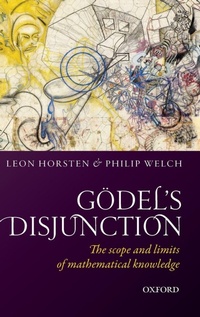
Gödel's Disjunction
The scope and limits of mathematical knowledge
Published on 25. August 2016
Book
Hardback
288 pages
978-0-19-875959-1 (ISBN)
Description
The logician Kurt Gödel in 1951 established a disjunctive thesis about the scope and limits of mathematical knowledge: either the mathematical mind is not equivalent to a Turing machine (i.e., a computer), or there are absolutely undecidable mathematical problems. In the second half of the twentieth century, attempts have been made to arrive at a stronger conclusion. In particular, arguments have been produced by the philosopher J.R. Lucas and by the physicist
and mathematician Roger Penrose that intend to show that the mathematical mind is more powerful than any computer. These arguments, and counterarguments to them, have not convinced the logical and philosophical community. The reason for this is an insufficiency if rigour in the debate. The contributions in
this volume move the debate forward by formulating rigorous frameworks and formally spelling out and evaluating arguments that bear on Gödel's disjunction in these frameworks. The contributions in this volume have been written by world leading experts in the field.
and mathematician Roger Penrose that intend to show that the mathematical mind is more powerful than any computer. These arguments, and counterarguments to them, have not convinced the logical and philosophical community. The reason for this is an insufficiency if rigour in the debate. The contributions in
this volume move the debate forward by formulating rigorous frameworks and formally spelling out and evaluating arguments that bear on Gödel's disjunction in these frameworks. The contributions in this volume have been written by world leading experts in the field.
Reviews / Votes
An introduction by the editors offers an accessible entry point to readers with a basic background in mathematical logic. Many of the papers are clearly aimed at experts, but their introductory sections are generally written for a broader audience. ... The editors do a particularly good job of establishing context and background, as well as summarizing the contributions of the individual papers. * Bill Satzer, MAA Reviews *More details
Other editions
Additional editions
E-Book
09/2016
1st Edition
OUP eBook
€113.99
Available for download
E-Book
09/2016
1st Edition
OUP eBook
€113.99
Available for download
Persons
Leon Horsten is a philosophical logician and philosopher of mathematics, working at the University of Bristol since 2007. His research is concentrated chiefly on bringing formal methods to bear on philosophical problems in the philosophy of science, the philosophy of mathematics, the philosophy of language, epistemology and metaphysics. Formal methods are meant to include not only logical methods, but also methods from other areas of mathematics and computer science
(graph theory, probability theory, complexity theory,.).
Philip Welch is a set theorist and mathematical logician, working in Bristol since 1986. For the period 1997-2000 he was at Kobe University Graduate School setting up a research group in Set Theory. He is the author of some 75 papers in set theory, logic, theories of truth, and transfinite models of computation. He is a subject Co-editor for the Stanford Encyclopaedia of Philosophy for philosophy of mathematics, and is an Editor for set theory of the Journal of Symbolic Logic. His doctoral
`grandfather' is Alan Turing, his supervisor at Oxford (1975-78) Robin Gandy, being Turing's only PhD student.
(graph theory, probability theory, complexity theory,.).
Philip Welch is a set theorist and mathematical logician, working in Bristol since 1986. For the period 1997-2000 he was at Kobe University Graduate School setting up a research group in Set Theory. He is the author of some 75 papers in set theory, logic, theories of truth, and transfinite models of computation. He is a subject Co-editor for the Stanford Encyclopaedia of Philosophy for philosophy of mathematics, and is an Editor for set theory of the Journal of Symbolic Logic. His doctoral
`grandfather' is Alan Turing, his supervisor at Oxford (1975-78) Robin Gandy, being Turing's only PhD student.
Content
ALGORITHM, CONSISTENCY AND EPISTEMIC RANDOMNESS; MIND AND MACHINES; ABSOLUTE UNDECIDABILITY