

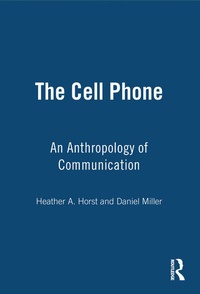
The Cell Phone
An Anthropology of Communication
1st Edition
Published on 1. August 2006
Book
Paperback/Softback
224 pages
978-1-84520-401-3 (ISBN)
Description
Few modern innovations have spread quite so quickly as the cell phone. This technology has transformed communication throughout the world. Mobile telecommunications have had a dramatic effect in many regions, but perhaps nowhere more than for low-income populations in countries such as Jamaica, where in the last few years many people have moved from no phone to cell phone. This book reveals the central role of communication in helping low-income households cope with poverty. The book traces the impact of the cell phone from personal issues of loneliness and depression to the global concerns of the modern economy and the transnational family. As the technology of social networking, the cell phone has become central to establishing and maintaining relationships in areas from religion to love. The Cell Phone presents the first detailed ethnography of the impact of this new technology through the exploration of the cell phone's role in everyday lives.
Reviews / Votes
A landmark in mobile phone studies that will appeal to a wide audience and that is likely to frame debates in this field for some time to come. - Journal of the Royal Anthropological InstituteMore details
Language
English
Place of publication
Oxford
United Kingdom
Publishing group
Taylor & Francis Ltd
Target group
College/higher education
Dimensions
Height: 234 mm
Width: 156 mm
Weight
410 gr
ISBN-13
978-1-84520-401-3 (9781845204013)
Copyright in bibliographic data and cover images is held by Nielsen Book Services Limited or by the publishers or by their respective licensors: all rights reserved.
Schweitzer Classification
Other editions
Additional editions
E-Book
07/2020
1st Edition
Routledge
€48.49
Available for download
E-Book
07/2020
1st Edition
Routledge
€48.49
Available for download
Book
08/2006
1st Edition
Berg Publishers
€206.30
Shipment within 3-4 weeks
Persons
Daniel Miller teaches in the Department of Anthropology, University College London. Heather A Horst is Postdoctoral Scholar, Center for New Media, University of California Berkeley.
Content
Chapter One: Introduction Chapter Two: Infrastructure Chapter Three: Locations Chapter Four: Possession Chapter Five: Link-Up Chapter Six: Coping Chapter Seven: Pressure Chapter Eight: Welfare Chapter Nine: Evaluation