

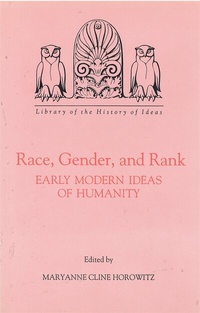
Race, Gender, and Rank
Early Modern Ideas of Humanity
Published on 17. December 1992
Book
Hardback
421 pages
978-1-878822-15-4 (ISBN)
Description
The essays in Race, Gender, and Rankexamine major cultural transformations from the 15th through to the 19th centuries. European colonization within and outside Europe increased `race-consciousness as a category of thought. From Christine de Pizan to Mary Wollstonecraft, feminist intellectuals raised consciousness of the ways societal institutions moulded men and women into specific gender roles, yet still the double standard persisted. The transformation of `rank-consciousness' to `class-consciousness' began in the ferment before the French Revolution and culminated in Karl Marx. Nevertheless, current controversy focuses on the liberal John Locke, who declared the natural right of life, liberty, and property, yet remained ambiguous on the slave trade and on the citizenship rights of those who own no property. Dr MARYANNE C. HOROWITZ is Professor of History, Occidental College, and Research Associate, University of California, Los Angeles. Contributors: MARYANNE CLINE HOROWITZ, JEFFREY L. KLAIBER, CLAUDINE HUNTING, WAYNE GLAUSSER, HERMAN LEBOVICS, JOHN C. GREENE, REGINALD HORSMAN, ASTRIK L. GABRIEL, NADIA MARGOLIS, KEITH THOMAS, JEROME NADELHAFT, G.J. BARKER-BENFIELD, CHARLES CONSTANTIN, STEVEN WALLECH, DALLAS L. CLOUATRE, MARCIA L. COLISH, JUDITH RICHARDS, LOTTE MULLIGAN, JOHN K. GRAHAM, JOHN C. WINFREY and NORMAN S. FIERING.
More details
Series
Language
English
Place of publication
Rochester
United States
Publishing group
Boydell & Brewer Ltd
Target group
Professional and scholarly
Product notice
Cloth over boards
Dimensions
Height: 579 mm
Width: 386 mm
ISBN-13
978-1-878822-15-4 (9781878822154)
Copyright in bibliographic data and cover images is held by Nielsen Book Services Limited or by the publishers or by their respective licensors: all rights reserved.
Schweitzer Classification
Person
Dr MARYANNE C. HOROWITZ is Professor of History, Occidental College, and Research Associate, University of California, Los Angeles. Contributors: MARYANNE CLINE HOROWITZ, JEFFREY L. KLAIBER, CLAUDINE HUNTING, WAYNE GLAUSSER, HERMAN LEBOVICS, JOHN C. GREENE, REGINALD HORSMAN, ASTRIK L. GABRIEL, NADIA MARGOLIS, KEITH THOMAS, JEROME NADELHAFT, G.J. BARKER-BENFIELD, CHARLES CONSTANTIN, STEVEN WALLECH, DALLAS L. CLOUATRE, MARCIA L. COLISH, JUDITH RICHARDS, LOTTE MULLIGAN, JOHN K. GRAHAM, JOHN C. WINFREY/I> and NORMAN S. FIERING.
Content
Part 1 Race and ethnicity: the posthumous Christianization of the Inca empire in colonial Peru, Jeffrey L. Klaiber; the philosophies and black slavery - 1748-1765, Claudine Hunting; three approaches to Locke and the slave trade, Wayne Glausser; the uses of America in Locke's "Second Treatise of Government", Herman Lebovics; the American debate on the negro's place in nature, 1780-1815, John C. Greene; origins of racial anglo-saxonism in Great Britain before 1850, Reginald Horsman. Part 2 Gender distinctions: the educational ideas of Christine de Pizan, Astrik L. Gabriel; Christine de Pizan - the poetess as historian, Nadia Margolis; the double standard, Keith Thomas; the Englishwoman's sexual civil war - feminist attitudes towards men, women, and marriage 1650-1740, Jerome Nadelhaft; Mary Wollstonecraft - sex and spirit in Wollstonecraft and Malthus, G.J. Barker-Benfield. Part 3 Politics and economics of rank: social equalitarianism in a tudor crisis, W. Gordon Zeeveld; the puritan ethic and the dignity of labour - hierarhy vs. equality; "Class Versus Rank" - the transformation of 18th century English social terms and theories of production, Steven Wallech; the concept of class in French culture prior to the revolution, Dallas L. Clouatre. Part 4 Human nature and compassion: the mime of God - vives on the nature of man, Marcia L. Colish; "Property" and "People" - political usages of Locke and some contemporaries, Judith Richards, et al; charity versus justice in Locke's theory of property, John C. Winfrey; irresistable compassion - an aspect of 18th century sympathy and humanitarianism, Norman S. Fiering.