


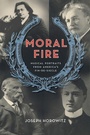
Moral Fire
Musical Portraits from America's Fin de Siecle
1st Edition
Will be published approx. on 22. May 2012
Book
Hardback
270 pages
978-0-520-26744-2 (ISBN)
Description
Joseph Horowitz writes in "Moral Fire": "If the Met's screaming Wagnerites standing on chairs (in the 1890s) are unthinkable today, it is partly because we mistrust high feeling. Our children avidly specialize in vicarious forms of electronic interpersonal diversion. Our laptops and televisions ensnare us in a surrogate world that shuns all but facile passions; only Jon Stewart and Bill Maher share moments of moral outrage disguised as comedy". Arguing that the past can prove instructive and inspirational, Horowitz revisits four astonishing personalities - Henry Higginson, Laura Langford, Henry Krehbiel and Charles Ives - whose missionary work in the realm of culture signaled a belief in the fundamental decency of civilized human nature, in the universality of moral values, and in progress toward a kingdom of peace and love.
Reviews / Votes
"A thoroughly engrossing read, a journey to an impassioned time rich in ideas, idealism, and hope for the future." -- Chester Lane Symphony Now "Horowitz's prose in "Moral Fire" is graceful and lucid, and his splendid musical analysis of such works as the "Concord" sonata and Ives's evocation of Henry David Thoreau's "silence of the night" are sure to send readers scurrying back to scores and recordings to revisit the works he discusses." -- Marion Lignana Rosenberg Wall Street Journal "Rich in historical detail, Moral Fire is highly rewarding to musicians and historians, bringing a new understanding to the mis-understood Gilded Age." -- Parsons American Record Guide "Essential reading for anyone who wants to grasp the distinctive early history of the BSO or the cultural roots of modern-day Boston." -- Jeremy Eichler Boston Globe "Today they are all but forgotten, yet Henry Higginson, Henry Krehbiel and Laura Langford were three American figures of astounding accomplishment... Horowtiz's book rightly reminds us of the achievements of these major fin-de-siecle protagonists." -- John Robert Brown Classical Music Magazine Horowitz makes [an] excellent [case] for ... a reexamination of turn-of-the-century high culture in the US... Recommended." -- D. A. Wells, California State University, Sacramento Choice "The most recent of Joseph Horowitz's commanding studies of American musical life concentrates on four figures from the turn of the twentieth century whose characters exemplify in distinctive ways the moral fire of his title." -- David Matthews Times Literary Supplement (TLS) "Fascinating history." -- Peter Jacobi Bloomington Herald-Times "Thoughtful and nuanced... We owe a debt of gratitude to Horowitz." -- Alexander H. Shapiro The Wagner Journal "Horowitz offers a revisionist view of the era-not as a philistine, materialistic 'Gilded Age' but as a time when right-minded individuals felt that they could and should improve the lot of their fellow humans." -- Fred Cohn Opera News "Horowitz's study of the Gilded Age makes one hope that, in 2114, historians will look back at the turn of the twenty-first century and find that we have kindled a moral fire of our own." Journal of the Society for American MusicMore details
Edition
First Edition
Language
English
Place of publication
Berkerley
United States
Target group
Professional and scholarly
Product notice
Cloth over boards
Illustrations
12 b-w photographs
Dimensions
Height: 229 mm
Width: 152 mm
Thickness: 23 mm
Weight
499 gr
ISBN-13
978-0-520-26744-2 (9780520267442)
Copyright in bibliographic data and cover images is held by Nielsen Book Services Limited or by the publishers or by their respective licensors: all rights reserved.
Schweitzer Classification
Other editions
Additional editions
E-Book
05/2012
1st Edition
Naval Institute Press
€46.49
Available for download
Person
Joseph Horowitz is the author of Classical Music in America, Artists in Exile, (UC Press), Understanding Toscanini, and Wagner Nights. Previously a New York Times music critic, then Executive Director of the Brooklyn Philharmonic, he is currently Artistic Director of DC's Post-Classical Ensemble.
Content
List of Illustrations Introduction Prologue: Screaming Wagnerites and America's Fin de Siecle Music and moral passion--Revisionist portraiture--Framing "fin de siecle" 1. Henry Higginson: High Culture, High Finance, and Useful Citizenship Civil War service--A second home in Vienna--Announcing the Boston Symphony Orchestra--John Sullivan Dwight and musical uplift--Building Symphony Hall--Choosing a conductor--"Masculine" business versus "feminine" art--Karl Muck and the Great War 2. Henry Krehbiel: The German-American Transaction Race and the World's Columbian Exposition--The making of a music critic--Anton Seidl and Wagnerism made wholesome--Antonin Dvorak and "Negro melodies"--An activist "American school of criticism"--"Salome" and Mahler debacles--German-Americans and the Great War--Art as uplift 3. Laura Holloway Langford: Servitude, Disquiet, and "The History of Womankind" "The Ladies of the White House"--A tangled past--From theosophy to Wagnerism--Musical missionary work--"Earnest, manly women"--Reforming the Shakers--A life in limbo 4. Charles Ives: Gentility and Rebellion Charles and Harmony--A life saga--The business of life insurance--Transcendentalism in music--The symphonic ideal--Stream of consciousness--Ives's "nervous complex"--The residual Progressive Summation: Defining an American Fin de Siecle Boston decadents--A fin-de-siecle template--Mark Twain and hybridity--"Social control" and "sacralization"--World War I poisons Romantic uplift Notes Index